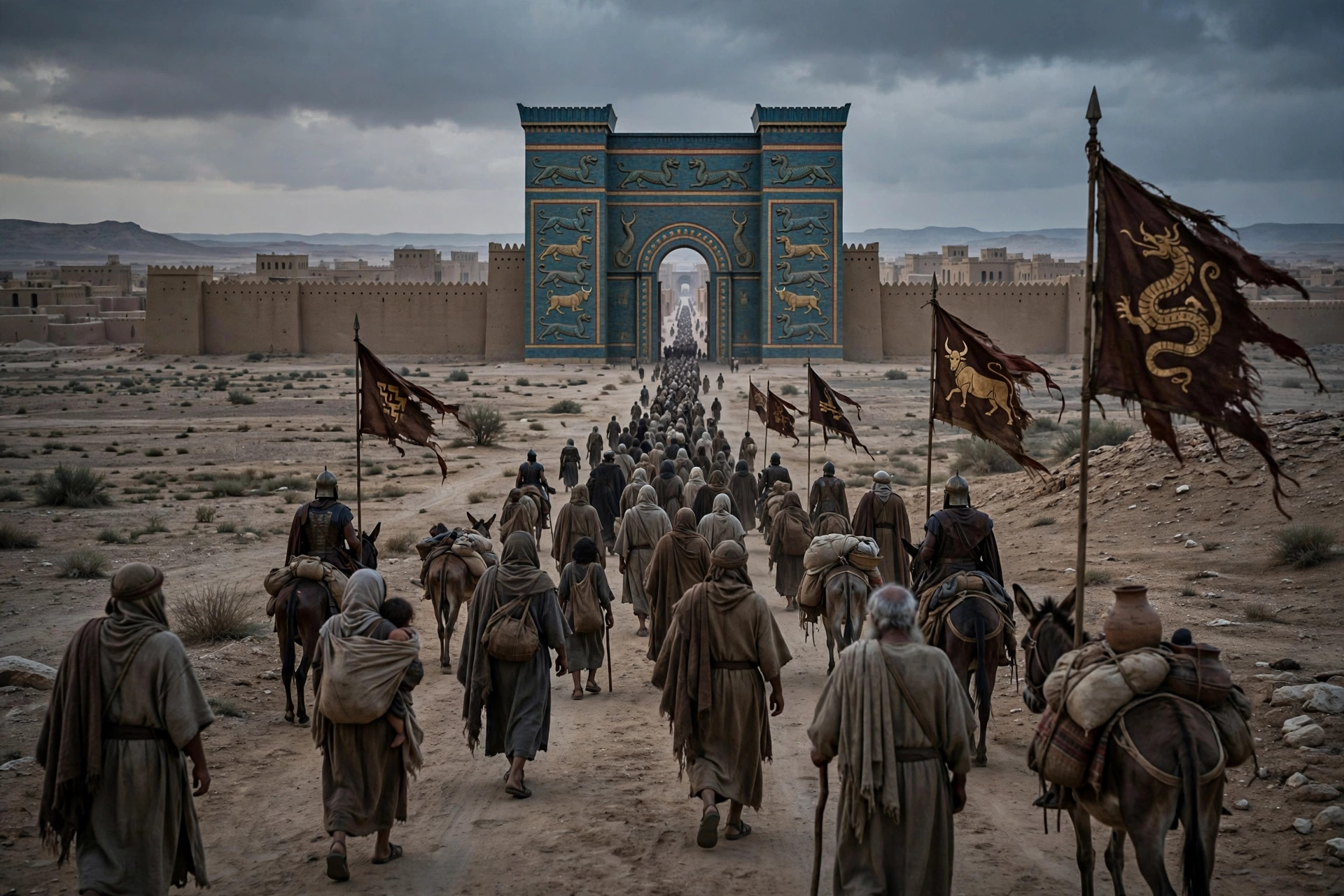
In 597 BC, the gates of Jerusalem opened to an empire that did not knock politely. Within a generation, the temple was rubble, the king was blinded and chained, and the people of God were marching east to Babylon in shackles. It is one of the darkest chapters in Israel’s story — and, strangely, one of the most hopeful. Because the God who wrote the sentence also wrote the release date.
Act I: The Sentence
Israel’s captivity came in two waves. After Solomon, the kingdom split, and the ten northern tribes spiraled into idolatry under Jeroboam, who set up golden calves at Dan and Bethel (1 Kings 12:28–30). In 722 BC, Assyria captured Samaria and scattered the north (2 Kings 17). The southern kingdom of Judah lasted longer — it had reformers like Hezekiah and Josiah — but eventually fell to Babylon. The crucial difference for Judah: God set a limit. Seventy years, then return (Jeremiah 29:10). When Persia’s Cyrus issued his decree, the exiles came home and rebuilt the temple (Ezra 1:1–4).
Why did God allow it? Scripture gives its own explanation, and it is unsparing. Idolatry: they worshiped Baal and “all the starry hosts” (2 Kings 17:16). Injustice: they “trampled on the heads of the poor” (Amos 2:7). Sabbath-breaking: the land finally “enjoyed its sabbath rests” while the people were gone (2 Chronicles 36:21). And rejected warnings: God sent messengers “again and again, because he had pity on his people” — until there was no remedy left (2 Chronicles 36:15–16).
Here is the hard truth the exile preaches: captivity is what persistent, unrepentant sin does to all of us. Israel’s chains were literal; ours are spiritual. But the pattern is identical — drift from God long enough, and you wake up in a far country wondering how you got there.
Act II: Mercy in the Middle of Babylon
And yet — mercy. The seventy years were roughly a lifetime; most of the adults who marched to Babylon would die there. But God put an expiration date on His discipline, and into the middle of the exile He spoke the most beloved promise in the Old Testament: “For I know the plans I have for you… plans to prosper you and not to harm you, plans to give you hope and a future” (Jeremiah 29:11).
Read that promise in context and it becomes staggering. It was not spoken to the deserving. It was spoken to the disciplined — to people reaping exactly what they had sown. That is chesed, God’s steadfast covenant love, holding firm even while His hand is heavy (Lamentations 3:22). The exiles were the golah — those carried away — living under shevi, captivity. But God was already whispering shuv: turn, return. The same word means both repentance and restoration, because in God’s grammar they are the same journey.
Notice what God told the exiles to do while they waited: “Build houses and settle down; plant gardens and eat what they produce… seek the peace and prosperity of the city to which I have carried you” (Jeremiah 29:5–7). No self-pity. No paralysis. Live faithfully in Babylon. Daniel did — rising to the top of a pagan empire without bending his knee (Daniel 6). Esther did — hidden in a Persian palace for “such a time as this” (Esther 4:14). And Daniel, reading Jeremiah’s prophecy of seventy years, did the only sensible thing: he prayed, fasted, and confessed — for himself and his people (Daniel 9).
Act III: The Road Home
When the seventy years were complete, God moved a pagan king’s heart. Cyrus of Persia decreed that the exiles could return and rebuild the house of God in Jerusalem (Ezra 1:1–4) — and the God who had allowed the captivity now decreed the return. The One who scattered, gathered.
The exile is also a living parable. Egypt and Babylon picture our bondage to sin; “Babylon the Great” becomes Scripture’s shorthand for the corrupt world system (Revelation 18). The return from exile pictures redemption in Christ — and Cyrus’s decree foreshadows a greater liberation, when Christ would “lead captivity captive” (Ephesians 4:8). The faithful remnant who came home prefigures the faithful church: small, scarred, and utterly kept by God.
Carrying the Exile Into Your Own Life
The captivity is history, but its lessons are present tense. Take sin seriously now, before God must take it seriously for you. Remember that discipline proves love, not its absence — “the Lord disciplines the one he loves” (Hebrews 12:6). Learn from Daniel and Esther that faithfulness is possible anywhere, even in Babylon; your zip code is never an excuse. Hold onto this: hope has a timetable. Seventy years felt eternal, but the deadline was real, and so is yours.
And while you wait — worship. The exiles hung their harps on the willows and wept (Psalm 137:2), but the wiser ones learned to sing in a foreign land. Don’t wait for the return to start praising. Pray like Daniel. Live faithfully like Esther. Trust the God who brings His people home — because the story of the exile doesn’t end in Babylon. It ends at home, in the arms of the God who never stopped loving you. If you’d like the historian’s view — timelines, kings, and cuneiform tablets — the Wikipedia article on the Babylonian captivity lays it out in detail.










