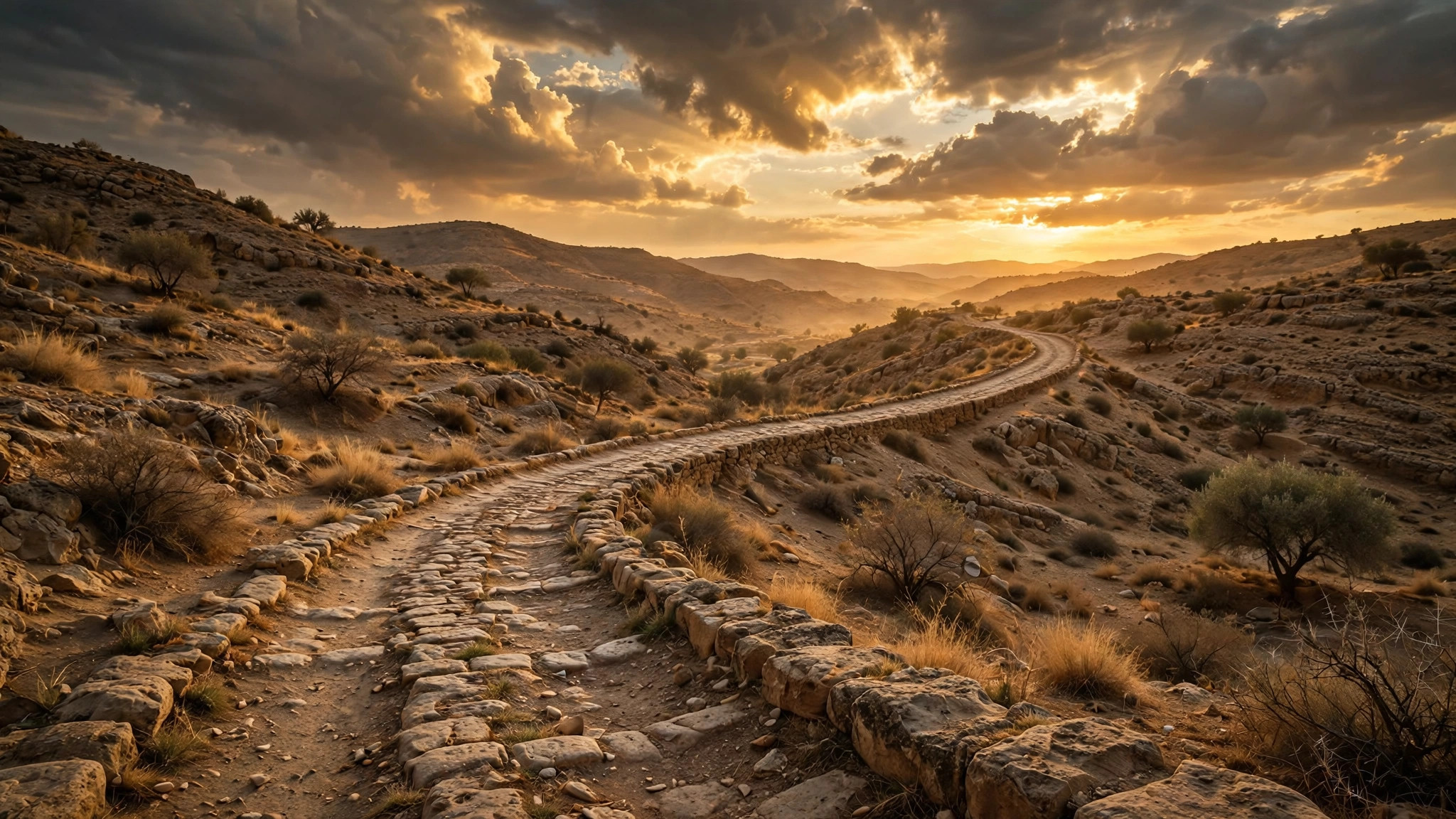
Long before GPS and interstate highways, one ancient road carried kings, armies, traders, and prophets across the Middle East. The Bible calls it the King’s Highway — and its meaning in Scripture is richer than most readers realize. It is a real road with real history, and at the same time one of Scripture’s most beautiful pictures of the path God prepares for his people.
Whether you are walking through a difficult season and need to know God has prepared a way, or you are simply curious about this biblical phrase, the King’s Highway has something to say to you: God builds roads before he asks you to walk them.
Stop One: A Real Road in a Real Desert
The King’s Highway was one of the great trade routes of the ancient Near East, running north-south along the eastern side of the Jordan Valley and the Dead Sea, through the highlands of Edom, Moab, and Ammon, from the Gulf of Aqaba in the south to Damascus in the north. Caravans carried spices, copper, grain, and gold along it. Armies marched on it. Kings taxed it. Whoever controlled the King’s Highway controlled the trade of the region — which is why it was called the king’s road: it belonged to kings, and it was kept open by royal authority.
The Bible first mentions it during Israel’s wilderness journey. When Israel asked Edom for passage, Moses said, “We will go along the King’s Highway and not turn to the right or to the left until we have passed through your territory” (Numbers 20:17). He made the same request of Sihon, king of the Amorites: “Let us pass through your country. We will not turn aside into any field or vineyard, or drink water from any well. We will travel along the King’s Highway until we have passed through your territory” (Numbers 21:22). The request was careful and respectful: Israel would stay on the road, take nothing, and pass through.
Both kings refused. Edom “came out against them with a large and powerful army” (Numbers 20:20), and Israel turned away. Sihon attacked, and Israel defeated him (Numbers 21:23-24, in substance). The road that was meant for peaceful passage became a battlefield — because some doors only open after a fight.
Stop Two: The Road That Reveals the Heart
Notice what Israel promised: “We will not turn to the right or to the left.” Staying on the King’s Highway meant staying on the appointed path — not wandering into fields, not helping oneself to wells, not seizing shortcuts. It was a picture of obedience: the road is fixed, and the traveler’s job is to stay on it.
Scripture returns to that image again and again. “Whether you turn to the right or to the left, your ears will hear a voice behind you, saying, ‘This is the way; walk in it'” (Isaiah 30:21, in substance). Joshua was told to keep the Law and “do not turn from it to the right or to the left” (Joshua 1:7). The King’s Highway is the road of covenant faithfulness: a straight path through a crooked wilderness, kept open by a King who knows where it leads.
There is comfort here for anyone who feels lost. You do not have to blaze your own trail through the desert. God has already built the road. Your task is not to invent the way but to walk in it — one obedient step at a time.
Stop Three: The Highway of Holiness
The prophets took the image of the King’s Highway and lifted it into prophecy. Isaiah saw a day when God would build a road for his redeemed people: “And a highway will be there; it will be called the Way of Holiness; it will be for those who walk on that Way. The unclean will not journey on it” (Isaiah 35:8). On that highway, “the redeemed will walk there, and those the Lord has rescued will return. They will enter Zion with singing; everlasting joy will crown their heads” (Isaiah 35:9-10).
Isaiah also saw God himself preparing the way: “In the wilderness prepare the way for the Lord; make straight in the desert a highway for our God” (Isaiah 40:3). “Build up, build up, prepare the road! Remove the obstacles out of the way of my people” (Isaiah 62:10). The King’s Highway became the image of God’s rescue: he does not merely point the way home — he builds the road, clears the stones, and walks it with his people.
That promise found its fulfillment in John the Baptist, who cried in the wilderness, “Prepare the way for the Lord, make straight paths for him” (Mark 1:3). The highway of holiness was, in the end, a person: Jesus, who said, “I am the way and the truth and the life. No one comes to the Father except through me” (John 14:6). The road that once carried caravans through Edom now carries sinners home to God.
Stop Four: Walking the King’s Highway Today
So what does the King’s Highway mean for your life this week? Four things.
First, God prepares the way before you walk it. Israel asked for the road before it marched. God had built it centuries earlier. The provision you need for the journey ahead may already be in place — the road, the relationships, the resources — waiting for you to step onto it.
Second, the road requires staying on course. The temptation in every wilderness is to wander — into bitterness, into compromise, into shortcuts that look faster. The King’s Highway traveler does not turn to the right or the left. Faithfulness is often less spectacular than adventure, but it is what gets you through the desert.
Third, opposition does not mean you are on the wrong road. Edom refused Israel; Sihon attacked. Both times, Israel was exactly where God had sent them. A blocked road is not proof you missed God’s will. Sometimes it is proof you are on it — and the way through is prayer, patience, and trust.
Fourth, the destination is worth the journey. The King’s Highway ended, for Israel, at the edge of the Promised Land. Isaiah’s highway ends in Zion, with singing and everlasting joy. The Christian road ends at the same place: the city of God, where “the ransomed of the Lord will return” and “sorrow and sighing will flee away” (Isaiah 35:10). Every hard mile is a mile closer to home.
Travelers, Not Tourists: The Highway of Exiles
There is one more layer to the King’s Highway. In the New Testament, Peter addresses Christians as “foreigners and exiles” (1 Peter 2:11) — people traveling through a world that is not their home. The King’s Highway is the picture of that journey. We are not tourists wandering wherever we please. We are travelers on a road built by a King, heading toward a destination he prepared.
That identity changes how we walk. Tourists demand comfort, complain about delays, and treat every inconvenience as an outrage. Travelers expect hardship, pack lightly, and keep their eyes on the destination. The King’s Highway traveler knows the road is not the destination — the kingdom is. So they walk with patience through Edom’s refusal, with courage through Sihon’s attack, and with hope through every wilderness mile, because the road was built by the King and it leads to the King’s city.
And the King himself walked it. Jesus traveled the roads of his land for three years, “with nowhere to lay his head” (Matthew 8:20, in substance), on his way to a cross outside Jerusalem. The road he walked ended in resurrection. The road you walk will end the same way — not in the desert, but in the city of God, where the highway of holiness finally arrives home.
Questions Readers Often Ask
Can you still travel the King’s Highway today? The ancient route survives in part as a modern road through Jordan, passing through places like Petra and Madaba. Travelers can still trace much of its path, though the modern road is paved and the ancient caravans are gone.
Is the King’s Highway the same as the “highway of holiness”? They are related but distinct. The King’s Highway is the historical road of Numbers 20–21. Isaiah’s “Way of Holiness” (Isaiah 35:8) is a prophetic image built on that road — God’s road of redemption for his people. The historical road inspired the prophetic picture.
What does “we will not turn to the right or to the left” mean? It was both a diplomatic promise — Israel would stay on the road and not trespass — and a spiritual picture: obedience means staying on God’s appointed path rather than wandering into shortcuts or compromises.
The Road Is Ready
Ancient kings maintained their highways so that travelers could reach their destinations in safety. The King of kings has done the same — and more. He built the road, he walked it first, and he walks it with you now. “In all your ways submit to him, and he will make your paths straight” (Proverbs 3:6). “Show me your ways, Lord, teach me your paths” (Psalm 25:4). The road is ready. The King has prepared it. All that remains is to walk it. For the historical background of this ancient route, the Wikipedia article on the King’s Highway offers a helpful overview.










