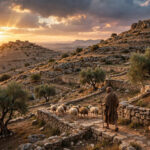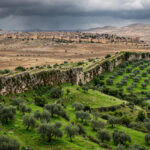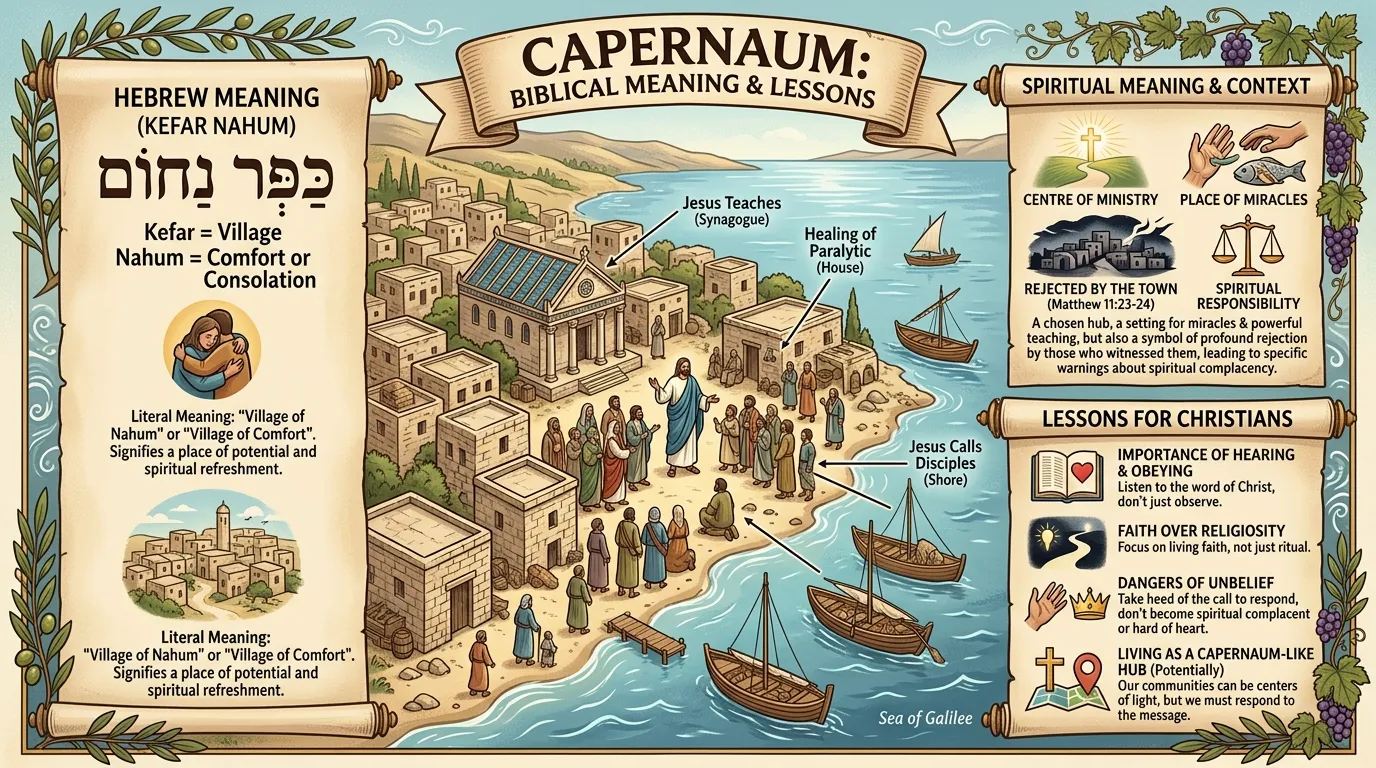
Jesus was born in Bethlehem, raised in Nazareth, and — if the Gospels are any guide — He made His home in Capernaum. Matthew says that after leaving Nazareth, Jesus “went and lived in Capernaum, which was by the lake” (Matthew 4:13). Mark says that when He was in Capernaum, He was “at home” (Mark 2:1). Peter lived there. So did Andrew, James, and John, the fishermen He called from their boats. Capernaum was the town where Jesus taught in the synagogue, healed the sick, ate with tax collectors, and launched the mission that would change the world. It was also the town He rebuked more sharply than any other. Capernaum’s story is the story of extraordinary privilege — and extraordinary responsibility.
A working town on the lake
Capernaum sat on the northwestern shore of the Sea of Galilee, at the junction of two important routes: the lakeside road running around the water, and the Via Maris, the great coastal highway linking Egypt and Damascus. The town’s economy was fishing, farming, and tolls. Matthew worked at a tax booth there. The Roman garrison posted a centurion there. The synagogue was built with the centurion’s money (Luke 7:5). Capernaum was not a resort or a capital. It was a working town with boats, nets, markets, and soldiers — the kind of place where news traveled fast and everyone knew everyone else’s business.
Archaeologists have identified Capernaum with the site of Tel Hum, where the remains of a limestone synagogue from the fourth or fifth century stand over an earlier basalt structure, and where an octagonal church marks the traditional site of Peter’s house. The excavations give us a picture of a modest town of stone houses, narrow streets, and courtyards — a place of ordinary life, not of monuments. That ordinariness is part of the point. Jesus did not make His headquarters in a palace or a university. He made it in a fishing town.
Why Jesus chose Capernaum
Matthew connects the move to prophecy. After John the Baptist’s arrest, Jesus withdrew to Galilee and settled in Capernaum, “to fulfill what was said through the prophet Isaiah” about the land of Zebulun and Naphtali seeing a great light (Matthew 4:14–16). But there were practical reasons too. Capernaum was central, populous, and on the lake — the lake He would use as a highway, a pulpit, and a classroom. Peter’s house gave Him a base. The synagogue gave Him a platform. The town’s crowds gave Him an audience. And the town’s mixture of Jews and Gentiles, soldiers and fishermen, made it a natural starting point for a mission that would reach the whole world.
The choice also had a personal dimension. Jesus called His first disciples from Capernaum’s shore. Simon and Andrew were casting nets; James and John were mending theirs. “Come, follow me,” Jesus said, “and I will send you out to fish for people” (Matthew 4:19). The town that gave Him His disciples also gave Him His home. Capernaum was where the mission became a community.
The miracles: a town that saw everything
No town in the Gospels saw more of Jesus’ power than Capernaum. The list is remarkable. He healed Peter’s mother-in-law of a fever (Mark 1:29–31). He healed the servant of the Roman centurion — a Gentile’s household — without even entering the house (Matthew 8:5–13). He healed a paralyzed man lowered through the roof by his friends, forgiving his sins first and then telling him to walk (Mark 2:1–12). He raised Jairus’s daughter from the dead (Mark 5:21–43). He healed the woman who had bled for twelve years, who touched His cloak in a crowd. He cast out demons in the synagogue. He healed “all who were sick” on a single evening (Mark 1:32–34).
The concentration of miracles in one town is itself a theological statement. Capernaum received more evidence than any other place on earth. Its people did not have to take Jesus on hearsay. They saw the healings. They heard the teaching. They watched demons flee and the dead rise. The town was given light in abundance — and light, as Jesus taught, brings responsibility.
The teaching: the Bread of Life
Capernaum was also the setting of one of Jesus’ hardest teachings. After the feeding of the five thousand, the crowds followed Him to Capernaum, and in the synagogue He delivered the Bread of Life discourse (John 6:22–71). “I am the bread of life,” He said. “Whoever comes to me will never go hungry, and whoever believes in me will never be thirsty” (John 6:35). He went further: “Whoever eats my flesh and drinks my blood has eternal life” (John 6:54).
Many of His followers found the teaching too hard and left. “From this time many of his disciples turned back and no longer followed him” (John 6:66). Jesus turned to the Twelve: “You do not want to leave too, do you?” Peter answered, “Lord, to whom shall we go? You have the words of eternal life” (John 6:68). Capernaum was where the crowds were sifted — where enthusiasm gave way to decision, and where the Twelve chose to stay when others walked away.
The warning: “Will you be lifted to the heavens?”
Jesus’ rebuke of Capernaum is one of the sternest passages in the Gospels. “Woe to you, Chorazin! Woe to you, Bethsaida! For if the miracles that were performed in you had been performed in Tyre and Sidon, they would have repented long ago in sackcloth and ashes. But I tell you, it will be more bearable for Tyre and Sidon on the day of judgment than for you. And you, Capernaum, will you be lifted to the heavens? No, you will go down to Hades” (Matthew 11:21–23).
The warning is not that Capernaum was worse than other towns. It is that Capernaum had been given more. Privilege and judgment are proportional in Jesus’ teaching. The towns that saw the most and repented the least would face the severest reckoning. Capernaum’s tragedy is not that it rejected Jesus violently, like Nazareth tried to do. Its tragedy is that it grew accustomed to Him — that miracles became routine, that the extraordinary became ordinary, that the town which hosted the Son of God eventually treated Him as one more feature of local life.
The centurion’s servant: faith from an outsider
One of Capernaum’s most remarkable miracles involved a man who was not even a Jew. A Roman centurion stationed in the town sent elders of the Jews to ask Jesus to heal his servant, who was dying. The centurion said he was not worthy to have Jesus come under his roof — and then gave one of the great statements of faith in the Gospels: “Just say the word, and my servant will be healed. For I myself am a man under authority, with soldiers under me” (Matthew 8:8–9). He understood authority because he lived under it. Jesus marveled and said, “Truly I tell you, I have not found anyone in Israel with such great faith” (Matthew 8:10). In the town that saw the most miracles, the greatest faith belonged to a Gentile soldier. Capernaum’s story is not only about Jewish privilege. It is about a faith that crosses every boundary — the faith of a Roman officer who recognized the authority of a Jewish carpenter.
The town’s synagogue also witnessed one of Jesus’ most controversial healings: a man with a shriveled hand, healed on the Sabbath, which provoked the Pharisees to plot against Him (Mark 3:1–6). Capernaum’s synagogue was thus a place of both revelation and rejection — where Jesus’ authority was displayed and where opposition hardened. The same pattern follows every display of God’s power: some believe, some resist, and the difference is the heart, not the evidence.
What Capernaum means for Christians
Capernaum is a mirror for every church, every family, and every believer who has been given much. Proximity to Jesus is not the same as faith in Jesus. Capernaum was close to Him geographically, and it missed Him spiritually. The town had the miracles, the teaching, and the presence — and it still did not repent. Christians who have grown up in church, who have heard the sermons, who have seen God work, face the same danger: familiarity can deaden wonder. The cure is not to seek new miracles but to respond to the ones already given — to repent, to believe, and to follow.
Capernaum also teaches that God’s grace is patient but not indefinite. Jesus stayed in Capernaum, taught there, healed there, and warned there. He did not abandon the town at the first sign of indifference. But He did tell the truth about the consequences of indifference. Grace and warning are not opposites. They are two sides of the same love — a love that pursues, and a love that tells the truth.
Finally, Capernaum reminds us that the mission begins at home. Jesus made a fishing town His headquarters, called fishermen His apostles, and built the church from the most ordinary materials available. He still does. The towns and workplaces where Christians live today are the Capernaums of this generation — the places where God’s light has dawned, and where the response is still ours to make.
For the archaeological findings at the site, including the synagogue and the traditional house of Peter, the Wikipedia article on Capernaum is a good starting point.