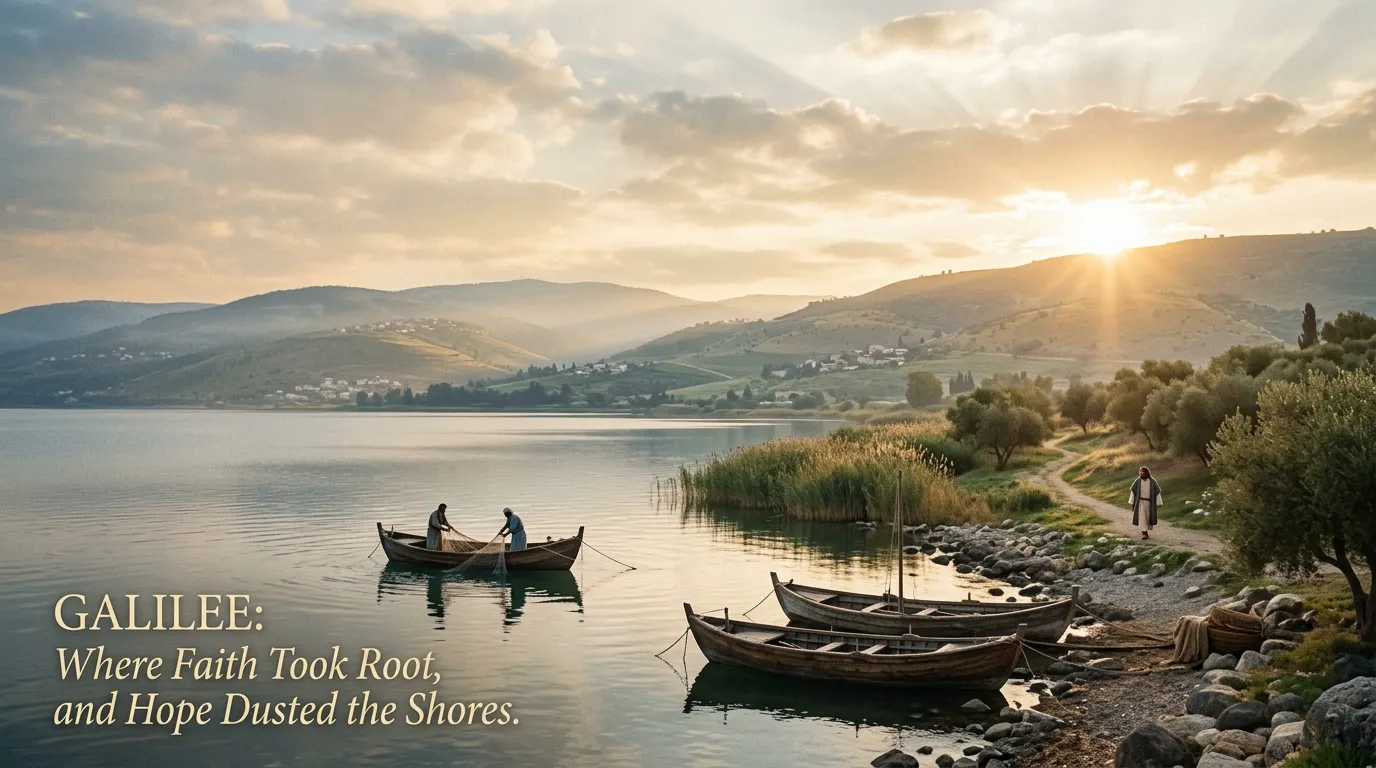
Isaiah called it “Galilee of the nations” — or, in the older translation, “Galilee of the Gentiles” (Isaiah 9:1). The name was not a compliment. Galilee was the northern region of Israel, far from Jerusalem, mixed in population, looked down on by the religious elite of the south. The people of Judea regarded Galileans as uneducated, rough, and religiously suspect. And it was in Galilee — that overlooked, mixed, northern borderland — that Jesus spent most of His ministry, called His disciples, performed His first miracles, and rose from the dead to meet His followers. The meaning of Galilee in the Bible is the meaning of that choice: God did His greatest work in the place nobody expected.
A region on the margins
Galilee in Jesus’ day was a region of hills, valleys, and lakeshore in northern Israel, centered on the Sea of Galilee — a freshwater lake about 21 kilometers long and 13 wide, 210 meters below sea level. The region was fertile, well-watered, and densely populated, with towns and villages scattered around the lake and along the trade routes. It was also ethnically mixed. After the Assyrian conquest, Gentile populations had settled in the region, and even in Jesus’ day Galilee had a significant non-Jewish presence. That mixture was why Judeans called it “Galilee of the Gentiles” and why they doubted that anything good — let alone a prophet — could come from there (John 7:52).
Galilee was governed by Herod Antipas, the son of Herod the Great, who built Tiberias on the lake’s western shore as his capital. The region was politically restless — the Zealot movement had roots there, and the Romans watched it closely. It was also religiously lively: synagogues in every town, teachers, debates, and a population that took the Law seriously even if Jerusalem’s elite looked down on their piety.
The name “Galilee” itself comes from a Hebrew word meaning “district” or “circle” — a region, a circuit. In the Bible it functions less as a proper name with a secret meaning and more as a place with a reputation. And the reputation was clear: Galilee was the periphery. Jerusalem was the center. That geography is the key to the whole story.
Prophecy: “The people walking in darkness have seen a great light”
Matthew’s Gospel makes the prophetic connection explicit. When Jesus began His ministry after John’s arrest, He withdrew to Galilee and settled in Capernaum. Matthew comments: “This was to fulfill what was said through the prophet Isaiah: ‘Land of Zebulun and land of Naphtali, the Way of the Sea, beyond the Jordan, Galilee of the Gentiles — the people living in darkness have seen a great light; on those living in the land of the shadow of death a light has dawned'” (Matthew 4:14–16; Isaiah 9:1–2).
Isaiah’s original context was the Assyrian invasion, which devastated the northern tribes of Zebulun and Naphtali — the very region of Galilee. The north was the first to fall to Assyria, and it would be the first to see the light. Matthew sees that pattern fulfilled in Jesus. The region that experienced judgment first now experiences grace first. The light dawns in the darkness, and it dawns in the north.
The prophecy also sets the tone for the whole ministry. Jesus does not begin in Jerusalem, in the temple, or among the scholars. He begins in Galilee, among fishermen, farmers, tax collectors, and crowds. The light comes to the margins first. That is not an accident of geography. It is the gospel’s character.
A ministry tour: the towns and villages of Galilee
The Gospels present Jesus’ Galilean ministry as a tour. He preaches in synagogues, heals the sick, casts out demons, and teaches crowds on hillsides and lakeshores. Capernaum becomes His base. Nazareth, His hometown, rejects Him. Chorazin, Bethsaida, and Capernaum itself — the towns that saw His greatest miracles — are rebuked for their lack of repentance (Matthew 11:20–24). The Sea of Galilee becomes the setting for the calling of the disciples, the stilling of the storm, the walking on water, and the feeding of the five thousand.
The miracles in Galilee are not random displays of power. They are signs of the kingdom: the blind see, the lame walk, lepers are cleansed, the deaf hear, the dead are raised, and the good news is proclaimed to the poor (Matthew 11:5). Each miracle is a small-scale picture of what the kingdom will do on a cosmic scale. Galilee is where the kingdom breaks in — not in Jerusalem’s courts, but on the lakeshore, in the synagogue, and at the dinner table of a tax collector.
The crowds in Galilee were large and mixed. Some came to be healed; some came to be fed; some came to watch. Jesus’ teaching in Galilee — the parables, the Sermon on the Mount, the instructions to the Twelve — was aimed at forming a community that would live by kingdom values. The disciples were not chosen from the educated elite. They were fishermen, a tax collector, a zealot, and ordinary men whose names would have meant nothing in Jerusalem. Galilee is where God drafted the leadership of the church from the lake’s working class.
Galilee and the cross: rejection and return
Galilee’s story does not end with the ministry tour. After the resurrection, the angel tells the women: “He has risen! He is not here. See the place where they laid him. But go, tell his disciples and Peter, ‘He is going ahead of you into Galilee. There you will see him, just as he told you'” (Mark 16:6–7). The risen Jesus meets His disciples in Galilee — the place where it all began. The Great Commission, in Matthew’s account, is given on a mountain in Galilee (Matthew 28:16–20).
The return to Galilee is deeply meaningful. The disciples had fled, denied, and scattered. Jesus does not meet them in Jerusalem, the scene of their failure. He meets them where they first followed Him — on the lakeshore, in the north, in the place of their calling. Galilee becomes the place of restoration. Peter’s threefold denial is answered by a threefold restoration beside the Sea of Galilee (John 21:15–19). The church’s mission begins where the disciples’ failure is forgiven.
Nazareth: the town that rejected Him
Galilee’s story includes its hardest moment: Nazareth. When Jesus returned to His hometown and preached in its synagogue, the people who had watched Him grow up took offense. “Isn’t this the carpenter’s son?” they asked (Matthew 13:55). They could not reconcile the boy they knew with the authority He claimed. Mark records that Jesus “could not do any miracles there, except lay his hands on a few sick people and heal them,” and “he was amazed at their lack of faith” (Mark 6:5–6). Nazareth is the warning inside Galilee’s hope: familiarity can blind us to glory. The people closest to Jesus were the ones most likely to dismiss Him, because they thought they already knew Him. The same danger faces every church, every family, and every believer who has been near Jesus so long that they have stopped expecting Him to act.
Yet even Nazareth’s rejection did not stop the mission. Jesus moved on to the other villages, teaching and healing. Rejection in one town was not the end of the work. The gospel does not depend on any single audience’s applause.
The lake itself: storms, fish, and daily bread
The Sea of Galilee was not only a backdrop; it was a workplace. Fishing was the region’s main industry, and the lake’s sudden storms were a constant danger — the surrounding hills funnel wind onto the water without warning. That is why the Gospels’ lake stories carry such weight. When Jesus stills the storm, He is not performing a parlor trick; He is commanding the force that governed Galilean livelihoods. When He calls fishermen, He is calling men who know risk, weather, and hard labor. The lake taught dependence daily: no one controls the wind, and no one guarantees the catch. The disciples learned on that water that the One who calls them is also the One who commands the storm.
What Galilee means for Christians
Galilee teaches that God works through the overlooked. The region was dismissed by the religious establishment, yet it became the cradle of the gospel. Christians who feel like they are from the wrong place, the wrong background, or the wrong class should take heart: Galilee is proof that God does not grade by address. He calls fishermen, not Pharisees; He starts in the north, not the capital.
Galilee also teaches that the gospel is for the nations. “Galilee of the Gentiles” was mixed, and its mixture was the point. The light that dawned there was never meant to stay there. It was meant to spread from Galilee to Jerusalem, from Jerusalem to Judea and Samaria, and to the ends of the earth (Acts 1:8). The Great Commission was given in Galilee, and it was given to the whole world.
Finally, Galilee teaches that failure is not the end. The disciples failed in Jerusalem, but they were restored in Galilee. The place of their calling became the place of their recommissioning. Christians who have failed do not need to find a new place to start. They need to return to the One who called them — and He will meet them there, on the shore, with breakfast cooking and a mission waiting.
For the region’s geography, history, and archaeology, the Wikipedia article on Galilee offers a helpful background survey.










