When Ezra the scribe opened the Book of the Law before the returned exiles, something remarkable happened at the end of his prayer. The whole congregation lifted their hands and answered with a single doubled word: “Amen, Amen!” Then they bowed their faces to the ground and worshiped (Nehemiah 8:6). No one had to explain what the word meant. It was the congregation’s way of signing its name to everything just prayed — a spoken seal, pressed onto the prayer like wax on a letter.
That little word has survived three thousand years of worship with its meaning intact. Jews say it, Christians say it, Muslims say a form of it. It closes prayers, hymns, creeds, and sermons in thousands of languages. Yet most people who say it daily have never stopped to ask what they are actually declaring. To say “Amen” in the Bible is to do far more than signal that the prayer is over. It is to swear that God is true, to take sides with His Word, and to bind your own heart to what has just been spoken.
From a Root That Means Trust
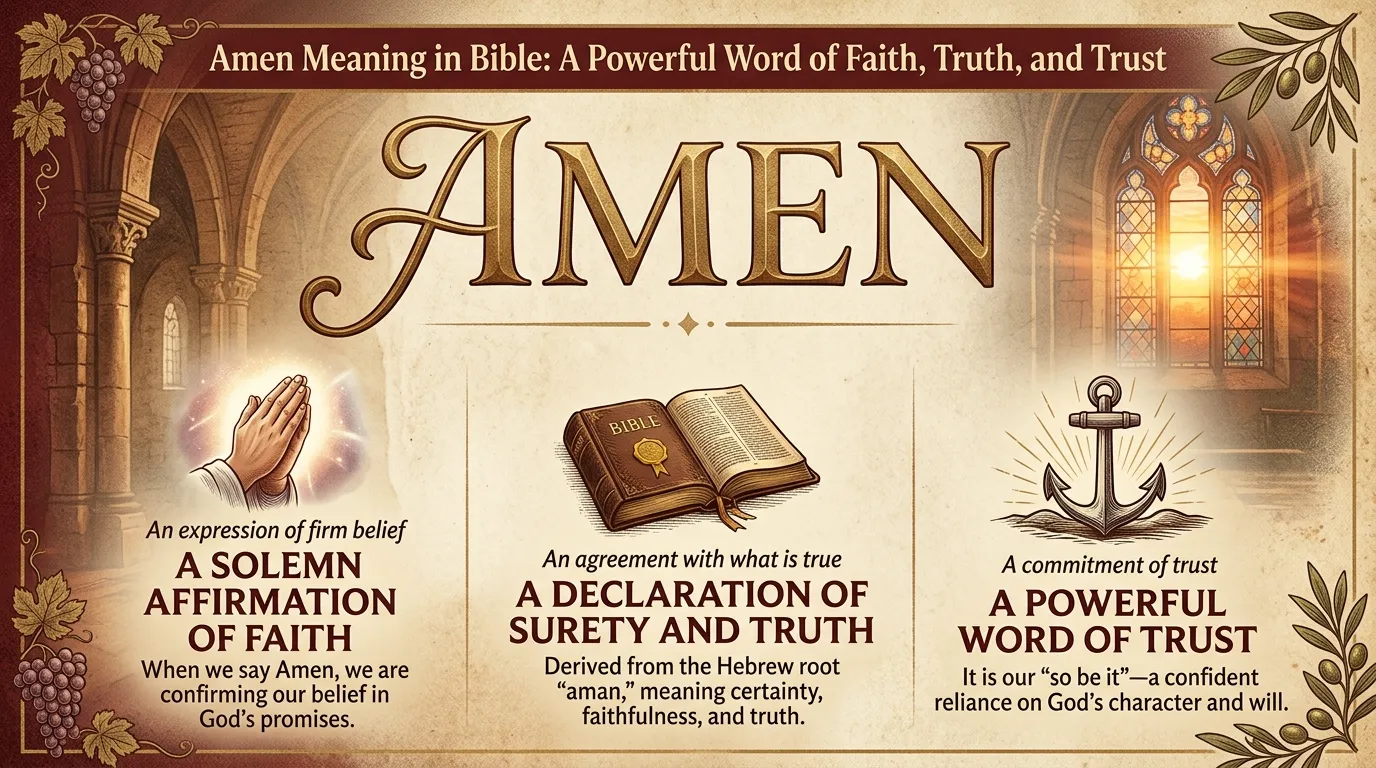
The word amen comes from the Hebrew root ‘aman, which carries the sense of firmness, steadiness, and reliability — the picture of something you can lean your full weight on without it giving way. From the same root comes the word for “believe”: when Genesis 15:6 says Abraham believed the LORD, it uses this root. Believing, in the Bible’s vocabulary, is not a vague feeling but a firm leaning. And from the same root comes the word for a faithful nurse or guardian — one who holds a child steady (Numbers 11:12; 2 Kings 10:1). So when you say “amen,” you are standing in a family of words that all mean the same thing: this is solid; I put my weight on it.
Isaiah makes the connection explicit in a striking wordplay: “If you are not firm in faith, you will not be firm at all” (Isaiah 7:9) — literally, “if you do not believe (‘aman), you will not be established (‘aman).” Faith and firmness are the same root because they are the same reality. To believe God is to become steady yourself. Every “amen” is a small act of that steadiness, a verbal footing planted on rock.
This is why the word feels so weighty when it appears in solemn moments. It is not decoration. It is the sound of a soul taking its stand. When the priests pronounced the curses of the covenant from Mount Ebal and “all the people shall say, Amen” (Deuteronomy 27:15-26), they were not merely agreeing with a sentiment. They were entering a binding oath, accepting God’s terms as true and just. “Amen” was the signature line of the covenant.
The “Amen” of the Whole Congregation
Throughout Israel’s worship, “amen” was the people’s appointed response — the moment the congregation stopped being an audience and became a participant. The Psalms are punctuated with it: the ends of the first four books of the Psalter each close with a double amen — “Amen and Amen” (Psalm 41:13; 72:19; 89:52; 106:48). Scholars believe these were the congregation’s responses when the psalms were sung in temple worship, preserved in the text like applause pressed between pages. The people heard God’s praise declared and answered, yes — let it be so.
Paul carries the same practice into the church. In 1 Corinthians 14:16, he assumes that when someone gives thanks in the assembly, the others will “say the ‘Amen’ to your thanksgiving.” The definite article matters: the Amen, the familiar, expected response. Early Christian worship, like the synagogue before it, gave the people a voice in the liturgy, and that voice said one word. To withhold it — to sit silent while God’s truth is declared — was, in Paul’s logic, to refuse fellowship. Saying “amen” is how ordinary believers preach back to the preacher, answering God’s Word with their own word of agreement.
Jesus and His Doubled “Amen”
No one in Scripture says “amen” the way Jesus does. More than seventy times in the Gospels — twenty-five of them in John alone — He introduces His most solemn teachings with the phrase usually translated “Truly, truly, I say to you.” In the Greek it is amēn amēn legō hymin: literally, “Amen, amen, I say to you.” Every other speaker in the Bible puts “amen” at the end, as agreement with what someone else has said. Jesus puts it at the beginning, as a guarantee of what He Himself is about to say. He does not need anyone’s confirmation. His word carries its own seal.
Notice what He attaches the doubled amen to: the new birth (John 3:3, 5), His unity with the Father (John 5:19, 24), the bread of life (John 6:26, 32, 47, 53), the good shepherd’s voice (John 10:1, 7), His betrayal foretold (John 13:21, 38), the coming of the Spirit (John 16:23). These are the load-bearing truths of the Gospel, and Jesus marks each one with His personal oath. When He says “amen, amen,” He is telling His hearers: you may lean your whole weight on what follows. It is the ‘aman root made flesh — firmness with a voice.
There is a quiet rebuke in this for casual religion. The crowds who heard Jesus could not treat His words as interesting opinions, because He prefaced them with an oath of truth. The doubled amen leaves no room for “well, that’s just His perspective.” It demands the congregation’s response — the very response the word was made for: amen.
Christ Himself Is the Amen
The most stunning use of the word comes near the end of the New Testament, where it becomes one of Christ’s own titles. To the church in Laodicea — the lukewarm church, confident in its wealth and blind to its poverty — the risen Jesus introduces Himself as “the Amen, the faithful and true witness, the beginning of God’s creation” (Revelation 3:14). Think about what that means. Jesus does not merely speak amen. He is the Amen: the final Yes to everything God has promised, the living guarantee that God’s Word will not fail.
Paul had said the same thing in different words: “For all the promises of God find their Yes in him. That is why it is through him that we utter our Amen to God for his glory” (2 Corinthians 1:20). Every promise God ever made — to Abraham, to David, to the exiles, to you — finds its “Yes” in Jesus Christ. And our part, the congregation’s part, is the answering “Amen”: the word by which we take hold of the promise and make it ours. The whole Gospel can be diagrammed in two words: God’s Yes in Christ, our Amen back to God. Worship is that exchange, repeated for a lifetime.
This also explains why so many New Testament letters end with “amen” — Romans, Galatians, Ephesians, Philippians, the pastoral epistles, Hebrews, Jude, and Revelation itself (Romans 16:27; Revelation 22:20-21). The apostles were not just signing off. They were teaching the churches to end every hearing of the Word the way Israel ended the Law’s curses and the Psalms’ praises: with a spoken act of trust. The last word of the Bible, fittingly, is an amen — the church’s answer to Christ’s promise, “Surely I am coming soon,” answered with “Amen. Come, Lord Jesus!”
Praying With an Honest “Amen”
If “amen” means this is true and I stake myself on it, then the word judges the way we use it. A mumbled amen at the end of a distracted prayer is a small dishonesty — the lips signing a document the heart never read. The Bible’s amens were loud, lifted, and deliberate: hands raised in Nehemiah 8, faces to the ground, the whole assembly answering together. The word deserves better than to be a religious period at the end of a sentence we didn’t mean.
Here is a practice worth recovering: before you say “amen,” pause. Ask yourself what you just asked for, and whether you actually trust God with the answer. If you prayed for forgiveness, your amen is your agreement that the blood of Jesus is enough — no penance required, no groveling added. If you prayed for provision, your amen is your refusal to keep clutching the worry after you said “in Jesus’ name.” If you prayed the Lord’s Prayer, your amen covers all of it: the daily bread, the forgiven debts, the deliverance from evil. Say it slowly. Mean it completely. That is what the word was made for.
And there is a corporate side to recover as well. In many churches the congregation’s “amen” has gone quiet — the people listen, the leaders pray, and no one answers. But Scripture pictures something livelier: a room full of believers who hear God’s promises read and cannot stay silent, who answer the sermon with the ancient seal of agreement. You do not need permission to say it. The next time the Word is preached or a prayer is prayed and your heart answers yes, let your mouth say so. That is not an interruption of worship. That is worship, in its oldest form.
The word you have said ten thousand times turns out to be a small creed: God is true, His promises stand, and I am staking my life on them. Say it at the end of your prayers, and mean it at the start of your week. The God who is Himself the Amen will honor every honest one you speak — and one day, when faith becomes sight, the church’s long answering “amen” will dissolve into the thing it always pointed to: the unbroken Yes of being home.
For readers curious about how this single Hebrew word traveled through synagogue liturgy, Greek Scripture, and Christian worship into the prayer language of the modern world, Wikipedia’s overview of “Amen” traces its remarkable journey across three millennia of faith.










