Every so often someone writes in about a number that keeps appearing — on a clock, a receipt, a license plate — and asks whether God is sending a message through it. The number 888 comes up more than most, usually with a hopeful question attached: is this a sign of something new beginning? It is a fair question, and it deserves an honest answer — the kind that neither mocks the curiosity nor invents a revelation Scripture never gave.
So let us begin with plain honesty, because Scripture-first means exactly that. The Bible never mentions the number 888. Not once, in either Testament, does 888 appear as a figure, a count, or a code. Anyone who tells you the Bible assigns 888 a specific meaning — new beginnings, triple blessing, angelic prosperity — is telling you something the Bible itself does not say. That matters, because building faith on claims Scripture never made is building on sand, however encouraging the claim sounds.
But the story does not end there. The number eight carries genuine weight in Scripture, and an ancient Christian tradition connects 888 with the name of Jesus. Both are worth understanding — clearly labeled for what they are: biblical truth on the one hand, church tradition on the other. Confusing the two has caused real harm; keeping them distinct lets us enjoy the tradition without worshiping it.
Why the Number Eight Keeps Showing Up in Scripture
Long before anyone added up Greek letters, the number eight had a job in the Bible. Circumcision — the sign of the covenant — was commanded for the eighth day (Genesis 17:12; Leviticus 12:3). A cleansed leper presented his offerings on the eighth day (Leviticus 14:10, 23). The great autumn feast ran seven days, and then, strikingly, the eighth day was its own sacred assembly (Leviticus 23:36; Nehemiah 8:18). A pattern emerges: seven is the number of completion — seven days of creation, sevenfold forgiveness — and eight is what comes after completion. It is the number of the overflow, the new start, the day beyond the finished week.
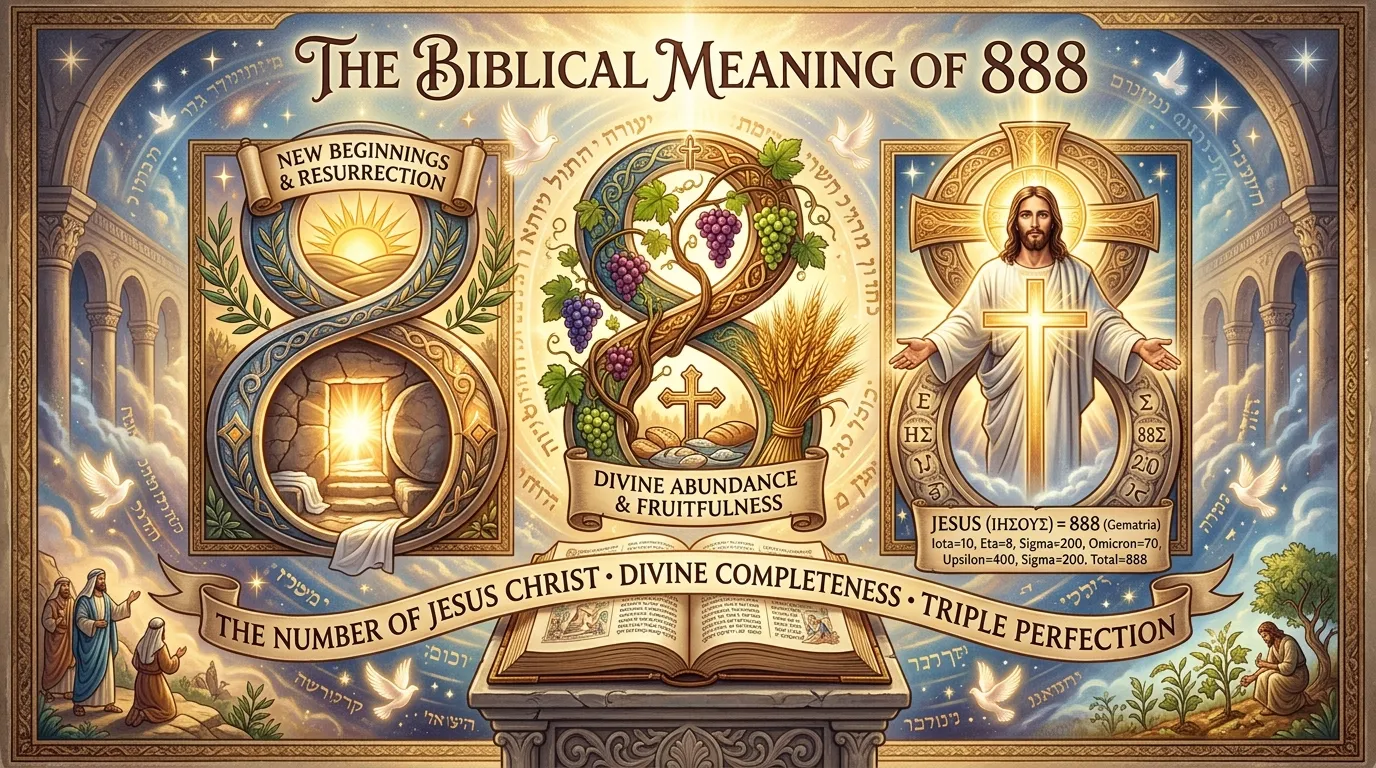
The New Testament quietly picks up the thread. Jesus rose on the first day of the week — which is also, by the ancient way of counting, the eighth day, the day after the Sabbath rest. The early church fathers loved this arithmetic: the resurrection inaugurated an eighth day, a new creation beyond the old week’s completion. Peter notes that eight souls were saved through the flood (1 Peter 3:20) — a remnant carried through judgment into a washed world, another eighth-day rescue. None of this makes 888 a biblical code. But it shows that Scripture genuinely associates the number eight with new beginnings, and that association is real, textual, and worth knowing.
The Greek Name That Adds Up to 888
Here is where 888 enters the picture — through an ancient practice called gematria, in which every letter of the Greek alphabet also served as a number. Add up the letters of the Greek name Iēsous (Jesus) — iota (10) + eta (8) + sigma (200) + omicron (70) + upsilon (400) + sigma (200) — and the total is exactly 888. Early Christian writers noticed this, and some found it delightful: the name of the risen Lord, the beginner of the eighth day, summing to a triple eight.
Delightful — and worth labeling honestly. Gematria was a common ancient word game, not a biblical doctrine. The New Testament never invites us to add up letters, and it never mentions the total 888. The church fathers who noticed it treated it as a curiosity that confirmed what they already believed from Scripture, never as a revelation in its own right. There is a difference between saying “isn’t it fitting that the name of Jesus adds up to 888” and saying “God is speaking to you through the number 888.” The first is tradition’s poetry; the second is a claim Scripture does not authorize.
That distinction protects us twice over. It protects Scripture from being loaded with meanings it never carried — a habit that has produced everything from harmless superstition to full-blown heresy. And it protects believers from disappointment: the person who builds hope on “I saw 888, so God must be opening a door” will eventually face a closed door on an 888 day, and the letdown can shake faith in the real promises. Better to anchor hope where the anchor holds.
New Beginnings: The Theme the Number Points To
If 888 has any legitimate spiritual value, it is as a reminder — a finger pointing at a theme the Bible does teach loudly. Scripture is saturated with new beginnings. The God who made the world in seven days rested and then, in Christ, began the eighth-day work of new creation. “If anyone is in Christ, he is a new creation. The old has passed away; behold, the new has come” (2 Corinthians 5:17). The resurrection morning was the first morning of a remade world. Baptism buries the old person and raises a new one (Romans 6:4). The risen Christ promises the overcomer a new name (Revelation 2:17) and makes all things new (Revelation 21:5).
So when the number catches your eye, let it do the one useful thing it can do: turn your thoughts toward the God of new starts. Are you carrying something that needs to be made new? A relationship, a habit, a season of grief? The Bible’s answer is not “watch for numbers” but “come to the One who makes things new.” The eighth day is not a code to crack; it is a Person to trust. Every Sunday morning — the church’s weekly eighth day — the congregation gathers to rehearse exactly this: Christ is risen, the old week is buried, and mercy is new.
Lamentations says it without any numbers at all: “The steadfast love of the LORD never ceases; his mercies never come to an end; they are new every morning” (Lamentations 3:22-23). That is the promise the number 888 can only gesture at. The mercies are not new every time you see a triple eight; they are new every morning, whether you notice or not. The sign was never the point. The faithful God behind it was.
How to Respond When a Number Catches Your Eye
What, then, should you actually do the next time 888 appears on a receipt or a clock? Scripture gives a clear, practical procedure — and it does not involve decoding.
First, receive it as a nudge, not a message. God may use anything to turn your thoughts toward Him — a sunset, a song, a number on a dashboard. The nudge is real; the content is not in the number but in where the nudge sends you. If seeing 888 makes you pray, give thanks, or open your Bible, then it has served you well — the way a church bell serves the village, not by containing the sermon but by calling people to it.
Second, take the nudge to the Word. Whatever theme the number suggests — new beginnings, hope, resurrection — open Scripture and let the Bible say it in its own words. Read John 20 on resurrection morning. Read 2 Corinthians 5 on new creation. Read Lamentations 3 on morning mercies. Let the text, not the number, do the teaching. “Test everything; hold fast what is good” (1 Thessalonians 5:21) applies to number-meanings as much as to prophecies.
Third, refuse the superstition, keep the wonder. There is a line between delight and divination, and the Bible draws it firmly. Delight says, “What a fitting coincidence that Jesus’ name totals 888 — how I love the eighth-day hope of the resurrection.” Divination says, “I saw 888 three times today, so God must be telling me to take that job.” The first is the joy of tradition; the second is seeking guidance from a source God never appointed. Israel was warned against reading omens precisely because God had given them something better: His Word, His Spirit, and wise counsel (Deuteronomy 18:10-14).
Finally, watch for the counterfeit. A whole industry sells number-meanings as spiritual guidance — angel numbers, prosperity codes, personalized “what 888 means for you” readings. Much of it baptizes numerology with Christian vocabulary and charges for the baptism. The biblical test is simple: does this teaching send me deeper into Scripture, prayer, and obedience — or does it make me dependent on the teacher’s private system of signs? The first is ministry. The second is merchandise.
The honest summary is this: 888 is not a biblical promise, but it can be a biblical reminder — of the eighth day, the empty tomb, the new creation, and the Greek name that adds up to 888 in an ancient word game the church fathers enjoyed. Enjoy the poetry. Just don’t build the house on it. Build on the rock: Christ risen, mercies new every morning, all things being made new. No receipt required.
Those interested in how ancient cultures — including early Christians — assigned meaning to numbers will find Wikipedia’s article on biblical numerology a useful map of the tradition, showing where Scripture’s own number patterns end and later interpretation begins.










