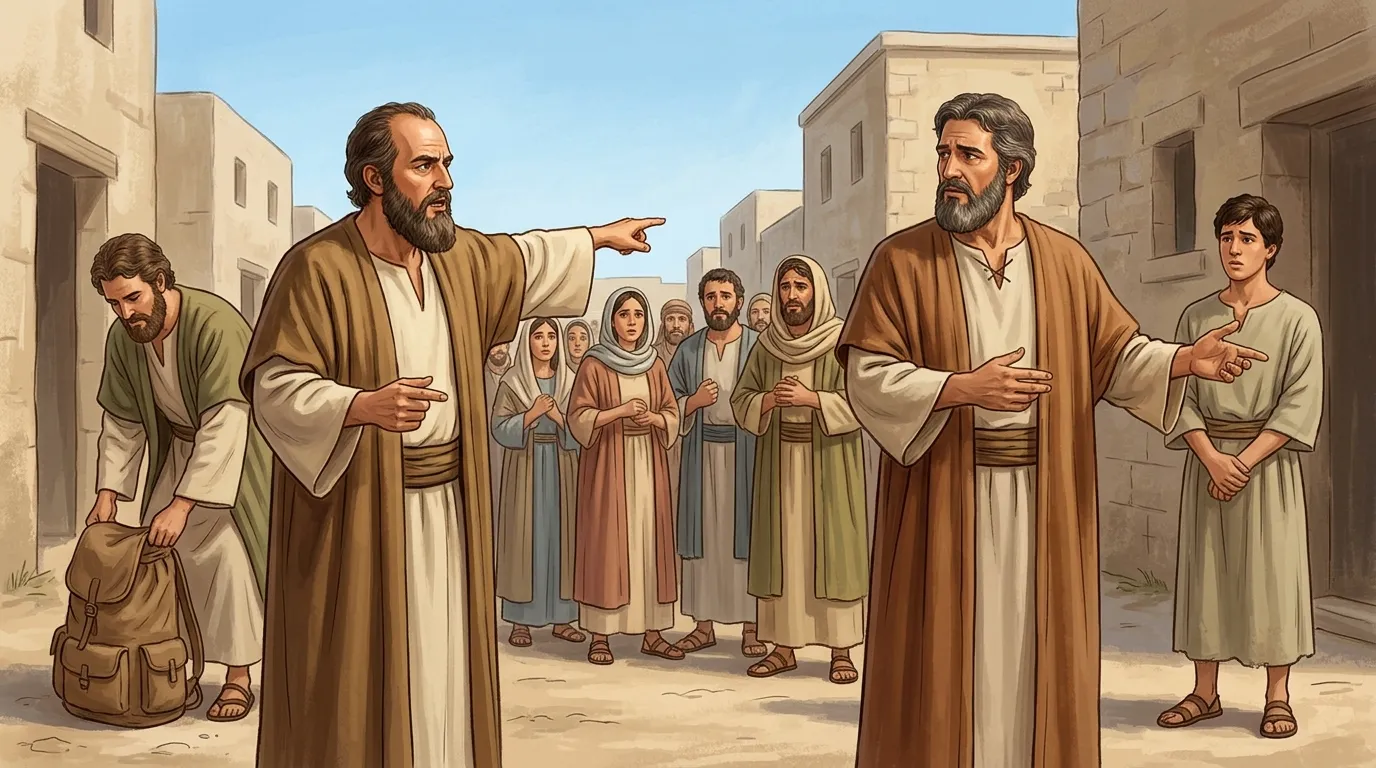
Paul arrived in Lystra with scars. He had been there before, on his first missionary journey, and the visit had ended with him being stoned, dragged outside the city, and left for dead (Acts 14:19–20). Now he was back, walking into the same streets where a crowd had tried to kill him. And in that city — a place of trauma and memory — he met the young man who would become his closest partner, his “true child in the faith,” and the successor who would carry his work after his death.
The meeting of Paul and Timothy, recorded in Acts 16:1–5, is one of the most important encounters in the New Testament. It is not a story about a dramatic conversion or a miraculous sign. It is a story about recommendation, mentorship, and the slow, ordinary way God builds the church: one faithful person investing in another.
Lystra: The City That Tried to Kill Paul
To understand the meeting, you have to understand the place. Lystra was a Roman colony in the region of Galatia, in what is now central Turkey. It was a backwater — a garrison town, far from Jerusalem, far from anywhere important. Paul had preached there on his first journey, healed a man who had never walked, and watched the crowd swing from worshiping him as a god to stoning him as a criminal. The city was a monument to the fickleness of crowds and the cost of the gospel.
When Paul returned, he was not returning to a victory lap. He was returning to a place of pain. And that is where Timothy was. Timothy’s faith had not been formed in a comfortable church with polished programs. It had been formed in Lystra — a town where following Jesus could get you killed, where the church was small, and where the memory of Paul’s stoning was fresh. The young man who would become Paul’s partner was a product of a persecuted church. His faith had already been tested before Paul ever met him.
That detail matters for anyone who thinks mentorship requires ideal conditions. Paul did not meet Timothy at a conference, a retreat, or a leadership summit. He met him in a scarred city, in a small church, in the aftermath of violence. God’s partnerships are often forged in hard places, not easy ones.
The Recommendation: Character Before Calling
Acts 16:2 gives the reason Paul chose Timothy: “He was well spoken of by the brothers at Lystra and Iconium.” Timothy was not chosen because he was talented, charismatic, or available. He was chosen because the believers who knew him best vouched for him. His reputation preceded him, and his reputation was godly.
Timothy’s background is a study in God’s grace across generations. His mother Eunice and his grandmother Lois were Jewish believers who taught him the Scriptures “from childhood” (2 Timothy 3:15). His father was a Greek, which meant Timothy grew up between two worlds — Jewish faith at home, Greek culture outside. That bicultural formation would become his greatest asset: he could move between Jewish and Gentile communities, translate between worlds, and serve as a bridge in a church that was learning to be multiethnic.
Paul’s choice illustrates a principle: character is the qualification for ministry, and reputation is the evidence of character. Paul did not recruit Timothy on potential. He recruited him on proof — the testimony of the local church. The church that knows a person best is the church best qualified to commend them. Modern ministry often reverses this, importing strangers with impressive gifts and no local reputation. Paul’s way is slower and safer: trust the people who have watched a person’s life up close.
The Hard Decision: Circumcision and Mission
Immediately after choosing Timothy, Paul did something that surprises modern readers: “Paul wanted Timothy to accompany him, and he took him and circumcised him because of the Jews who were in those places, for they all knew that his father was a Greek” (Acts 16:3). This is startling, because Paul had just come from the Jerusalem Conference, which had decided that Gentiles did not need to be circumcised. Why would Paul circumcise Timothy?
The answer is missionary wisdom, not theological contradiction. Timothy was half-Jewish, and his uncircumcised state would have been a constant barrier in synagogues and Jewish communities. Paul was not requiring circumcision for salvation — he had fought that battle and won it. He was removing an unnecessary obstacle to the gospel. In Corinth, he would later write, “I have become all things to all people, that by all means I might save some” (1 Corinthians 9:22). Circumcising Timothy was the same principle: give up a freedom for the sake of the mission.
The contrast with Titus is instructive. In Galatians 2, Paul refused to circumcise Titus, a full Gentile, because doing so would have implied that circumcision was necessary for salvation. Same apostle, opposite decisions — because the situations were opposite. With Titus, circumcision would have compromised the gospel. With Timothy, it advanced it. Paul’s flexibility was not inconsistency. It was the wisdom of knowing the difference between a gospel principle (never compromise) and a missionary method (always adapt).
The Partnership: From Assistant to Successor
What followed was one of the great partnerships in Christian history. Timothy traveled with Paul on the second missionary journey, through Philippi, Thessalonica, Berea, Athens, and Corinth. He was sent on solo missions — to Thessalonica to strengthen the church, to Corinth to deal with problems, to Ephesus to confront false teachers. Paul’s letters mention Timothy more than any other coworker. He is listed as a co-sender of six epistles. Paul calls him “my beloved and faithful child in the Lord” (1 Corinthians 4:17) and “my true child in the faith” (1 Timothy 1:2).
The relationship was not one-directional. Timothy was not merely Paul’s assistant. He was Paul’s companion, his envoy, his representative, and eventually his successor. When Paul was imprisoned in Rome, facing execution, he wrote to Timothy: “Do your best to come to me soon” (2 Timothy 4:9). The old apostle, at the end of his life, wanted the young man he had met in Lystra by his side. The mentorship had become a friendship, and the friendship had become a legacy.
Paul’s final charge to Timothy is the passing of the torch: “What you have heard from me in the presence of many witnesses entrust to faithful men, who will be able to teach others also” (2 Timothy 2:2). Four generations in one verse: Paul, Timothy, faithful men, others. The meeting in Lystra was not about Paul and Timothy. It was about the chain — the gospel passed from one generation to the next, hand to hand, life to life.
What the Meeting Teaches
The meeting of Paul and Timothy teaches that God’s work is done through relationships. The church is not built by programs, platforms, or personalities. It is built by people investing in people — by older believers who see potential in younger ones, by younger believers who submit to mentorship, by churches that commend character, and by leaders who are willing to be replaced.
It also teaches that mentorship is a long game. Paul did not meet Timothy and immediately hand him a church. He traveled with him, tested him, sent him on missions, corrected him, and encouraged him over years. The letters to Timothy — 1 and 2 Timothy — are the curriculum of that mentorship: doctrine, character, courage, endurance. “Let no one despise you for your youth, but set the believers an example in speech, in conduct, in love, in faith, in purity” (1 Timothy 4:12). Timothy was young, timid by temperament, and prone to illness. Paul did not wait for him to become impressive. He invested in him as he was.
Timothy’s Later Ministry
Timothy’s story did not end with Paul’s journeys. After Paul’s death, Timothy continued the work — leading the church in Ephesus, confronting false teachers, and enduring hardship. Tradition holds that he was eventually martyred for his faith, beaten to death for opposing a pagan festival. Whether or not the details are exact, the arc of his life is clear: the young man Paul met in Lystra became a pillar of the early church. His faith, planted by his grandmother and mother, watered by Paul’s mentorship, and tested by years of ministry, endured to the end. The meeting in Lystra was not a footnote in Paul’s story. It was the beginning of Timothy’s — and Timothy’s faithfulness is the reason Paul’s legacy survived. The chain held.
And it teaches that every believer needs both a Paul and a Timothy — someone ahead of you who is pouring into you, and someone behind you into whom you are pouring. The Christian life is not a solo journey. It is a relay. Paul ran his leg, handed the baton to Timothy, and Timothy handed it on. The baton is in our hands now. The question is whether we will carry it faithfully — and hand it to someone else. For the background on Timothy’s life and letters, see the article on Saint Timothy in the New Testament and early tradition.










