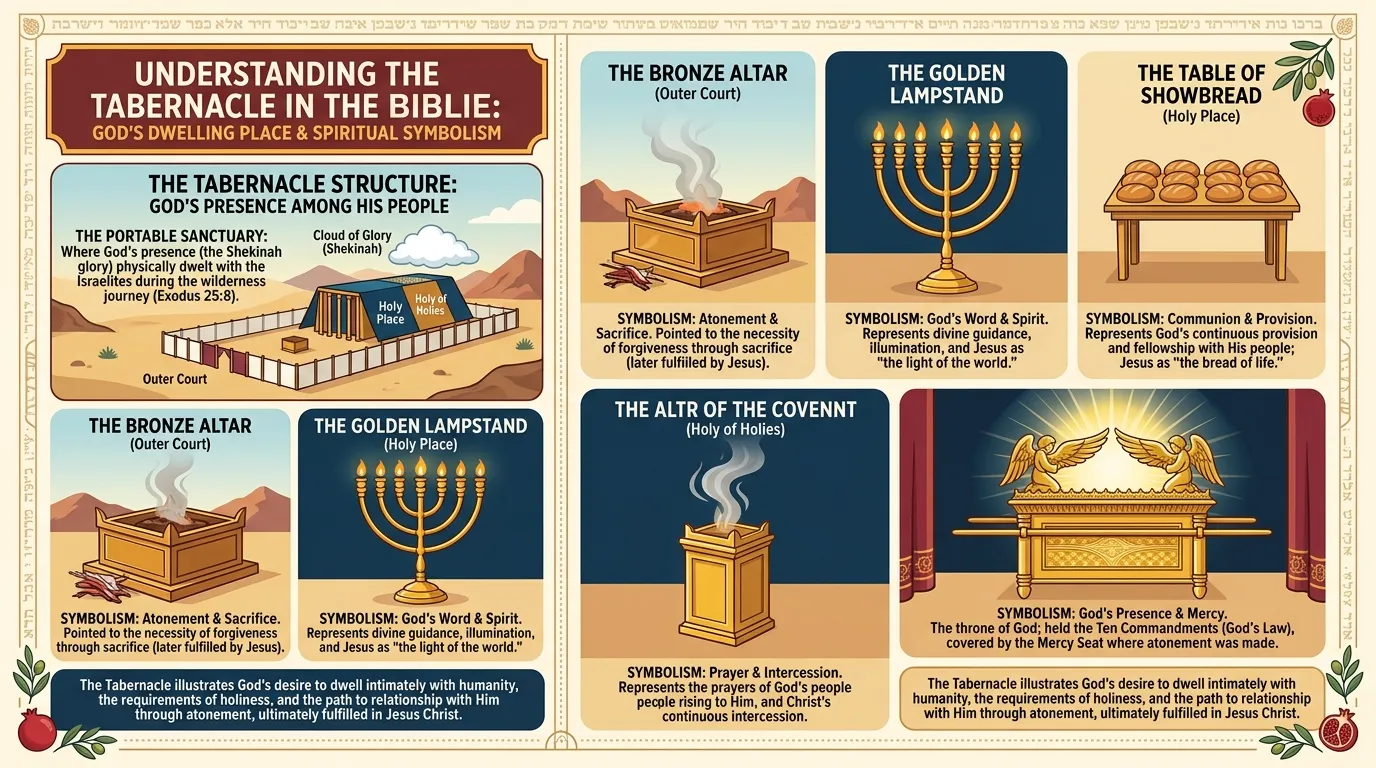
For nearly five hundred years, the holiest place on earth was a tent. Not a temple of marble — a portable structure of wood, cloth, and skins, carried through the wilderness on the shoulders of Levites. The tabernacle: God’s address among His people, pitched at the center of Israel’s camp, with the twelve tribes arranged around it like a congregation around a pulpit.
Every detail was dictated: “according to all that I shew thee, after the pattern of the tabernacle” (Exodus 25:9). Nothing was left to the decorators. That precision is the first lesson — God cares how He is approached — and the second is that every object in the tent was a sermon in furniture. Walk through it with me.
The Outer Court: Where Sin Is Dealt With
You enter through a single gate on the east side — one way in, wide enough for all. The white linen fence surrounding the court speaks of purity; the single entrance speaks of exclusivity. Jesus would later say, “I am the door” (John 10:9), and the tabernacle had been preaching it for centuries: there is one way to God, and it is open to whoever comes.
The first object you meet is the brazen altar — massive, horned, always burning. Here the sacrifices die: burnt offerings, sin offerings, peace offerings. The message is unavoidable and comes first for a reason: you do not stroll into God’s presence; you come through blood. “Without shedding of blood is no remission” (Hebrews 9:22) was not a New Testament innovation; it was the first thing every Israelite saw.
Next stands the laver, a great bronze basin where the priests wash hands and feet (Exodus 30:18-21). Sacrifice deals with guilt; washing deals with defilement. The order matters: cleansed by blood, then cleansed for service. David echoes it: “I will wash mine hands in innocency: so will I compass thine altar, O LORD” (Psalm 26:6).
The Holy Place: Where Fellowship Happens
Past the court, through a woven veil, lies the Holy Place — a room no natural light ever enters, lit only by the golden lampstand with its seven lamps (Exodus 25:31-40). The lampstand, beaten from a single talent of pure gold, burns continually (Leviticus 24:2-4). Light in Scripture is truth, guidance, God’s presence — and the lampstand’s almond-blossom design whispers of life and fruitfulness. Zechariah would later see the lampstand as a vision of the Spirit’s power: “Not by might, nor by power, but by my spirit, saith the LORD” (Zechariah 4:6).
Opposite stands the table of showbread, holding twelve loaves — one for each tribe — renewed every Sabbath (Leviticus 24:5-8). The tribes are perpetually “before the LORD,” represented in His presence even when they are miles away in their tents. It is intercession in furniture: God’s people, held before God’s face, sustained by God’s bread. Jesus claims the image outright: “I am the bread of life” (John 6:35).
Before the inner veil stands the altar of incense, where fragrant smoke rises morning and evening (Exodus 30:7-8). Incense is prayer made visible — “Let my prayer be set forth before thee as incense” (Psalm 141:2), and Revelation shows golden bowls of incense as “the prayers of saints” (Revelation 5:8). The Holy Place teaches that forgiven people do not merely visit God; they dwell with Him — in light, in bread, in prayer.
The Holy of Holies: Where God Dwells
Behind the great veil — thick, woven with cherubim, blue and purple and scarlet — lies a perfect cube, fifteen feet each way. It contains one object: the ark of the covenant, a gold-covered chest holding the tablets of the Law, Aaron’s budded rod, and a pot of manna (Hebrews 9:4) — Israel’s history of rebellion and God’s faithfulness, kept together in one box.
The ark’s lid is the mercy seat — in Hebrew, kapporeth, the place of atonement — where two cherubim face each other with outstretched wings. Once a year, on the Day of Atonement, the high priest enters alone, with blood, and sprinkles it on the mercy seat (Leviticus 16:14-15). Above that lid, between the cherubim, God says, “there I will meet with thee” (Exodus 25:22).
The theology is exquisite: the Law inside the ark condemns; the blood on the lid covers; and God meets His people at the place where judgment is covered by atonement. The mercy seat is the gospel in gold.
The Veil Tears: What Changed
For centuries the veil held — one man, once a year, with blood, lest he die (Leviticus 16:2). Then, at the moment of Christ’s death, “the veil of the temple was rent in twain from the top to the bottom” (Matthew 27:51). From the top — God’s doing, not man’s. The way into the Holy of Holies, so long restricted, stands open.
Hebrews explains what happened: Christ entered “not… with the blood of goats and calves, but by his own blood… having obtained eternal redemption for us” (Hebrews 9:12). The tabernacle was “a figure for the time then present” (Hebrews 9:9) — a scale model of heavenly realities (Hebrews 8:5). Every altar pointed to the cross; every washing to regeneration; every loaf to the Bread of Life; the mercy seat to the atonement; the veil to Christ’s flesh, torn for us (Hebrews 10:20).
“Let us therefore come boldly unto the throne of grace” (Hebrews 4:16). Boldly — the word means with frankness, with confidence. The tent with one gate and one annual visitor has become a throne room with an open door. That is what the cross purchased.
The Cloud and the Fire: Presence You Could See
The tabernacle was never an empty monument. When Moses finished the work, “a cloud covered the tent of the congregation, and the glory of the LORD filled the tabernacle” (Exodus 40:34) — so overwhelming that “Moses was not able to enter.” God’s presence was not a doctrine at the tent; it was a phenomenon: cloud by day, fire by night, visible to the whole camp (Exodus 40:38).
The cloud was also Israel’s guidance system: “when the cloud was taken up from over the tabernacle, the children of Israel went onward in all their journeys: but if the cloud were not taken up, then they journeyed not” (Exodus 40:36-37). Move when God moves; stay when God stays. The tabernacle taught a whole nation the rhythm of divine guidance — presence before progress, glory before marching orders.
And the presence was dangerous as well as beautiful. “Our God is a consuming fire” (Hebrews 12:29). Uzzah learned it at the threshingfloor (2 Samuel 6:6-7); Nadab and Abihu learned it with strange fire (Leviticus 10:1-2). The tabernacle held together what modern religion often separates: God is near — dwelling in the camp — and God is holy — unapproachable except through blood. Nearness without holiness is presumption; holiness without nearness is despair. The tent preached both, in cloud and fire.
The Tent in the New Testament’s Memory
The tabernacle does not disappear when the temple is built — it lives on in the New Testament’s imagination. Stephen’s speech before the Sanhedrin retells the story pointedly: “our fathers had the tabernacle of witness in the wilderness” (Acts 7:44), and then delivers the sting — “the most High dwelleth not in temples made with hands” (Acts 7:48). The tent that moved with God rebukes the temple that tried to contain Him.
John’s prologue makes the boldest connection: “the Word was made flesh, and dwelt among us” (John 1:14) — dwelt is eskēnōsen, “tabernacled.” The incarnation is God pitching His tent in human flesh. And Revelation closes the circle: “the tabernacle of God is with men, and he will dwell with them” (Revelation 21:3). Tent, temple, Christ, new creation — one dwelling-places story, from Exodus to the end. The God who moved into a tent in the wilderness has never moved out of His people’s midst.
What the Tent Still Teaches
God wants to dwell with His people. The tabernacle’s whole purpose is stated in Exodus 25:8: “let them make me a sanctuary; that I may dwell among them.” The incarnation — “the Word was made flesh, and dwelt among us” (John 1:14, literally “tabernacled”) — and the New Jerusalem — “the tabernacle of God is with men” (Revelation 21:3) — are the same desire fulfilled.
Approach God His way. The single gate, the prescribed sacrifices, the exact pattern — all of it says worship is not self-expression but response. Nadab and Abihu learned the cost of improvisation (Leviticus 10:1-2). Sincerity does not sanctify disobedience.
You are the tabernacle now. “Know ye not that ye are the temple of God, and that the Spirit of God dwelleth in you?” (1 Corinthians 3:16). The furniture has become personal: Christ our sacrifice, the Spirit our light, prayer our incense, our bodies the holy place. The tent was always a preview of you.
A tent in the desert, and it contained the universe’s deepest truths: sin requires blood, God desires nearness, and the way that was closed is now open. The Wikipedia article on the tabernacle details its construction and dimensions as scholars reconstruct them; Hebrews supplies what no floor plan can — the meaning of every curtain, and the Christ at the center of them all.










