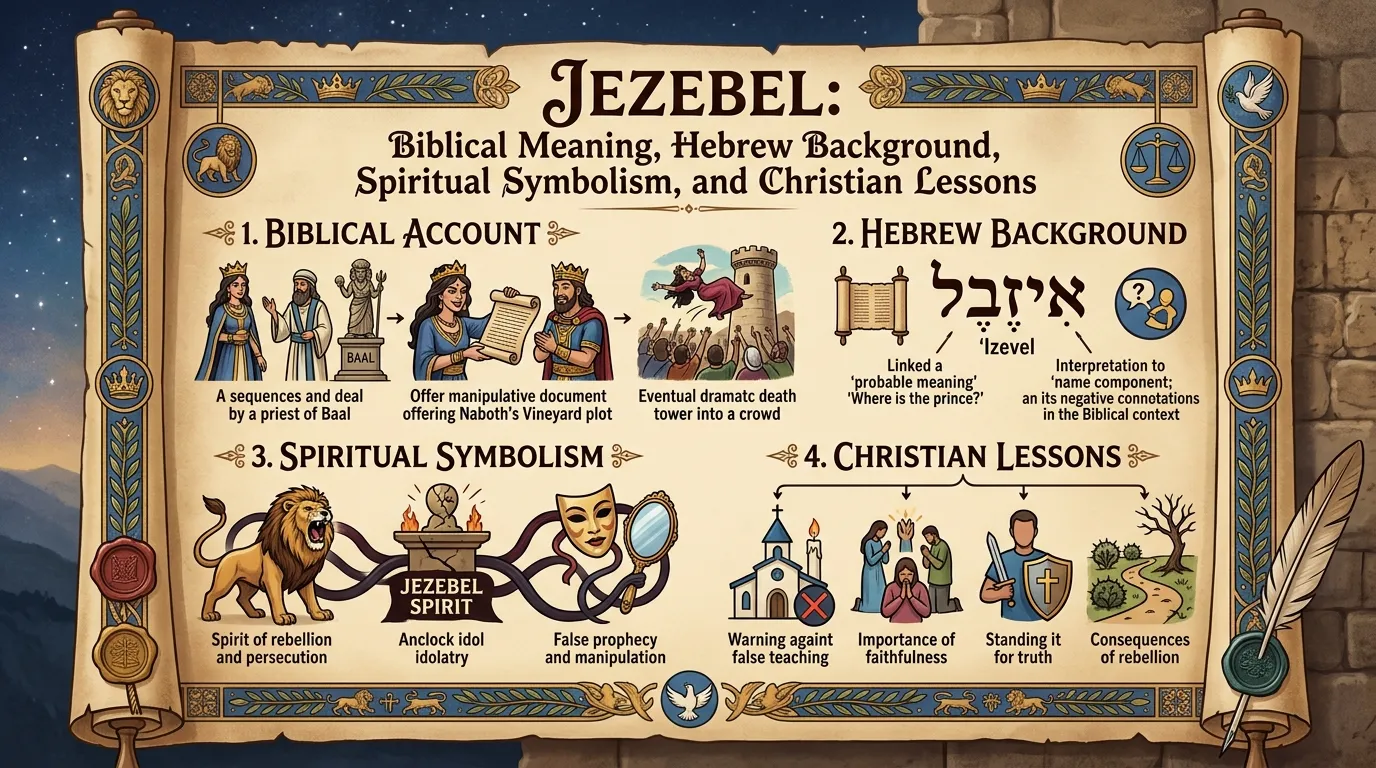
The scene is unforgettable: a queen at a window, painted eyes, arranged hair, looking down at the man who has come to kill her. “Had Zimri peace, who slew his master?” she calls to Jehu (2 Kings 9:31) — defiant to the last breath. Moments later, at Jehu’s command, her own servants throw her from the window. Dogs leave almost nothing for burial, exactly as Elijah had foretold (2 Kings 9:36-37).
It is a dramatic death, and it has made Jezebel a byword — but for what, exactly? In popular use, her name became a slur aimed at women: a “Jezebel” means a scheming, seductive woman. That usage is worth confronting directly, because it is not what the Bible is about when it tells her story. Scripture’s indictment of Jezebel has nothing to do with her being a woman and everything to do with her being a tyrant. She is condemned for the same things male tyrants are condemned for: idolatry, murder, and the corruption of power.
Who She Actually Was
Jezebel was a Sidonian princess, daughter of Ethbaal, king of the Sidonians and priest of Astarte (1 Kings 16:31). Her marriage to Ahab, king of Israel, was a political alliance — the ancient equivalent of a treaty sealed in a wedding. She arrived in Samaria as a foreign queen with a foreign god, and she did not assimilate. She converted — or tried to convert — the kingdom to Baal.
The Hebrew of her name is uncertain; some scholars connect it to a Phoenician form meaning something like “where is the prince?” — possibly a ritual cry for Baal. What is certain is her program: she “cut off the prophets of the LORD” (1 Kings 18:4), sustained 450 prophets of Baal and 400 prophets of Asherah at the royal table (1 Kings 18:19), and made Baal worship the state religion of Israel. This was not private devotion. It was a systematic attempt to replace the worship of Yahweh.
The Confrontation on Carmel
Elijah’s showdown with the prophets of Baal on Mount Carmel (1 Kings 18) is the centerpiece of Jezebel’s story, though she is offstage for most of it. The contest is total: two altars, two gods, fire from heaven as the verdict. Baal’s prophets rave from morning to evening with no answer. Then Elijah prays a prayer of sixty-three words, fire falls, and the people cry, “The LORD, he is the God” (1 Kings 18:39).
Jezebel’s response to the most dramatic vindication of Yahweh in Israel’s history? She sends Elijah a death threat: “So let the gods do to me, and more also, if I make not thy life as the life of one of them by to morrow about this time” (1 Kings 19:2). Evidence does not move her. The mighty prophet who called down fire flees to the wilderness and asks to die. One woman’s entrenched power nearly breaks the greatest prophet of the age — a measure of how formidable she was.
Naboth’s Vineyard: Power at Its Ugliest
If Carmel shows Jezebel’s religion, Naboth’s vineyard (1 Kings 21) shows her politics. Ahab wants Naboth’s vineyard; Naboth refuses to sell his ancestral inheritance — a refusal rooted in the law of God (Leviticus 25:23; Numbers 36:7). Ahab sulks. Jezebel takes over.
What follows is a masterclass in the abuse of power: forged letters in the king’s name, a rigged trial, false witnesses, a judicial murder by stoning — all to seize a vegetable garden. “Dost thou now govern the kingdom of Israel?” she sneers at Ahab (1 Kings 21:7). She understands power better than he does, and she uses it without a flicker of conscience.
Elijah’s verdict on the crime is God’s verdict on all such tyranny: “In the place where dogs licked the blood of Naboth shall dogs lick thy blood, even thine” (1 Kings 21:19). And to Jezebel specifically: “The dogs shall eat Jezebel by the wall of Jezreel” (1 Kings 21:23). The punishment fits the crime with prophetic precision — the one who devoured the innocent is devoured.
Ahab: The Other Half of the Story
Jezebel did not operate alone, and Scripture is careful to distribute the blame. Ahab “did sell himself to work wickedness in the sight of the LORD, whom Jezebel his wife stirred up” (1 Kings 21:25) — stirred up, not forced. Ahab was a willing participant: he wanted Naboth’s vineyard, he sulked when refused, and he accepted the murder’s proceeds without asking how they were obtained. “Hast thou found me, O mine enemy?” he asks Elijah (1 Kings 21:20) — the whine of a man who knows exactly what he has done.
This matters because the popular telling sometimes makes Jezebel the sole villain and Ahab the passive victim — a framing with its own gendered distortion, the weak man led astray by the strong woman. The text refuses it. Ahab “did more to provoke the LORD God of Israel to anger than all the kings of Israel that were before him” (1 Kings 16:33) — he did. His repentance, when it comes, is real enough that God delays judgment (1 Kings 21:27-29): even this king finds mercy when he humbles himself.
The full picture is a partnership in evil — a passive king and an active queen, each culpable, each judged. Tyranny is a team sport, and Scripture indicts the whole team. Remembering Ahab keeps Jezebel’s story honest: she was not a woman who corrupted an innocent man but a ruthless ruler who found a willing accomplice on the throne beside her. Power shared is still power judged — and no partnership in evil, however royal, escapes the reckoning.
What “Jezebel” Means — and Does Not Mean
Two things must be said clearly, because the church has not always said them.
First, Jezebel is condemned for tyranny and idolatry, not for female power. The Bible celebrates powerful women constantly — Deborah judging Israel (Judges 4-5), Esther saving the Jews (Esther 4-9), Priscilla teaching Apollos (Acts 18:26), Phoebe serving as a deacon (Romans 16:1). Scripture’s problem with Jezebel is identical to its problem with Ahab, Manasseh, or Herod: she used power to destroy God’s people and replace God’s worship. To turn her into a warning against strong women is to misread the text and slander half the church.
Second, her seductiveness is political and religious, not sexual. The Bible never describes Jezebel as sexually immoral. Her “whoredoms” are spiritual — the prophets’ standard metaphor for idolatry (2 Kings 9:22 uses the term for her witchcrafts and whoredoms, meaning Baal worship). The window scene with painted eyes is a queen dressing in royal dignity to face death, not a seductress plying her trade. Later tradition sexualized her; the text does not.
The Jezebel of Revelation
Centuries later, the risen Christ uses her name as a symbol — and the usage confirms the interpretation above. To the church in Thyatira He says: “thou sufferest that woman Jezebel, which calleth herself a prophetess, to teach and to seduce my servants to commit fornication, and to eat things sacrificed unto idols” (Revelation 2:20). Whether a real woman or a symbolic figure, the “Jezebel” spirit is defined by false teaching that leads God’s people into idolatry and compromise — the same program as the original, in spiritual form.
Note what the symbol preserves: not femaleness, not sexuality, but influence used to corrupt worship. A male teacher doing the same thing would be equally “Jezebel” in spirit. The name became shorthand for a pattern — power plus false religion — that has no gender.
Lessons From a Queen’s Ruin
Power without accountability becomes predatory. Jezebel operated where no one could check her — a foreign queen, a weak husband, a silenced prophetic voice. Every Naboth’s vineyard in history, from ancient Israel to modern boardrooms, follows the same script. Structures of accountability are not unspiritual; they are Jezebel-prevention.
Idolatry is never private. Jezebel’s Baal worship was personal conviction weaponized into state policy. What we worship shapes what we permit — and eventually what we enforce. The gods we serve always demand sacrifices; the only question is whose.
Evidence does not convert the entrenched. Carmel should have ended it. Fire fell, the people confessed, the prophets of Baal were executed — and Jezebel doubled down. Some hearts do not need more proof; they need the miracle of a new heart (Ezekiel 36:26). Pray accordingly.
God’s justice is patient but precise. Years passed between Naboth’s murder and Jezreel’s window. The delay was not absence. “Be sure your sin will find you out” (Numbers 32:23) — and when it does, the correspondence between crime and consequence will be exact.
Jezebel’s story is not a warning about women. It is a warning about what happens when power, religion, and ruthlessness combine in any human heart — and a testimony that no window is too high, no throne too secure, for the justice of God. The Wikipedia article on Jezebel covers her historical context as a Phoenician princess and the archaeological debates around her; Scripture adds the verdict that history alone cannot pronounce.










