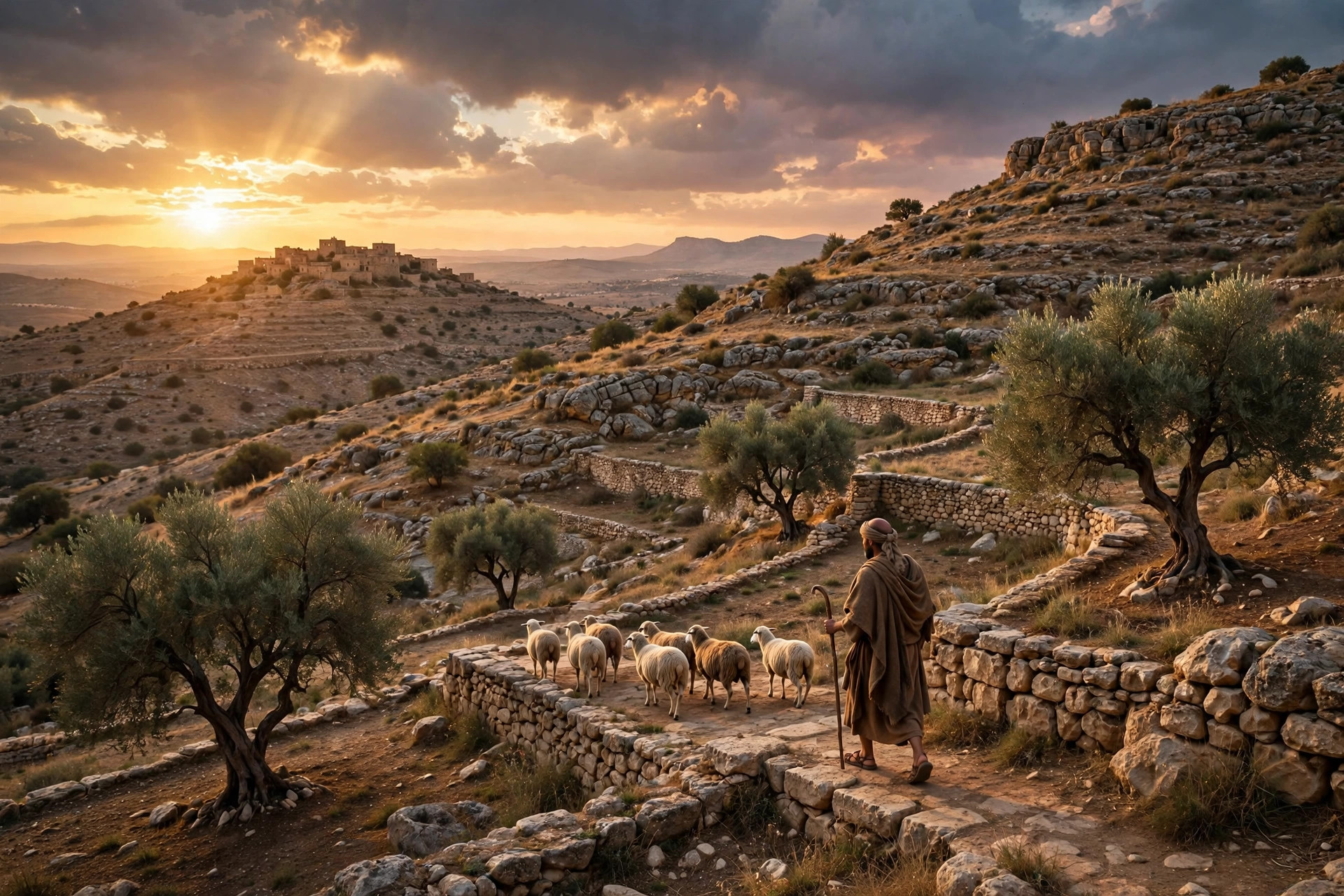
Stand beside an Israelite shepherd three thousand years ago, look up at the night sky, and ask him what the world looks like. He would not hand you a globe. He would point to the hills around him, to the sea glittering in the west, to the desert stretching east, and to the dome of heaven above — and he would tell you that God made all of it, rules all of it, and placed his people right in the middle of the story. The world known to Hebrews in the Bible is not a geography lesson first. It is a window into how ancient Israel understood creation, the nations, and their own place under God.
That matters for how we read Scripture today. When the biblical writers describe the earth, the flood, or the ends of the world, they speak from inside their own horizon. If we force their words into a modern science textbook, we will misunderstand them. If we dismiss them as primitive, we will miss the theology they carry. The better path is to listen to them on their own terms — and then let their God-centered vision reshape how we see our own world.
A Map With Jerusalem Near the Middle
Ancient Israel lived in the ancient Near East, a crossroads of empires, deserts, seas, and mountain ranges. Their mental map was real, detailed, and limited — much like any person’s map before satellites and printed atlases. They knew Canaan intimately: its hills, valleys, springs, and harvests. Deuteronomy 8:7-9 describes the land lovingly, as a good land of brooks, wheat, vines, figs, pomegranates, olive oil, and honey.
Beyond their own hills, they knew the great neighbors. Egypt lay to the southwest, the land of their slavery and later of trade and refuge. Mesopotamia lay to the northeast, home of Assyria and Babylon, the empires that would conquer and exile them. The Mediterranean Sea bordered them to the west, and they called it the Great Sea (Numbers 34:6). To the north were the mountains of Lebanon; to the south, the wilderness of Sinai and the Negev. This was their neighborhood, and they knew it the way farmers know their fields.
What they did not know is equally important. The Hebrews knew nothing of the Americas, Australia, or East Asia. Their world centered on the lands ringing the eastern Mediterranean. So when Scripture says that a decree went out that “all the world should be registered” (Luke 2:1), it means the Roman world — the world within the writer’s horizon. When Genesis says the waters of the flood covered the earth (Genesis 7:19), it describes a catastrophe as vast as the writer’s world, in the language of total judgment, not a modern geological survey. Reading “all the earth” with ancient eyes keeps us from asking the text questions it was never trying to answer.
The Language of the Sky
The Hebrews described the world the way it appears to an observer standing on the ground. They spoke of the firmament (Genesis 1:6), the pillars of the earth (1 Samuel 2:8), the ends of the earth (Psalm 65:5), and the sun rising and setting (Ecclesiastes 1:5). Modern readers sometimes stumble over this language, as if the Bible were teaching a false astronomy. It is not. It is speaking phenomenologically — describing how things look — the same way we still say “sunrise” and “sunset” without believing the sun orbits the earth.
At the same time, the poetry carries profound truth. “The earth is the Lord’s, and everything in it” (Psalm 24:1). “He sits enthroned above the circle of the earth” (Isaiah 40:22). “He spreads out the northern skies over empty space; he suspends the earth over nothing” (Job 26:7). The biblical writers never claimed to give a scientific model. They claimed something greater: that the world is not an accident, that it belongs to its Maker, and that the Maker is personally involved in it. The Hebrew word for “earth,” eretz, can mean soil, land, country, or the whole world depending on context — a reminder to read each passage in its own setting rather than importing a single modern meaning.
The creation account itself (Genesis 1:1) opens not with a diagram but with a declaration: “In the beginning God created the heavens and the earth.” Whatever else the Hebrews did not know about the cosmos, they knew its Author. “Through him all things were made” (John 1:3), the apostle John would later write — and that conviction, not any map, was the center of their worldview.
One Family, Many Nations
Genesis 10, often called the Table of Nations, lists the descendants of Noah’s sons — Shem, Ham, and Japheth — spreading across the known world. It names peoples from Elam in the east to Egypt in the south, from Greece (Javan) in the west to Arabia in the south. This was the ancient world’s ethnography, and it carried a stunning claim: all the peoples of the earth belong to one human family.
That claim echoes through the rest of Scripture. “From one man he made all the nations, that they should inhabit the whole earth” (Acts 17:26). Ruth, a Moabite, could say to Naomi, “Your people will be my people and your God my God” (Ruth 1:16) — and be grafted into Israel’s story. The Queen of Sheba could travel from the ends of the known world to hear Solomon’s wisdom (1 Kings 10:1). Jonah could sail toward Tarshish (Jonah 1:3) and discover that God’s mercy pursued even Nineveh.
Israel’s calling was never to hoard God for itself. “All peoples on earth will be blessed through you” (Genesis 12:3), God told Abraham. Isaiah saw a day when “the mountain of the Lord’s temple will be established as the highest of the mountains” and “all nations will stream to it” (Isaiah 2:2; Micah 4:1). Revelation completes the picture: people “from every nation, tribe, people and language” standing before the throne (Revelation 7:9). The Hebrew map of the world was small, but the Hebrew hope for the world was enormous.
What They Got Wrong — and What They Got Right
Honesty requires us to say it plainly: the biblical writers shared the geography of their time. They did not know the planet was a sphere floating in space, and Scripture never claims to teach them that. God did not give Israel a modern science education; he gave them something else — the truth about who made the world, why it matters, and what he intends to do with it.
That distinction protects us from two mistakes. The first is treating every ancient phrase as a scientific claim, then tying the Bible’s authority to a cosmology it never taught. The second is treating the ancient worldview as proof the Bible is unreliable. But the Bible’s authority was never grounded in its authors’ knowledge of plate tectonics. It rests on God’s revelation of himself: his character, his covenant, his promises, and above all his Son. “All Scripture is God-breathed” (2 Timothy 3:15), and what it breathes out is truth about God and his purposes — truth that stands whether the writer pictured the horizon as a dome or a curve.
Consider the psalmist gazing at the night sky: “When I consider your heavens, the work of your fingers, the moon and the stars, which you have set in place” (Psalm 8:3). He did not know how far away the stars were. He knew something better — that the same God who set them in place had set his love on human beings. “The heavens declare the glory of God” (Psalm 19:1) is true in any century, under any cosmology.
Reading “All the Earth” With Ancient Eyes
This perspective changes how we read several famous passages. When the psalmist says God will be exalted “among the nations” (Psalm 47:8), he means the nations Israel knew — and the principle extends to every nation we know today. When Isaiah says “all the ends of the earth will see the salvation of our God,” the horizon has widened, but the promise is the same. When Jesus commands his disciples to “make disciples of all nations” (Matthew 28:19), the mission inherits the same universal scope the prophets foresaw — and now we know how wide “all nations” truly is.
The same care applies to judgment passages. “The whole earth” in a prophetic oracle usually means the whole world as the prophet and his audience knew it — the lands under judgment — not necessarily every square mile of the planet. Recognizing this is not weakening Scripture. It is reading it the way its first readers would have, with the same commonsense understanding of language that we use when we say “everyone in town” without meaning every human alive.
What This Changes for Us
First, it humbles us. Our maps are far more complete than the Hebrews’ — and yet our knowledge, like theirs, has edges. Future generations will smile at some of our confident assumptions. The God who is “the King eternal” (Daniel 4:35) is not threatened by what we do not yet know.
Second, it centers us. The Hebrews put God, not themselves, at the center of the map. The world was not “theirs” to exploit; it was the Lord’s to steward. “The earth is the Lord’s” (Psalm 24:1) is a claim about ownership — and therefore about responsibility. We care for creation, love our neighbors, and welcome strangers precisely because the world belongs to God, not to us.
Third, it widens our hope. The nations the Hebrews knew were the beginning, not the end, of God’s plan. “From the rising of the sun to the place where it sets, people will praise my name” (Psalm 65:5, in spirit). The gospel that began in a small corner of the ancient Near East now reaches every continent the Hebrews never imagined. Their small map carried a big promise — and the promise is still being fulfilled.
Questions Readers Often Ask
Did the Hebrews think the earth was flat? They described the world as it appears — with horizons, pillars, and a dome of sky — which is the language of observation, not a scientific theory. Scripture’s purpose was to reveal God, not to teach astronomy, and its theological claims about creation and sovereignty stand regardless of the authors’ cosmology.
Does the ancient worldview undermine the Bible’s authority? No. The Bible’s authority rests on God’s revelation of himself, his character, and his redemptive plan. The writers shared the geography of their time, but the message God spoke through them — creation, covenant, judgment, and salvation — is true in every age.
Why does the Bible say “all the earth” when it means a region? Because biblical writers, like all people, used “all” the way we do — to mean “all within the horizon in view.” Luke’s “all the world” in Luke 2:1 means the Roman world. Reading each passage in its context keeps us from forcing modern global precision onto ancient idiom.
Seeing Your World Through God’s Eyes
The Hebrews looked at a small world and saw a great God. We look at a vast world — galaxies, continents, oceans they never named — and the same God meets us there. The map has grown; the Maker has not changed. “He is before all things, and in him all things hold together” (Colossians 1:16). If you want to place your own life on the map, start where Israel started: the world is the Lord’s, you are part of one human family, and the God who made it all has a purpose for your small corner of it. For a broader historical overview of the people who carried this worldview, the Wikipedia article on the Hebrews offers useful background and context.










