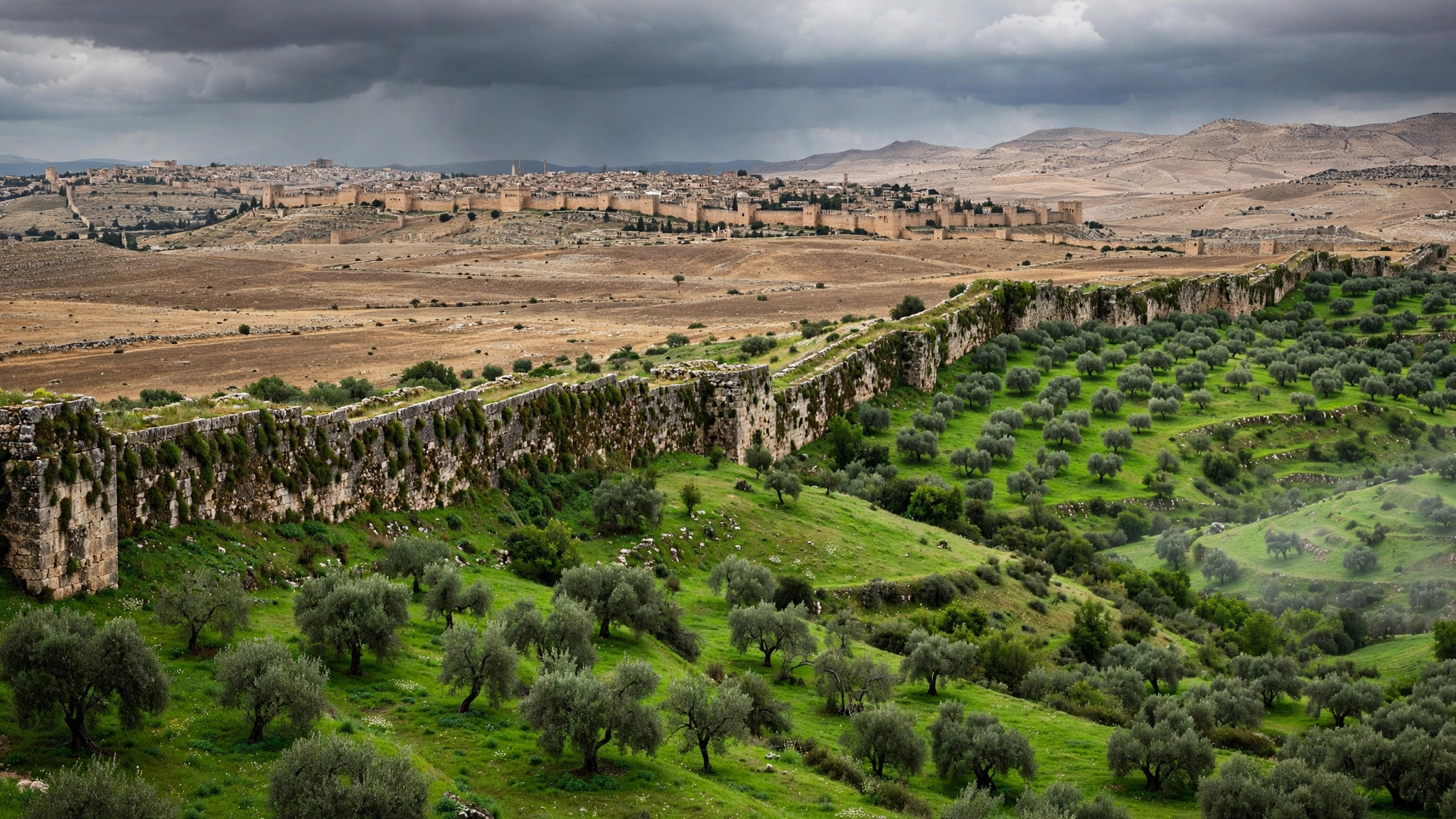
Open your Bible to 1 Kings 12 and you will watch a nation tear itself in half. One moment Israel stands united under Solomon; the next, ten tribes walk away, and two kingdoms emerge where one had stood. The divided kingdom is one of Scripture’s most important — and most overlooked — stories, because nearly half the Old Testament was written against the backdrop of this fracture. To understand the prophets, the exile, and even the coming of Jesus, you have to understand the split.
This is not just ancient politics. It is a story about pride, leadership, worship, and a God who keeps working through broken things.
The Crack: How One Kingdom Became Two
Solomon’s reign had been glorious — the temple, the wealth, the wisdom. But it was built on heavy taxation and forced labor, and Solomon’s heart had drifted toward the gods of his foreign wives (1 Kings 11:1-11, in substance). God warned that the kingdom would be torn away — not in Solomon’s lifetime, for David’s sake, but under his son.
The tear came swiftly. When Solomon’s son Rehoboam came to the throne, the people asked him to lighten the burden. The older counselors advised kindness: “If today you will be a servant to these people and serve them and give them a favorable answer, they will always be your servants” (1 Kings 12:7). The young counselors advised arrogance. Rehoboam chose arrogance: “My father made your yoke heavy; I will make it even heavier” (1 Kings 12:10-11, in substance). The ten northern tribes answered with a cry that still echoes: “What share do we have in David? … To your tents, Israel!” (1 Kings 12:16).
The split was political, but it was also theological. “This is the Lord’s doing,” the narrator tells us (1 Kings 12:15, in substance). God was judging Solomon’s idolatry — and he was also setting in motion a story that would run for centuries. Human pride tore the kingdom; God’s purpose marched on through the wreckage.
The Two Kingdoms Side by Side
After the split, two kingdoms stood side by side, and their differences mattered.
Israel — the northern kingdom. Ten tribes, capital eventually at Samaria, first king Jeroboam. It was larger, richer, and more powerful. It also had no legitimate temple and no Davidic king. From its first day, it was built on a religious shortcut, and it never recovered. Nineteen kings ruled the north; the biblical historians give none of them a good report. The kingdom lasted about two hundred years before Assyria destroyed it in 722 BC and scattered its people (2 Kings 17:6-7, in substance).
Judah — the southern kingdom. Two tribes (Judah and Benjamin), capital at Jerusalem, kings from David’s line. It was smaller and weaker, but it had the temple, the priesthood, and the covenant promise to David (2 Samuel 7:16). Twenty kings ruled Judah; a few — Asa, Jehoshaphat, Hezekiah, Josiah — led genuine reforms. But the pattern kept repeating: reform, relapse, rebellion. In 586 BC, Babylon destroyed Jerusalem and carried Judah into exile (2 Kings 25:8-11, in substance).
The two kingdoms were rivals, sometimes at war, sometimes in uneasy alliance. Their kings intermarried; their armies clashed; their prophets crossed borders. A reader who misses the split will constantly wonder why “Israel” sometimes means the north, sometimes the whole people, and sometimes the southern kingdom. The answer is always the split.
Jeroboam’s Sin: The Wound That Never Healed
The northern kingdom’s original sin was not just political — it was worship. Jeroboam feared that if his people kept traveling to Jerusalem to worship at the temple, their hearts would return to Rehoboam. So he built an alternative: two golden calves at Dan and Bethel, with the slogan, “Here are your gods, Israel, who brought you up out of Egypt” (1 Kings 12:28). He appointed priests who were not Levites and invented his own festivals (1 Kings 12:31).
It was pragmatic, popular, and catastrophic. The biblical historians call it “the sin of Jeroboam” again and again, long after Jeroboam was dead. Every northern king who followed is measured by whether he continued in it. Jeroboam’s sin teaches a sobering lesson: the most dangerous idolatry is not the kind that looks evil — it is the kind that looks practical. A golden calf built for political security is still a golden calf.
The Prophets and the Two Kingdoms
The divided kingdom was the age of the prophets. Elijah and Elisha confronted the Baal worship of Ahab and Jezebel in the north. Amos, a shepherd from Judah, traveled north to announce judgment on Israel’s corruption: “I hate, I despise your religious festivals” (Amos 5:21) — because worship without justice is empty. Hosea preached God’s heartbreak over a faithless people. Isaiah and Jeremiah spoke to Judah, warning that the same idolatry that destroyed Israel would destroy Judah too. Ezekiel preached to the exiles in Babylon.
The prophets are often hard to read because they are not arranged in a tidy timeline — they are voices speaking into specific crises in specific kingdoms. Once you know which kingdom a prophet addressed, and whether he spoke before or after the fall of Samaria (722 BC) or Jerusalem (586 BC), the books come alive. The prophets were not fortune-tellers. They were covenant lawyers, prosecuting God’s case against his people and pleading for their return.
Why Israel Fell — and Why Judah Fell Later
Israel fell in 722 BC because, in the words of 2 Kings 17, the people “worshiped other gods,” “followed the practices of the nations,” and “would not listen” — even after God “warned Israel and Judah through all his prophets and seers” (2 Kings 17:7-15, in substance). Assyria was the instrument, but idolatry was the cause.
Judah fell later, in 586 BC, for the same reasons. Judah had one advantage: the reforms of Hezekiah and Josiah, and the promise to David, bought it another century. But Manasseh’s long reign filled Jerusalem with idols and innocent blood (2 Kings 21:16), and the rot ran deep. Jeremiah warned for decades that Babylon was coming. When it came, the temple burned, the walls fell, and the people went into exile.
And yet — the exile was not the end. The prophets had also promised return. Jeremiah spoke of seventy years (Jeremiah 25:11). Ezekiel saw dry bones come to life and two sticks joined into one: “I will make them one nation in the land” (Ezekiel 37:22). The divided kingdom would one day be healed — not by politics, but by God.
Explicit Teaching vs. Interpretation
Scripture explicitly teaches that the kingdom split because of Solomon’s idolatry and Rehoboam’s folly, that both kingdoms fell because of persistent idolatry and covenant-breaking, and that God promised a future restoration. The Bible also explicitly teaches that division is a spiritual danger: “Every kingdom divided against itself will be ruined” (Luke 11:17).
What requires more care is applying the story. The divided kingdom is sometimes used as a simple allegory for church splits or personal “divided hearts.” Those applications can be edifying, but they are applications, not the text’s direct meaning. The text is first of all history — real kings, real armies, real exiles — and its lessons come from taking that history seriously.
Practical Lessons for Everyday Life
First, small compromises compound. Jeroboam’s calves seemed like a minor adjustment. Two centuries later they had destroyed a kingdom. The compromises we make for convenience — in worship, in honesty, in marriage — rarely stay small.
Second, leadership is stewardship. Rehoboam inherited a kingdom and broke it with one arrogant speech. Leaders who listen, serve, and heed wise counsel preserve what God has entrusted to them. Leaders who must prove their strength usually destroy it.
Third, division is the enemy’s favorite tool. The split weakened both kingdoms and made both vulnerable to their enemies. Paul would later urge the church to “make every effort to keep the unity of the Spirit through the bond of peace” (Ephesians 2:14, in the reconciliation of Jew and Gentile; Ephesians 4:3, in substance). Unity is not uniformity — the tribes were always diverse — but it is a refusal to let pride tear apart what God joined.
Fourth, God works through broken things. The divided kingdom looked like the end of the promise. It was actually the stage on which God displayed his patience, raised up prophets, preserved a remnant, and prepared the way for a King who would reunite not just two kingdoms but all peoples. “From this man’s descendants God has brought to Israel the Savior Jesus, as he promised” (Acts 13:23, in substance).
Questions Readers Often Ask
Why are there two kingdoms called Israel? After Solomon, the name “Israel” can mean the whole people, the northern kingdom specifically, or — in later prophets — the restored people of God. Context decides. When a passage names kings like Jeroboam, Ahab, or Hoshea, it means the north; when it names Rehoboam, Hezekiah, or Josiah, it means Judah.
What happened to the ten lost tribes? When Assyria conquered the north in 722 BC, many Israelites were deported and others fled south to Judah or assimilated. The “lost tribes” were never literally lost to God — the prophets promised their restoration, and the New Testament speaks of the twelve tribes as a present reality (James 1:1, in substance).
Did God want the kingdom to split? Scripture presents the split as both human sin and divine judgment: Rehoboam’s arrogance and Jeroboam’s idolatry were real choices, and God used them to fulfill his word to Solomon. Human responsibility and divine sovereignty run together through the whole story.
How does the divided kingdom point to Jesus? The prophets promised a future King from David’s line who would heal the division. Jesus, “the Lion of the tribe of Judah” (Revelation 5:5), came to make “one new humanity out of the two” (Ephesians 2:14) — and Revelation ends with a kingdom that will never divide again.
The Kingdom That Will Never Divide
The story of the divided kingdom ends in hope. The throne in Jerusalem stood empty for centuries — until a child was born in Bethlehem, in the line of David, of whom the angel said, “The Lord God will give him the throne of his father David, and he will reign over Jacob’s descendants forever; his kingdom will never end” (Luke 1:32-33). The kingdoms of Judah and Israel fell. The kingdom of Jesus never will. For the wider historical background of Judah’s story, the Wikipedia article on the Kingdom of Judah is a helpful reference.










