Let’s begin with honesty, because God is the God of truth and His people should be people of truth: the name William does not appear in the Bible. Not in Hebrew, not in Greek, not in any translation. It could not — William is a Germanic name born centuries after the last book of Scripture was written. Anyone claiming a “Hebrew meaning of William” is inventing etymology. But that is not the end of the story; it is the beginning of a better one. For William has a genuine history, a noble meaning of its own, and a set of biblical themes that fit it like a sheath fits a sword. A name need not be in the Bible to be worthy of a biblical life.
Where William Actually Comes From
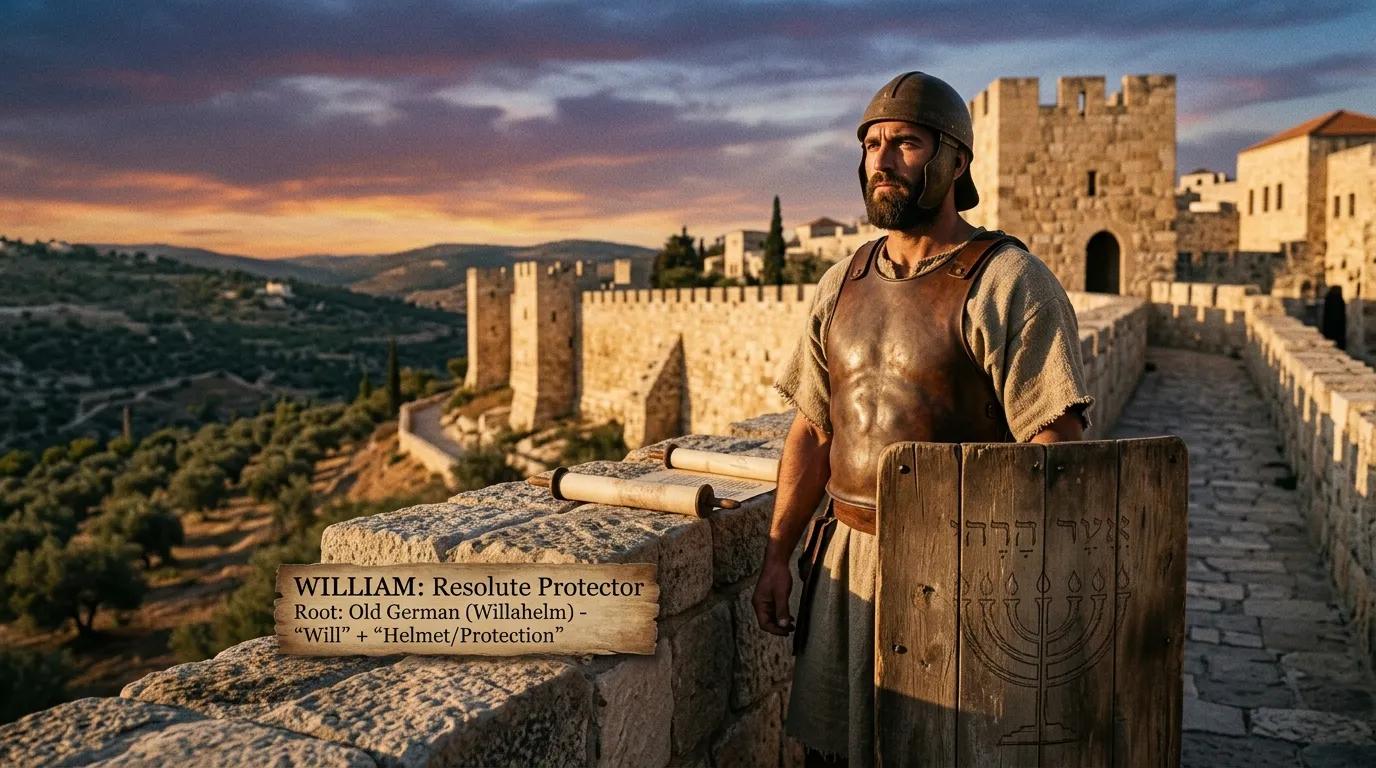
William descends from the Old Germanic Willahelm — sometimes rendered Wilhelm — compounded of two elements: wil, meaning “will, desire, resolve,” and helm, meaning “helmet” or “protection.” The standard rendering: “resolute protector” or “strong-willed guardian.” It was a warrior’s name, borne by dukes and kings — most famously William the Conqueror, who carried it across the Channel in 1066 and planted it permanently in the English-speaking world.
The Normans brought it; the English kept it; Christians baptized their sons with it for a thousand years. It became the name of reformers, missionaries, pastors, and hymn-writers — William Carey, the “father of modern missions,” who carried the gospel to India; William Wilberforce, whose resolute protection of the enslaved helped abolish the British slave trade. The name’s history among God’s people is the history of its meaning lived out: resolve put in service of protection.
What the Bible Says About the Things “William” Means
Scripture may not contain the name, but it is saturated with its meaning. The Bible’s God is the great Protector — “The LORD is my rock and my fortress and my deliverer” (Psalm 18:2) — and He repeatedly calls His people to the same work: “defend the weak and the fatherless; uphold the cause of the poor and the oppressed” (Psalm 82:3). Resolute protection is not merely a Germanic warrior ideal; it is a biblical vocation.
Consider how Scripture honors the protector’s resolve. Nehemiah rebuilt Jerusalem’s walls with a sword in one hand and a trowel in the other, posting guards while the work went on (Nehemiah 4) — resolve and protection fused in a single leader. Boaz used his standing to shield Ruth, a vulnerable foreign widow, at personal cost (Ruth 2-3). The Good Shepherd Himself defines the protector’s ethic: “The good shepherd lays down his life for the sheep. He who is a hired hand… sees the wolf coming and leaves the sheep and flees” (John 10:11-12). And the charge God gave Joshua — “Be strong and courageous… for the LORD your God is with you wherever you go” (Joshua 1:9) — is the divine backing for every resolute protector: courage is commanded because Presence is promised.
Even the helmet in William’s etymology has a biblical echo: “the helmet of salvation” in the armor of God (Ephesians 6:17) — protection for the mind, guarding thought itself. A William who wears that helmet protects not only bodies but minds: his family’s thinking, his children’s convictions, his own inner life.
Williams Who Lived the Name
The name’s meaning — resolute protector — has been incarnated by remarkable bearers, and their stories sketch what the name can signify at its best. William Tyndale (c. 1494-1536) resolved to put the English Bible into the plowboy’s hands — “I will cause a boy that driveth the plough shall know more of the Scripture than thou doest,” he told a cleric — and was strangled and burned for it. His dying prayer, “Lord, open the King of England’s eyes,” was answered within years. A resolute protector of the Word, shielding Scripture’s access for the common person at the cost of his life.
William Carey (1761-1834), the cobbler-turned-missionary, spent forty years in India translating Scripture, fighting sati (widow-burning), and founding schools — his famous motto, “Expect great things from God; attempt great things for God,” is resolve distilled. When his life’s work of manuscripts burned in a fire, he wept, then started over. A resolute protector of people — the vulnerable, the unreached, the unborn work of translation.
William Wilberforce (1759-1833) took up the abolition of the slave trade as a young parliamentarian and did not lay it down for forty-six years — through mockery, defeat, illness, and political wilderness — until the Slavery Abolition Act passed days before his death. A resolute protector of the enslaved, proving that the will in “William” can outlast empires.
None of these men were perfect; all would point away from themselves to Christ. But together they form a cloud of Williams witnessing to one truth: resolve, submitted to God and spent for others, changes history. The name’s Germanic warrior root, baptized by centuries of Christian bearers, has come to mean something the first Wilhelms never imagined: not the protector who conquers, but the protector who serves — after the pattern of the Good Shepherd who lays down His life (John 10:11).
The Shadow Side: When Resolve Turns Stubborn
Honesty requires the warning too. Wil — strong will — is a gift with a shadow. The same resolve that protects can harden into stubbornness; the guardian can become the controller. Scripture’s strong-willed men supply both portraits: Jacob wrestled God and would not let go — and was renamed and blessed (Genesis 32). Pharaoh hardened his heart again and again — and was ruined (Exodus 7-14). The difference was never the strength of the will but its object: surrendered to God, resolve becomes faithfulness; set against God, it becomes rebellion.
For a William, then, the life question is the will’s direction. A resolute protector submitted to Christ is a fortress for others; a strong will submitted only to itself is a fortress against others. The prayer of every William should be the psalmist’s: “Teach me to do your will” (Psalm 143:10) — resolve aimed by revelation.
The Name Day by Day: A William’s Rule of Life
What does “resolute protector” look like in ordinary weeks? Not in parliaments and mission fields only, but in kitchens and cubicles. Protect the vulnerable in your orbit: the new kid at school, the overwhelmed coworker, the elderly neighbor — resolve spent in small shieldings counts as much as in great ones. Keep your word as a fortress: let your yes be yes (Matthew 5:37); the protector’s first weapon is reliability. Guard the minds entrusted to you: children, friends, followers — protect their thinking from cynicism and despair by modeling hope. Stand when standing costs: the will in William is proven not in comfort but in the moment when protecting what’s right means risking what’s comfortable.
And the daily prayer of the name: “Lord, make my will resolute for Your purposes and surrendered to Your will; make me a helmet for others and keep me under Your own.” Pray it in the morning; the day will supply the opportunities. A name is a vocation — and vocations are lived one Tuesday at a time.
Bearing the Name: A Charge
So what does it mean to be named William as a Christian? It means carrying a vocation in your name: to be the one who stands firm when others flee, who shields the vulnerable at cost, who keeps his word when keeping it hurts. It means remembering William Carey, who said “Expect great things from God; attempt great things for God” — resolve harnessed to mission. It means, above all, pointing beyond yourself to the greater Protector: “The LORD is my shepherd” (Psalm 23:1), the one whose protection never fails and whose resolve at the cross purchased our safety forever.
A name absent from Scripture can still be full of Scripture’s meaning. William means “resolute protector” — and the Bible’s final word to every protector is this: the strongest guard is the one who knows he is himself guarded. “The name of the LORD is a strong tower; the righteous man runs into it and is safe” (Proverbs 18:10). Be the tower for others, William — because you have run into the Tower yourself.
Is William a Christian name?
It is not a biblical name, but it has been a Christian name for a millennium — borne by saints, missionaries, and reformers. What makes a name Christian is not its etymology but the life lived under it. Any name becomes holy when its bearer belongs to the Holy One.
What is the spiritual meaning of William?
Linguistically: “resolute protector” (Germanic: will + helmet). Spiritually, Christians have read it as a calling to courageous guardianship — protecting the weak, standing firm in faith, and reflecting the God who is our ultimate shield (Psalm 3:3).
William never appears in the Bible’s pages, but its meaning marches through them — in every shepherd who faced the wolf, every wall rebuilt under threat, every believer who stood firm. For the name’s linguistic history, see William (given name).










