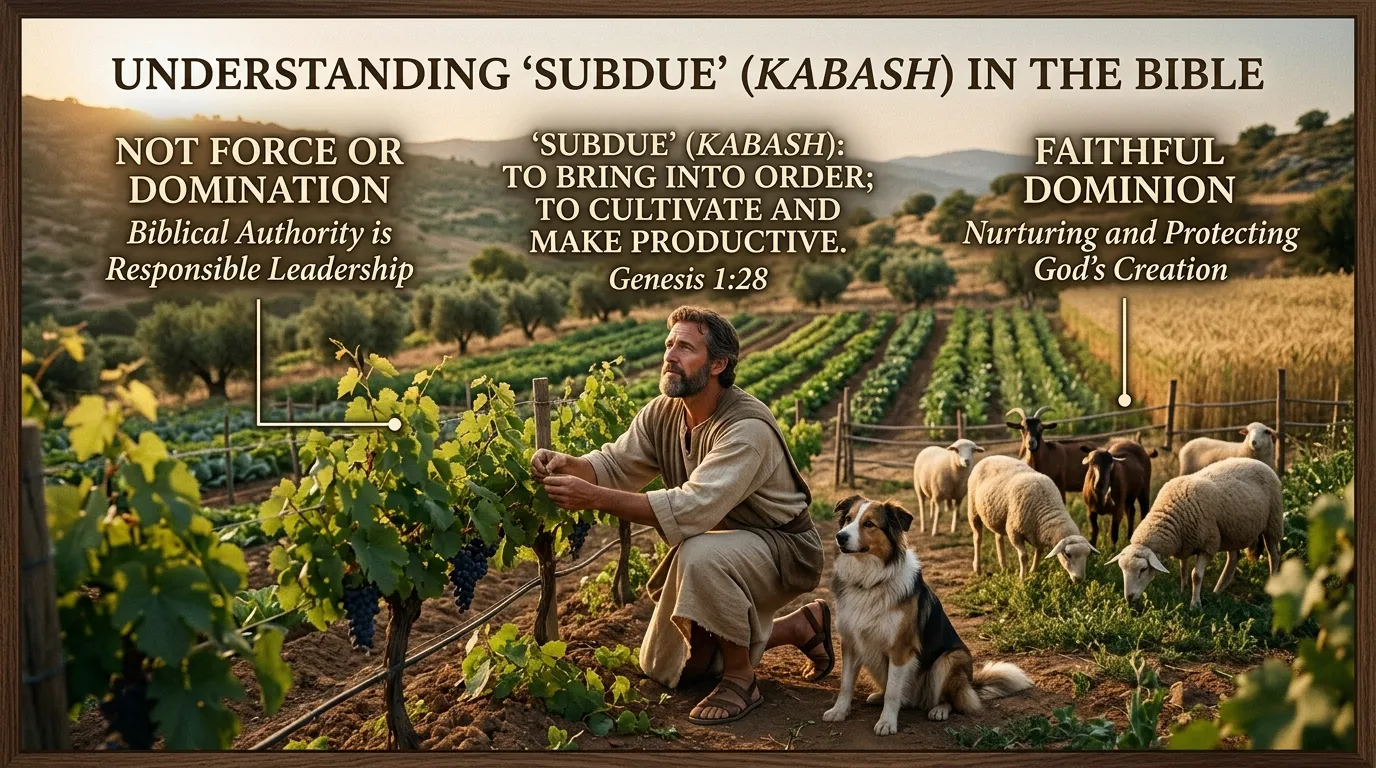
It is the first job description ever given to humanity, and it contains one of the Bible’s most misunderstood words: “Be fruitful and multiply and fill the earth and subdue it, and have dominion over the fish of the sea and over the birds of the heavens and over every living thing that moves on the earth” (Genesis 1:28). Subdue. The word sounds like conquest — and in the wrong hands, it has licensed exploitation. But in Hebrew, in context, and in the full counsel of Scripture, “subdue” turns out to mean something far nobler: the royal stewardship of a gardener-king, not the plunder of a tyrant.
Kabash: What the Hebrew Word Actually Means
The Hebrew verb is kabash — to bring into subjection, to tread down, to master. It is a strong word, used elsewhere for subduing enemies (Zechariah 9:15) and even for forced labor (Jeremiah 34:11). But words take their moral color from their context, and the context of Genesis 1:28 is decisive: the verse sits inside a creation that God has just called “very good” (Genesis 1:31), and the humans commanded to subdue it are themselves made “in the image of God” (Genesis 1:27).
That image-bearing is the key. In the ancient Near East, kings placed statues of themselves in distant territories to mark their rule. Genesis presents humanity as God’s living statues — His representatives, exercising His kind of rule over creation. And what is God’s kind of rule? The creation account shows a God who orders, fills, blesses, and delights — who makes gardens, not strip mines. To subdue the earth as God’s image-bearer means to bring creation’s potential to fruition under His character: cultivating, ordering, protecting, and developing the world the way its Maker would.
Genesis 2:15 confirms it: the man was put in the garden “to work it and keep it” — keep being the same word used for the priests’ guardianship of the tabernacle. Humanity’s first occupation was priestly gardening: serving and guarding sacred space. Subduing the earth was never a license to wreck it; it was a commission to unfold it.
Dominion vs. Domination: The Line Scripture Draws
History shows what happens when kabash is severed from the image of God: dominion curdles into domination. The same word used for humanity’s noble commission is used for harsh enslavement elsewhere — proof that subduing can be done wickedly. The Bible’s verdict on exploitative rule is unsparing. The prophets thunder against shepherds who feed themselves instead of the flock (Ezekiel 34), against land-grabbers who “join house to house” until the poor have nowhere to live (Isaiah 5:8), against all who treat creation and fellow creatures as mere raw material for appetite.
Jesus redefined greatness itself along these lines: “The rulers of the Gentiles lord it over them… But whoever would be great among you must be your servant” (Matthew 20:25-26). If that is true of human authority, how much more of our authority over the non-human world? The dominion of Genesis 1 is stewardship: the strong serving the flourishing of the weak, the knowledgeable ordering the world for the good of all. A tyrant extracts; a steward cultivates. The earth is the Lord’s (Psalm 24:1); we are its tenants, and tenants answer to the Owner.
This reframes modern debates entirely. Care for creation is not a political platform; it is a creation ordinance, older than Israel, older than the church — given to humanity as such. And human dignity is not an obstacle to that care; it is its foundation. We subdue because we are royal, and we subdue gently because we are God’s.
Subduing the Inner Wilderness
Scripture turns the word inward too. If humanity is to subdue the earth, it must first subdue itself — for an unmastered soul masters nothing well. Paul describes the discipline bluntly: “I discipline my body and keep it under control” (1 Corinthians 9:27) — literally, subdue it — lest the preacher be disqualified. The appetites, the temper, the wandering eye, the undisciplined tongue: these are the inner territories awaiting a godly kabash.
The promise is that we do not do this alone. Micah 7:19 gives one of Scripture’s most beautiful reversals: God Himself “will again have compassion on us; he will tread our iniquities underfoot [subdue our iniquities].” The God who commanded us to subdue the earth stoops to subdue our sins — treading down the very things we cannot. And the New Testament’s climax: Christ “must reign until he has put all his enemies under his feet” (1 Corinthians 15:25), until every rebellion — cosmic and personal — is subdued under His gracious rule (Hebrews 2:8).
The Groaning Creation: What Subduing Looks Like Now
Genesis 1:28 was given before the fall; we live after it. And Paul describes the creation we actually steward: “the creation was subjected to futility… the whole creation has been groaning together in the pains of childbirth until now” (Romans 8:20-22). The world we are commanded to subdue is a wounded world — thorns in the soil (Genesis 3:18), disasters in the news, decay in every system. Subduing, in the present age, is not the triumphant ordering of a perfect garden; it is triage in a field hospital: binding, healing, restoring, awaiting the day when the work is finished.
This is why Christian stewardship has a groaning quality — hope mixed with grief. We plant trees whose shade we won’t enjoy. We clean rivers that will dirty again. We fight diseases that mutate. And we do it anyway, because the groaning is “the pains of childbirth” — not death throes but birth pangs. Something is coming: “the creation itself will be set free from its bondage to corruption and obtain the freedom of the glory of the children of God” (Romans 8:21). Every act of faithful subduing now — every garden tended, every injustice opposed, every wound bound — is a rehearsal for the restored creation, a small “yes” to the future God has promised.
And we groan with it: “we ourselves, who have the firstfruits of the Spirit, groan inwardly as we wait eagerly for adoption as sons, the redemption of our bodies” (Romans 8:23). The subduer is also a sufferer; the steward also needs redemption. This keeps stewardship humble: we are not saviors of the planet but fellow patients in the ward, doing our appointed work while awaiting the Great Physician’s final cure. The dominion of Genesis 1 will be fully realized only when Christ returns and “the earth will be filled with the knowledge of the glory of the LORD as the waters cover the sea” (Habakkuk 2:14) — subdued at last, completely, by love.
Until then, we subdue as heirs, not as owners — “heirs of God and fellow heirs with Christ” (Romans 8:17), tending the estate until the Estate-Master returns. That identity changes the tone of all our work: no frantic grasping (it’s His), no despairing abandonment (it’s promised), just faithful, hopeful stewardship — subduing in the strength He supplies, toward the restoration He guarantees.
The Subdued Life: What It Looks Like
So what does a person living out Genesis 1:28 look like on an ordinary week? They work with excellence — developing skills, building, creating, ordering chaos into beauty, whether in a laboratory, a kitchen, or a classroom. Human work is subduing in miniature: bringing form to the formless.
They treat creation as a trust — using resources wisely, wasting little, caring for animals (Proverbs 12:10 — “the righteous cares for the life of his animal”), leaving places better than they found them. Not worshiping nature, which is idolatry, but honoring it as the Owner’s handiwork.
They master themselves — bringing appetites, emotions, and habits under the Spirit’s control, so that the inner kingdom is ordered before they attempt the outer one. The person who cannot subdue his temper will not subdue anything else well.
They serve the flourishing of others — because dominion in God’s image is always for someone. The parent subduing chaos into a peaceful home, the teacher subduing ignorance into understanding, the leader subduing disorder into justice — all are exercising the first commission.
Does “subdue the earth” justify environmental exploitation?
No — it forbids it. Exploitation treats creation as disposable; subduing in God’s image treats it as entrusted. The same Bible that commands subduing also commands Sabbath rest for the land (Leviticus 25), kindness to animals (Deuteronomy 25:4), and warns that God will “destroy the destroyers of the earth” (Revelation 11:18). Dominion is stewardship, and stewards give account.
What about subduing enemies or spiritual forces?
Scripture does use subduing language for victory over evil — God subdues our iniquities (Micah 7:19), Christ subdues all enemies (1 Corinthians 15:25-28). But note the agent: God does the ultimate subduing; our warfare is spiritual and defensive in posture (Ephesians 6), fought with truth and prayer, never with coercion of conscience. We subdue sin in ourselves by the Spirit; God subdues evil in the world by the Son.
From the garden to the kingdom, “subdue” has always meant the same thing: bring order, fruitfulness, and flourishing under God’s gracious rule — in the world, in the soul, and one day, in all things. For the theological framework behind this stewardship, see stewardship (theology).










