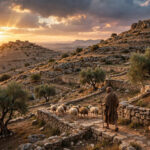
Every December, billions of people celebrate a birthday the Bible never dates, with customs the Bible never commands, on a day the Bible never names. And yet Christmas may be the most biblically grounded celebration in the world — because while Scripture is silent about December 25th, it is thunderous about what happened: “For unto you is born this day in the city of David a Savior, who is Christ the Lord” (Luke 2:11). The honest question is not whether Christmas is “biblical” in every detail, but what the Bible actually says about Christ’s birth — and what to do with the rest. That requires separating history from hearsay with a clear head and a glad heart.
What Scripture Actually Says (and Doesn’t)
The Bible gives us two birth narratives — Matthew 1-2 and Luke 1-2 — and both are theologically rich and chronologically spare. We learn of the virgin conception (Matthew 1:18-25; Luke 1:26-38), the journey to Bethlehem fulfilling Micah 5:2, the manger because there was no room in the inn (Luke 2:7), the angels’ announcement to shepherds (Luke 2:8-14), and the Magi’s later visit to the house (Matthew 2:11 — note: house, not stable; the Magi came months later, which is why Herod targeted boys two years old and under).
What we do not get: a date, a season, or a command to commemorate the birth annually. The shepherds were “keeping watch over their flock by night” (Luke 2:8), which some take as evidence against a winter date — though shepherds in that climate could be out in winter too. The honest answer is we don’t know when Jesus was born. The early church didn’t celebrate His birth at all for the first two centuries; Easter (the resurrection) was the original Christian feast. Christmas as a December 25 festival emerged in the 300s.
This silence is not a problem to solve but a perspective to keep. Scripture’s emphasis falls overwhelmingly on Christ’s death and resurrection, not His birthday. The birth matters infinitely — “the Word became flesh and dwelt among us” (John 1:14) — but the Bible treats it as the beginning of the rescue, not the whole of it. A Christmas that majors on the manger and minors on the cross has inverted the New Testament’s proportions.
December 25th: How the Date Happened
Why December 25? The popular claim — repeated endlessly online — is that Christians simply baptized the pagan festival of Saturnalia or the birthday of the sun god (Sol Invictus). The truth is more nuanced, and honesty requires the nuance.
First, the chronology is awkward for the simple “stolen holiday” theory: the earliest evidence for a December 25 celebration of Sol Invictus dates to after Christians were already associating the date with Christ’s birth. Second, an ancient Christian tradition computed the date theologically: early Christians believed the great prophets died on the same calendar date as their conception, and an old tradition placed Christ’s conception (and crucifixion) on March 25 — nine months later is December 25. Whether or not the reasoning convinces us, it shows Christians choosing the date for christological reasons, not merely copying pagans.
That said, the broader point stands: as Christmas spread through the Roman world, it absorbed surrounding midwinter customs — feasting, lights, greenery. Cultures always dress new celebrations in familiar clothes. The question for Christians was never “did any custom have a non-Christian origin?” (many did) but “does the celebration now honor Christ?” A wedding ring has pagan roots; no one suggests married Christians are idolaters. Meaning is determined by current use and intent, not ancient etymology.
The Pagan-Roots Claim: A Balanced Verdict
Let’s be forthright: some Christmas customs do have pre-Christian origins. Evergreens, Yule logs, and midwinter feasting predate the church’s December festival in northern Europe. The church, as it evangelized those peoples, often redirected rather than abolished their customs — filling old forms with new meaning, the way a missionary today might use a local musical style for worship songs.
But three cautions keep this honest. First, a pagan origin does not equal a pagan meaning today. Nobody lighting a Christmas tree is worshiping Thor; intent and understanding define the act. Second, many “pagan origins” claims circulating online are historically shaky — repeated without sources, exaggerated, or simply invented. Christians should not outsource their history to memes. Third, the New Testament itself gives the principle: “One person esteems one day as better than another, while another esteems all days alike. Each one should be fully convinced in his own mind. The one who observes the day, observes it in honor of the Lord” (Romans 14:5-6). Paul refuses to bind consciences on calendar observances. The brother who celebrates Christmas unto the Lord and the brother who abstains unto the Lord are both accepted — and commanded not to despise each other.
What Christmas Is Actually For
Strip away the debates, and the biblical core of Christmas is staggering. God kept His promise. The birth fulfills Isaiah 7:14 (the virgin), Isaiah 9:6 (“unto us a child is born… and his name shall be called Wonderful Counselor, Mighty God”), and Micah 5:2 (Bethlehem) — prophecies spanning seven centuries, all landing in a manger. Christmas is proof that God does what He says, on a timescale that tests faith and rewards it.
God came low. The Creator entered creation as a helpless infant, announced first not to emperors but to shepherds — the working poor of Judea. “Glory to God in the highest, and on earth peace among those with whom he is pleased!” (Luke 2:14). The gospel’s social logic is set at the manger: heaven’s King identifies with earth’s lowly.
God gave. “For God so loved the world, that he gave his only Son” (John 3:16). Every gift under every tree is a dim echo of the Gift in the manger. Christian generosity at Christmas is not consumerism baptized; it is theology enacted — we give because He gave.
God arrived on schedule. “When the fullness of time had come, God sent forth his Son” (Galatians 4:4). Christmas declares that history is not random; it is ruled, timed by a Father’s wisdom down to the census of Caesar Augustus (Luke 2:1).
Keeping the Center: A Christmas Rule of Life
How does a Christian celebrate Christmas without losing it — neither to consumer frenzy nor to joyless suspicion? Consider a simple rule of life for the season, built on the biblical core:
Begin with the story, not the shopping. Read Luke 2 aloud as a household before the presents, the way the church has done for centuries. Let the angels speak first. Everything else — tree, table, gifts — becomes commentary on the text rather than replacement of it.
Give like the Magi, not like the mall. The wise men’s gifts were worship before they were presents — gold for a King, frankincense for God, myrrh for the Man who would die (Matthew 2:11). Let at least one gift this Christmas be pure worship: a generous donation to the poor, given secretly (Matthew 6:3-4); a present for someone who cannot repay you. “It is more blessed to give than to receive” (Acts 20:35) is never truer than in December.
Make room — literally. There was no room in the inn (Luke 2:7); see that there is room at your table. Invite the lonely student, the widowed neighbor, the family far from home. Christmas hospitality is incarnation in miniature: making space for the outsider, as God made space for us.
Sing the theology. The church’s carols are doctrinal vaults — “Veiled in flesh the Godhead see,” “Word of the Father, now in flesh appearing.” Sing them thoughtfully, and let children ask what the strange old words mean. A carol explained is a catechism lesson that feels like joy.
End with the cross in view. The manger’s shadow is the cross — the myrrh hinted at burial, Herod’s rage previewed rejection. A Christmas that never glances toward Good Friday is unfinished. Let December’s joy be informed joy: He was born to die, and He died to rise. That is why the angels could say “good news of great joy.”
Should Christians celebrate Christmas if the date is uncertain?
The date’s uncertainty is irrelevant to the celebration’s legitimacy. We celebrate people on days chosen for convenience all the time; what matters is who we honor and how. Celebrate the incarnation with Scripture, worship, generosity, and joy — and the date becomes what it always was: a servant of the feast, not its master.
How should I respond to “Christmas is pagan” claims?
With honesty and grace. Acknowledge what is true (some customs have pre-Christian roots; the date is traditional, not revealed), correct what is exaggerated (most viral claims are historically weak), and point to Romans 14: each conscience before God. Never let the debate eclipse the proclamation: unto you is born a Savior.
Christmas, rightly kept, is not about a date on a calendar or customs on a tree. It is about the day heaven’s promise became earth’s reality — the Word made flesh, the Savior born, the light shining in the darkness that the darkness has not overcome (John 1:5). For the full history of the feast, see Christmas.