Have you ever felt like you were walking through a dry season in life? You pray, but answers seem slow. You try to move forward, but the path feels empty and uncertain. The Bible often uses wilderness places to help us understand seasons like these.
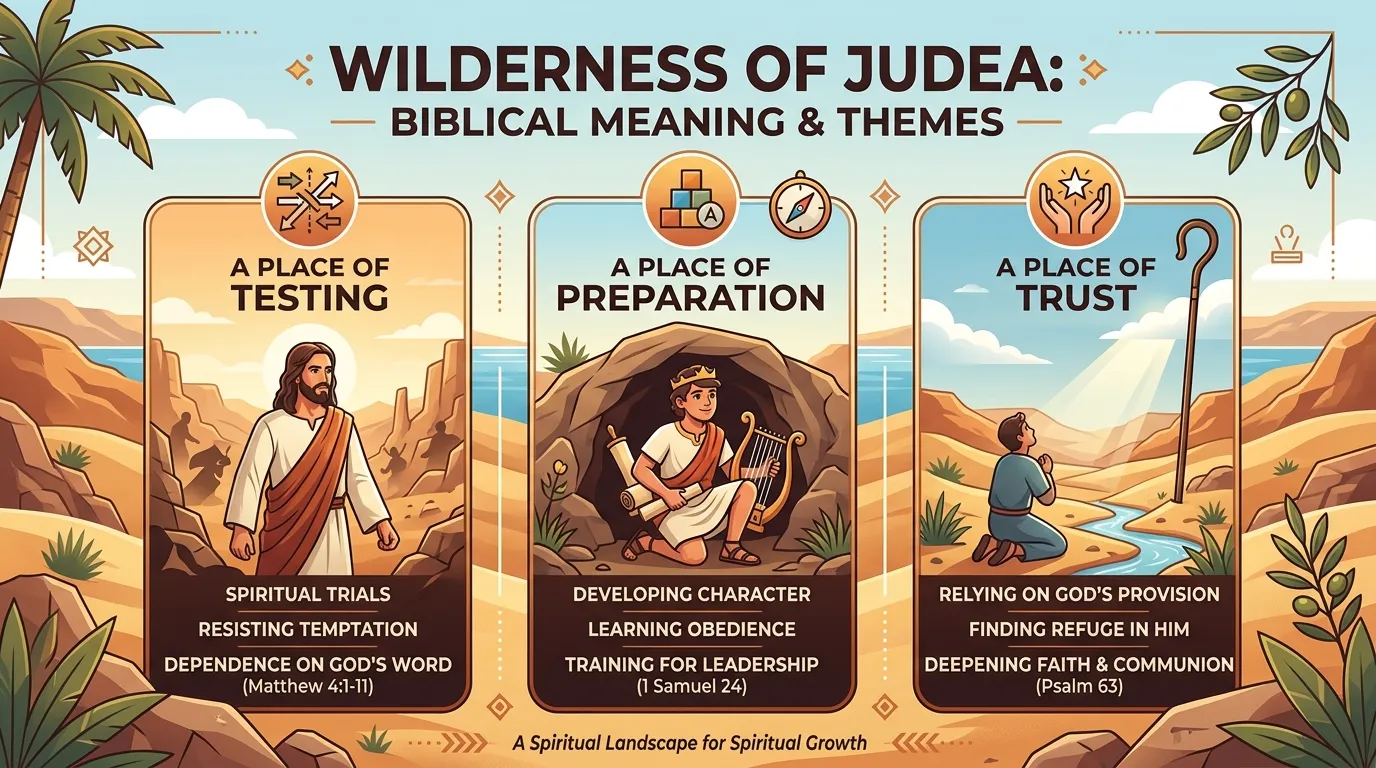
The Wilderness of Judea meaning in the Bible is closely connected with testing, preparation, repentance, dependence on God, and spiritual renewal. It was a real, rugged region near Jerusalem and the Jordan River, but Scripture also gives the wilderness an important spiritual setting.
Most importantly, the Bible does not teach that every difficult season has one hidden meaning. Instead, the stories of the wilderness show us how God can meet people in hard places and teach them to trust Him.
What Is the Wilderness of Judea in the Bible?
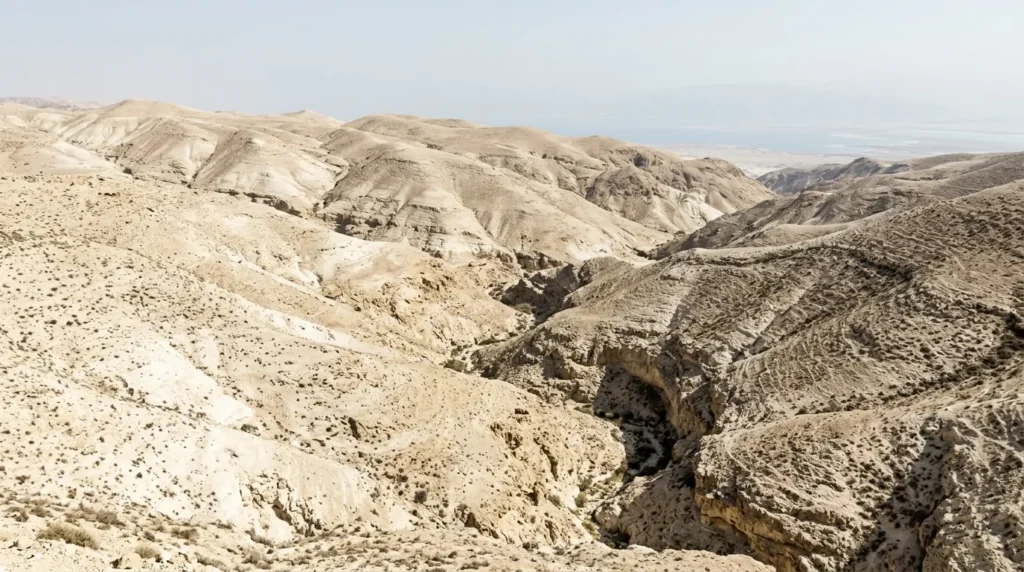
The Wilderness of Judea was a dry, rocky region in the area of Judea. It stretched along the eastern side of the Judean hills toward the Dead Sea and Jordan Valley.
The area was not a lush forest. It had rough land, steep slopes, caves, rocks, and very little water. It was a fitting place for solitude and hardship.
The wilderness is especially important in the New Testament because John the Baptist preached there, and Jesus was tempted in the wilderness.
Matthew 3:1 says that John the Baptist came preaching in the wilderness of Judea. His message was simple and powerful:
“Repent, for the kingdom of heaven is at hand.”
John prepared people for the coming ministry of Jesus. His location in the wilderness also connects with Isaiah’s prophecy about a voice crying in the wilderness (Isaiah 40:3).
So, biblically, the Wilderness of Judea was more than an empty landscape. It became the setting for a message of repentance, preparation, and God’s coming salvation.
Wilderness of Judea Hebrew Meaning
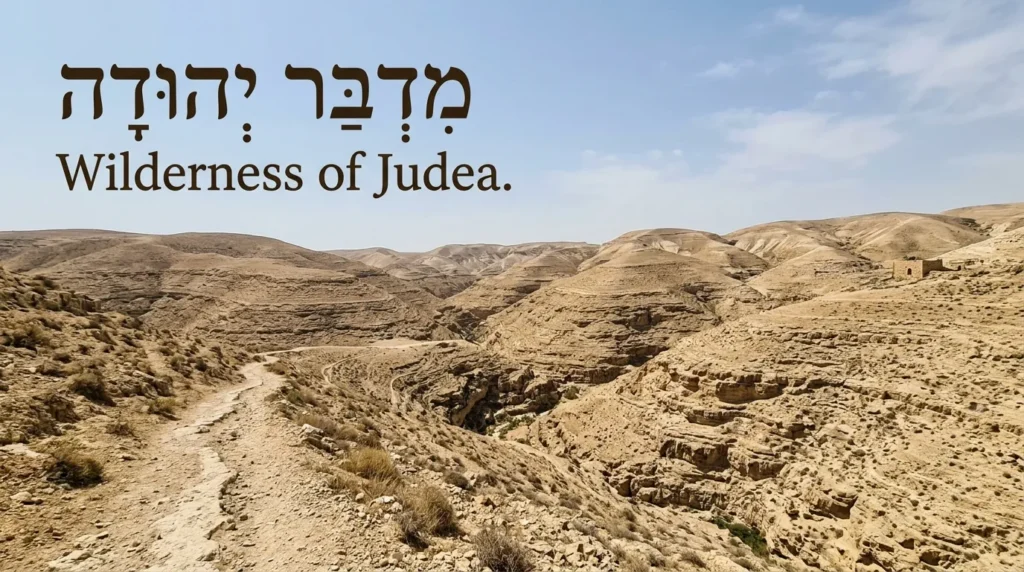
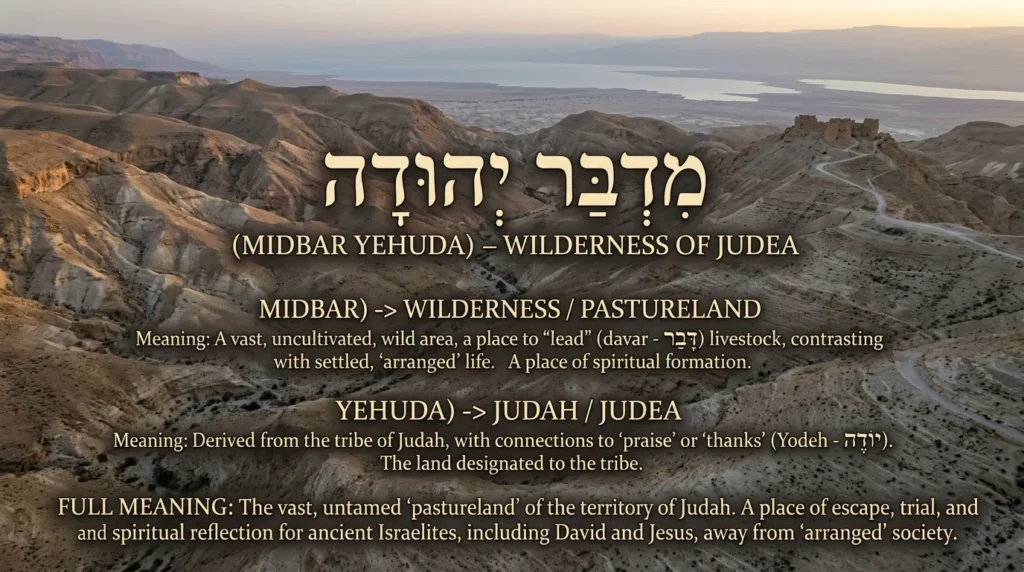
The phrase Wilderness of Judea is translated from biblical terms connected with the Hebrew idea of a wilderness or desert region.
The Hebrew word commonly associated with “wilderness” is midbar (מִדְבָּר). It can refer to a wilderness, desert, or open, uncultivated land. It does not always mean a completely empty place with no life.
The word midbar appears many times in the Old Testament. It describes places where people lived, traveled, wandered, worshiped, and encountered God.
The word “Judea” refers to the region associated with Judah and, later, the southern part of the land of Israel.
Therefore, the basic idea behind the phrase is:
The Wilderness of Judea was a wilderness region in Judea where important biblical events took place.
The Hebrew meaning itself does not prove that every wilderness experience has a secret spiritual message. Christians should be careful not to turn a geographic name into a mystical formula.
Instead, Scripture gives the place meaning through the events that happened there.
The Wilderness of Judea and John the Baptist
One of the clearest biblical connections is John the Baptist.
Matthew 3:1–3 introduces John as a preacher in the Wilderness of Judea. He called people to repentance because God’s kingdom was near.
John’s ministry fulfilled the words of Isaiah 40:3:
“The voice of one crying in the wilderness: ‘Prepare the way of the Lord.’”
John’s message was not about the wilderness itself. His message was about preparing hearts for Christ.
People came from Jerusalem, Judea, and surrounding areas to hear him. Many confessed their sins and were baptized in the Jordan River.
This gives the Wilderness of Judea an important biblical theme:
God can use quiet and unlikely places to prepare people for His work.
John did not need a palace or a famous platform. His ministry began in a wilderness.
That can encourage Christians today. Your current surroundings may seem ordinary, difficult, or even lonely. Yet God does not need impressive circumstances to accomplish His purposes.
Jesus in the Wilderness of Judea
The wilderness becomes even more significant when Jesus enters it.
After Jesus was baptized, Matthew 4:1 says that the Spirit led Him into the wilderness to be tempted by the devil.
Jesus fasted for forty days and nights. He then faced three major temptations.
Satan challenged Jesus concerning:
- Physical hunger
- Trust in God’s protection
- Power and worship
Jesus answered each temptation with Scripture.
For example, when Satan tempted Him to turn stones into bread, Jesus replied from Deuteronomy:
“Man shall not live by bread alone, but by every word that comes from the mouth of God.” — Matthew 4:4
Jesus’ response shows that obedience to God is more important than satisfying an immediate desire.
The wilderness was therefore a place of testing, but it was not a place where Jesus was abandoned by God.
That distinction matters.
A difficult season does not automatically mean God has rejected you.
What Does the Wilderness Represent Spiritually?
The Bible does not give one universal symbolic definition for every wilderness experience. However, several themes appear clearly in Scripture.
Testing of Faith
Jesus’ wilderness experience involved testing.
Likewise, Israel’s wilderness journey tested its faith and obedience. Deuteronomy 8:2 explains that God led Israel through the wilderness to humble and test them and to reveal what was in their hearts.
This does not mean God enjoys making His people suffer.
Rather, Scripture shows that difficult circumstances can reveal where we place our trust.
A person may discover during a hard season:
“I have been depending more on my circumstances than on God.”
That realization can become the beginning of deeper faith.
Preparation for a New Season
John the Baptist’s wilderness ministry prepared people for Jesus.
Jesus’ wilderness experience came before His public ministry began.
This gives the wilderness a strong biblical picture of preparation.
Sometimes Christians look at a waiting season and think nothing is happening.
But preparation can happen quietly.
You may be learning patience before a new responsibility. You may be growing in wisdom before making an important decision. You may be learning to pray before stepping into something unfamiliar.
We should not automatically claim that every delay is preparation for a specific future event. Scripture does not promise that.
But Scripture does show that God can work deeply in seasons that feel hidden.
Dependence on God
The wilderness often exposes human weakness.
There is little comfort in a desert. Water may be scarce. Food may be limited. The surroundings can remind us that we cannot control everything.
Israel learned this lesson through God’s provision of manna.
Deuteronomy 8:3 explains that God allowed Israel to hunger and then fed them with manna so they would learn that people do not live by bread alone.
The lesson was deeper than food.
Human beings need God.
That truth remains important today.
Repentance and Spiritual Renewal
John’s message in the Wilderness of Judea was a call to repent.
Repentance means turning away from sin and turning toward God.
Therefore, when Scripture connects the wilderness with John’s ministry, it reminds us that difficult or quiet places can become opportunities to examine our hearts.
A wilderness season can lead a Christian to ask:
- Am I obeying God?
- Have I allowed sin to become normal?
- Have I stopped praying?
- Do I trust God even when I cannot see the outcome?
- Is there something I need to surrender?
These questions can lead to healthy spiritual growth.
Is the Wilderness of Judea a Symbol of Loneliness?
It can be tempting to see the wilderness only as a picture of loneliness.
The Bible does show people experiencing isolation in wilderness settings. John lived and ministered in a remote environment, and Jesus spent time alone there.
However, the wilderness does not always mean loneliness.
Jesus was physically alone during His temptation, but He was not separated from God.
This is an important distinction for Christians.
You might feel alone without actually being abandoned.
A Christian going through a lonely season can remember God’s promise in Hebrews 13:5:
“I will never leave you nor forsake you.”
Your feelings are real, but they do not have the final word about God’s presence.
Wilderness of Judea Meaning in Dreams
Some people search for the Wilderness of Judea meaning in a dream because they have dreamed about deserts, rocks, dry places, or biblical landscapes.
A Christian should approach such dreams carefully.
The Bible contains dreams and visions through which God sometimes communicated with people. However, Scripture does not teach that every dream carries a divine message.
Dreams can also come from daily experiences, emotions, memories, stress, fears, or ordinary brain activity during sleep.
If you dream about the Wilderness of Judea, you can use it as an opportunity for personal reflection without immediately declaring, “God is telling me this.”
Ask yourself:
- What emotions did I experience in the dream?
- Am I currently facing a difficult season?
- Am I waiting for an answer from God?
- Is there an area where I need greater trust?
- Does anything I believe the dream means agree with Scripture?
Scripture must remain the standard for Christian belief.
If an interpretation contradicts God’s Word, the interpretation should be rejected.
What Does It Mean to Go Through a Spiritual Wilderness?
Christians sometimes use the phrase spiritual wilderness to describe a season when God feels distant or life feels unusually difficult.
This phrase can be useful, but it should not become an excuse for assuming that God has a secret plan that we can automatically identify.
A spiritual wilderness may involve:
- A season of waiting
- Unanswered questions
- Major life changes
- Loss or disappointment
- A struggle with doubt
- A need for repentance
- A period of spiritual growth
- Learning deeper dependence on God
The Bible gives us examples of people who experienced hardship without suggesting that every hardship had the same purpose.
That gives us room for humility.
Sometimes we know why something happened. Sometimes we do not.
Yet we can still trust God’s character.
What Can Christians Learn From the Wilderness of Judea?
The Wilderness of Judea offers several practical lessons for everyday Christian life.
God Can Meet You in Hard Places
God’s presence is not limited to comfortable places.
John preached in the wilderness. Jesus endured temptation there. Israel experienced God’s provision in the wilderness.
Your difficult circumstances do not prevent God from working.
You may be sitting in a hospital waiting room, searching for work, raising children through a hard season, dealing with disappointment, or simply waiting for clarity.
God is still God in the wilderness.
Do Not Let Hunger Make Your Decisions
Jesus was hungry when Satan tempted Him.
The temptation appealed to an immediate physical need, but Jesus refused to place His desires above God’s will.
We face similar choices.
We may be tempted to make a rushed decision because we are lonely, angry, afraid, or desperate.
The wilderness teaches us to pause.
A strong desire does not automatically make something God’s will.
Use Scripture When You Are Tested
Jesus answered temptation with God’s Word.
This does not mean quoting Bible verses as a magical formula. It means knowing God’s truth and allowing it to shape our choices.
For example, when fear says, “You are alone,” Scripture reminds us of God’s presence.
When temptation says, “You must have this now,” Scripture reminds us to obey God.
When discouragement says, “There is no hope,” Scripture points us toward God’s faithfulness.
Waiting Does Not Mean Wasted Time
The wilderness can feel unproductive.
Yet Scripture shows that important preparation happened in wilderness settings.
If you are waiting, continue doing what God has clearly called you to do.
Pray.
Read Scripture.
Serve others.
Seek wise counsel.
Repent when needed.
Remain faithful in small things.
You do not need to understand everything before you can obey God today.
The Wilderness and God’s Provision
One of the strongest biblical wilderness themes is God’s provision.
Israel experienced hunger and received manna. They experienced thirst and saw God provide water.
The wilderness did not teach Israel that they would never face hardship.
It taught them that God could sustain them through hardship.
This is a helpful distinction.
Faith does not mean believing that life will always be easy.
Faith means trusting God even when life is not easy.
Philippians 4:19 reminds believers that God supplies their needs according to His riches in Christ Jesus.
This does not promise that Christians will receive every material desire.
Instead, it encourages confidence in God’s faithful care.
How Should You Pray During a Wilderness Season?
If you feel like you are in a spiritual wilderness, your prayer does not need to be complicated.
You can pray honestly:
“Lord, I do not understand this season, but I choose to trust You. Show me what I need to learn, protect me from temptation, and help me remain faithful to Your Word. Give me wisdom for today and strength for tomorrow. Amen.”
You can also pray through Scripture.
Psalm 23 is especially comforting because it reminds us that God’s care continues even through dark valleys.
The goal is not to force yourself to feel strong.
The goal is to bring your weakness honestly before God.
Frequently Asked Questions
What is the Wilderness of Judea in the Bible?
The Wilderness of Judea was a dry and rugged region in Judea. It is especially connected with John the Baptist’s preaching and Jesus’ temptation.
What does the Wilderness of Judea symbolize?
Biblically, its stories connect it with themes such as repentance, preparation, testing, obedience, and dependence on God. Christians may also use “wilderness” to describe difficult spiritual seasons, but Scripture does not give one meaning for every wilderness experience.
Why did John the Baptist preach in the Wilderness of Judea?
John preached there as part of his prophetic ministry preparing people for the coming Messiah. Matthew 3 connects his ministry with Isaiah’s prophecy about a voice crying in the wilderness.
Why did Jesus go into the wilderness?
Matthew 4:1 says the Spirit led Jesus into the wilderness, where He was tempted by the devil. Jesus responded to each temptation with obedience and Scripture.
Does the wilderness always mean a difficult season?
No. The Bible uses wilderness settings in different ways. Although they can involve hardship and testing, the meaning depends on the specific biblical passage.
What does dreaming about a wilderness mean spiritually?
A dream about a wilderness does not automatically have a divine meaning. Christians can reflect on the emotions and circumstances involved, but any spiritual interpretation should be tested against Scripture rather than treated as certain revelation.
Is God with me when I am in a spiritual wilderness?
Yes. Scripture repeatedly teaches God’s presence and faithfulness. A difficult season is not proof that God has abandoned you.
Final Thoughts
The Wilderness of Judea meaning in the Bible becomes clearer when we look at the people and events connected with it.
John the Baptist preached repentance there.
Jesus faced temptation there.
Israel’s wilderness journey showed the importance of trusting God’s provision.
Together, these stories remind us that wilderness seasons can expose our weakness, strengthen our dependence, and prepare our hearts for faithful obedience.
But we should also remain humble. The Bible does not say that every hardship has one specific hidden meaning. We do not need to invent an explanation when Scripture has not given one.
What we can know is this: God is faithful.
If you are in a season that feels dry, lonely, confusing, or uncertain, bring that season to Him. Open His Word. Pray honestly. Seek wise Christian counsel. Refuse temptation. Keep doing what is right, even when you cannot see the outcome.
The wilderness may feel empty, but God’s presence is not empty.
You may not know what God is doing in your wilderness, but you can know the God who walks with you through it.
Take time today to pray, reflect on Scripture, and place your unanswered questions in God’s hands. Trust Him one step at a time. His grace is enough for today’s journey, and His wisdom is greater than what we can see.