Walk through the New Testament from Matthew to Revelation and the temple keeps changing shape. In the Gospels it is a building of stone in Jerusalem, crowded with pilgrims, merchants, priests, and a money changers’ tables. By the letters it has become something else entirely: the people of God themselves. By Revelation it has disappeared from the picture altogether, because God’s presence no longer needs a house. Following that journey is the key to understanding what the temple means in the New Testament — not as a single fixed symbol, but as a reality that moves from a place, to a person, to a people, and finally to a promise.
A building at the center of Jewish life
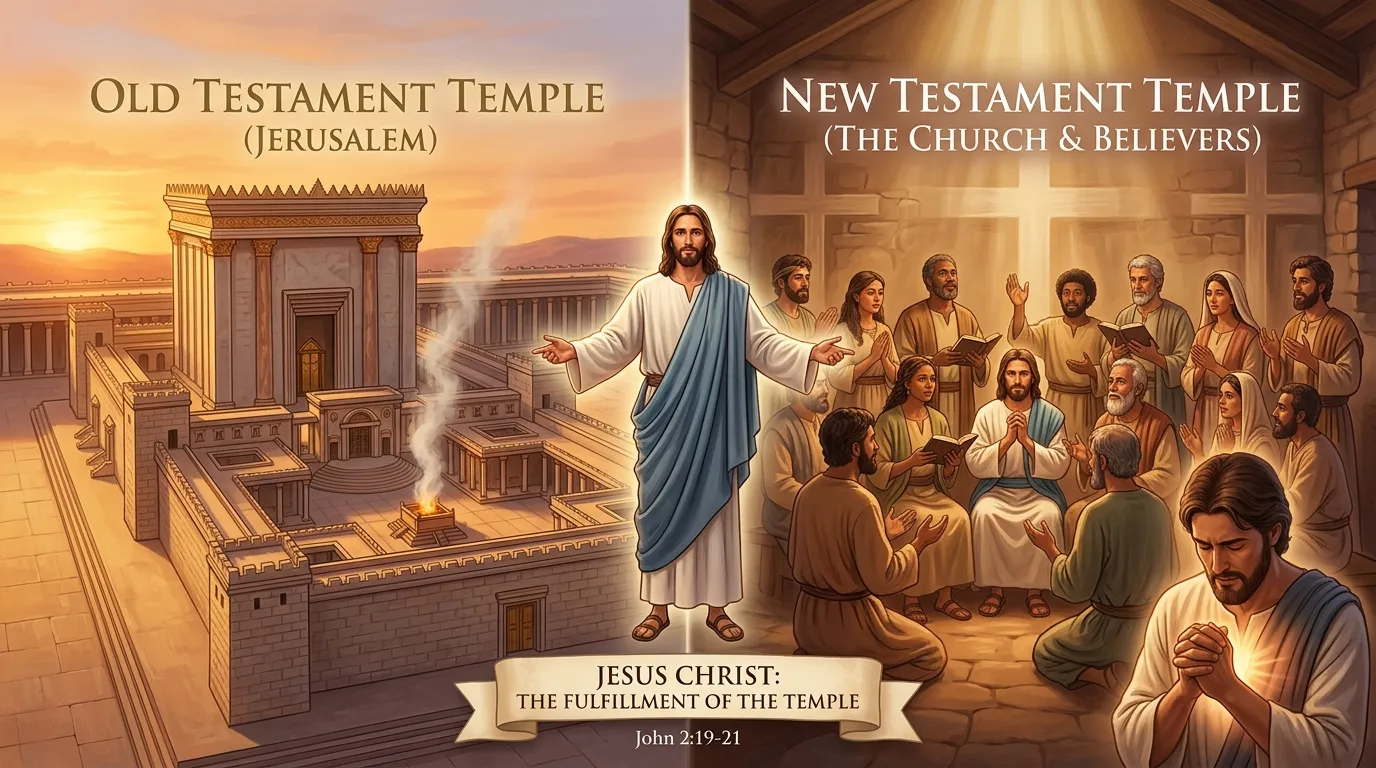
The temple in the New Testament is Herod’s temple, the massive reconstruction of the post-exilic sanctuary that Herod the Great began around 20 BC and that was still being finished during Jesus’ ministry (John 2:20). It dominated Jerusalem. Its white stone and gold ornament could be seen for miles. Its courts drew pilgrims from across the Roman world for Passover, Pentecost, and Tabernacles. Its priests offered daily sacrifices, and its inner rooms — the Holy Place and the Holy of Holies — represented God’s dwelling among His people.
The Gospels treat the temple as a real, functioning institution, not as a backdrop. Mary and Joseph bring the infant Jesus there for dedication (Luke 2:22–38). At twelve, Jesus stays behind in the temple, listening to the teachers and asking questions (Luke 2:41–52). As an adult He teaches in its courts, debates its authorities, and observes a widow giving two small coins (Mark 12:41–44). The temple is where Jewish life happens, and Jesus is at home in it — which makes His confrontations there all the more striking.
Jesus confronts the temple
Twice the Gospels show Jesus disrupting the temple’s commerce. Early in John’s Gospel and again in the final week, He drives out the sellers and money changers and overturns their tables (John 2:13–17; Matthew 21:12–13). The problem was not trade itself — pilgrims needed animals for sacrifice and currency for the temple tax — but the way commerce had crowded out prayer. Jesus quotes Isaiah: God’s house was to be “a house of prayer for all nations,” yet it had become “a den of robbers” (Mark 11:17). Worship had been bent toward profit, and the Gentile court, where the nations were meant to pray, was full of stalls.
When challenged, Jesus gives an answer that reframes everything: “Destroy this temple, and I will raise it again in three days” (John 2:19). His hearers think He means the stone building. John tells us He was speaking about “the temple of his body” (John 2:21). The claim is staggering. The place where God meets humanity is no longer a building; it is a person. And the proof will be resurrection.
Jesus also predicts the stone temple’s end. Standing on the Mount of Olives, looking across at the magnificent structure, He tells His disciples that not one stone will be left on another (Matthew 24:1–2). Within a generation, in AD 70, Roman armies destroyed it. The prediction matters because it shows that Jesus was not merely criticizing abuses in the temple system. He was announcing that the system itself had reached its appointed end.
The curtain torn: what happened at the cross
At the moment of Jesus’ death, Matthew records that the curtain of the temple was torn in two from top to bottom, the earth shook, and rocks split (Matthew 27:51). The curtain separated the Holy Place from the Holy of Holies, the innermost room where the high priest entered once a year. Its tearing was a theological announcement: the way into God’s presence, once restricted and mediated, was now open through Christ’s death. The direction matters — torn from top to bottom, as if by a hand from heaven, not by human hands below.
The writer of Hebrews unfolds the meaning. Jesus is the great high priest who entered the true Holy Place, “not made with hands,” by His own blood, securing eternal redemption (Hebrews 9:11–12). The sacrifices of the old temple could never finally take away sin; they pointed forward to the one sacrifice that could. The temple’s rituals were shadows; Christ is the substance (Colossians 2:17). Christians do not need a priesthood of the old order or an altar in Jerusalem, because the once-for-all offering has been made.
Pentecost: the presence moves house
Fifty days after the resurrection, at the feast of Pentecost, the Holy Spirit falls on the disciples gathered in Jerusalem (Acts 2). The signs recall the temple’s dedication in Solomon’s day — fire, wind, the filling of a house with glory — but now the glory fills people, not a building. From this point on, the New Testament consistently calls believers God’s temple. “Don’t you know that you yourselves are God’s temple and that God’s Spirit dwells in your midst?” Paul asks the Corinthians (1 Corinthians 3:16). Peter describes believers as “living stones” being built into a spiritual house (1 Peter 2:5).
This is not metaphorical decoration. It changes how Christians think about worship, holiness, and community. Worship is no longer tied to pilgrimage; Jesus told the Samaritan woman that true worshipers would worship “in the Spirit and in truth,” not on this mountain or that (John 4:21–24). Holiness is no longer guarded by walls and curtains; it is expressed in how the community treats one another. And the community itself becomes the place where the world encounters God’s presence — or fails to, when the church is divided, as Paul warns the Corinthians.
Believers as the temple: what it requires
The temple image carries both comfort and warning. The comfort is that God is near. He does not wait in a distant shrine; He dwells in His people. The warning is that a temple is a holy place, and defiling it has consequences. Paul applies this directly to the Corinthian church: their divisions, their tolerance of sin, and their lawsuits against one another were not merely organizational problems. They were desecrations of the house God was building (1 Corinthians 3:17).
Paul also applies the image to the individual body: “Your bodies are temples of the Holy Spirit” (1 Corinthians 6:19). That is why sexual ethics, self-control, and care for the body are not side issues in the New Testament. They are temple matters. The God who once demanded that His house be kept holy now asks the same of the lives He inhabits.
Ephesians adds a corporate dimension. Jews and Gentiles, once separated by the temple’s dividing wall, are now built together into one dwelling (Ephesians 2:14–22). The old temple literally had a wall excluding Gentiles from the inner courts, with an inscription threatening death to trespassers. In Christ that wall is broken down. The new temple is not an ethnic monument; it is a multi-nation household.
Stephen and the temple made with hands
Before Paul ever used the temple image, Stephen did. Accused of speaking against the temple, Stephen retold Israel’s story and concluded with a pointed claim: “the Most High does not live in houses made by human hands” (Acts 7:48). The speech cost him his life, but its theology became the church’s. God had never been contained by a building. Solomon himself said so at the dedication: “Will God really dwell on earth? The heavens, even the highest heaven, cannot contain you. How much less this temple I have built!” (1 Kings 8:27). The temple was a sign of God’s presence, not a box for it. Stephen’s point was that Israel’s leaders had turned the sign into an idol — they trusted the building while rejecting the One it pointed to.
That warning still applies. Churches can treat their own buildings, traditions, and programs the way some in Jerusalem treated the temple: as guarantees of God’s favor. Stephen reminds us that God is not impressed by architecture. He is honored by hearts that receive His Son and lives that reflect His holiness. The temple’s greatest lesson may be that God’s presence was always meant to spill beyond its walls.
Revelation: a city with no temple
The temple thread ends where it must. In John’s vision of the new Jerusalem, he writes, “I did not see a temple in the city, because the Lord God Almighty and the Lamb are its temple” (Revelation 21:22). There is no temple because there is no longer any separation for a temple to mediate. God’s presence fills the whole city, and the nations walk by its light. The journey that began with a tent in the wilderness and a house on Mount Moriah ends with a world that is itself the Holy of Holies.
That ending guards Christians against two mistakes. The first is nostalgia — the idea that true worship requires returning to a building in Jerusalem. The second is carelessness — the idea that because God’s presence is everywhere, holiness no longer matters. Revelation holds both together: God will dwell with His people fully, and His people will be those who have washed their robes and kept His commands.
What the temple means for worship today
Christians do not need a temple, but they still need what the temple taught: reverence, sacrifice, and the nearness of God. Our worship can be reverent without being tied to a place. Our sacrifice is no longer animal offerings but “a living sacrifice” of ourselves (Romans 12:1) and “a sacrifice of praise” (Hebrews 13:15). And our confidence is that the God who once filled a house with glory now fills His people, wherever they gather — in a cathedral, a living room, or a prison cell.
For the wider history of the Jerusalem temple across the centuries, including its architecture and its fate after the New Testament period, see the Wikipedia article on the Temple in Jerusalem.