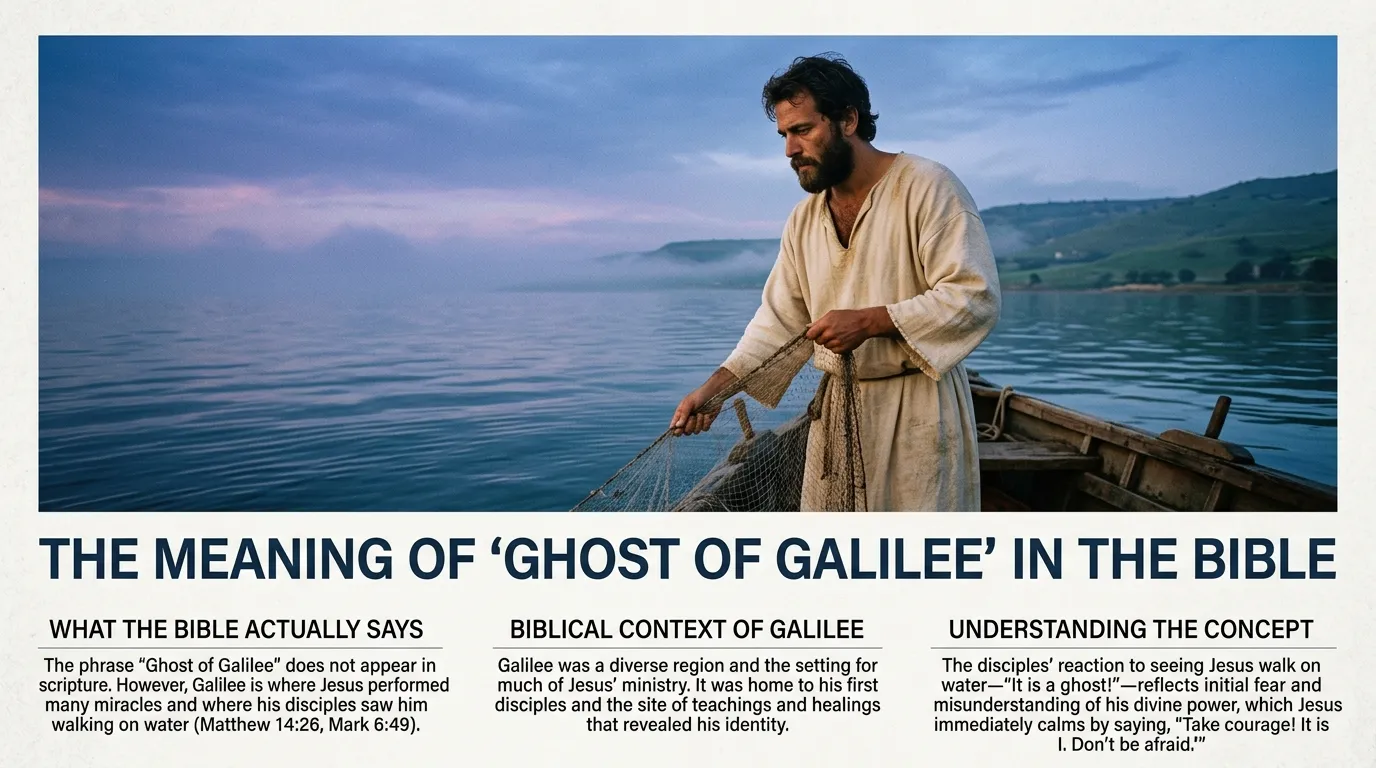
Have you ever read the story of Jesus walking on the water and wondered why the disciples thought they were seeing a ghost? The scene is both frightening and deeply meaningful. In the dark, on the Sea of Galilee, the disciples saw Jesus walking toward them and cried out in fear.
The Ghost of Galilee meaning in the Bible is closely connected to fear, faith, and the revelation of who Jesus truly is. The Bible does not teach that Jesus was a ghost. Instead, the disciples mistakenly thought they were seeing a spirit or apparition because they did not yet understand what they were witnessing.
This story gives Christians an important message today: fear can affect what we think we see, but Jesus meets us in the storm and calls us to trust Him.
What Does “Ghost of Galilee” Mean in the Bible?
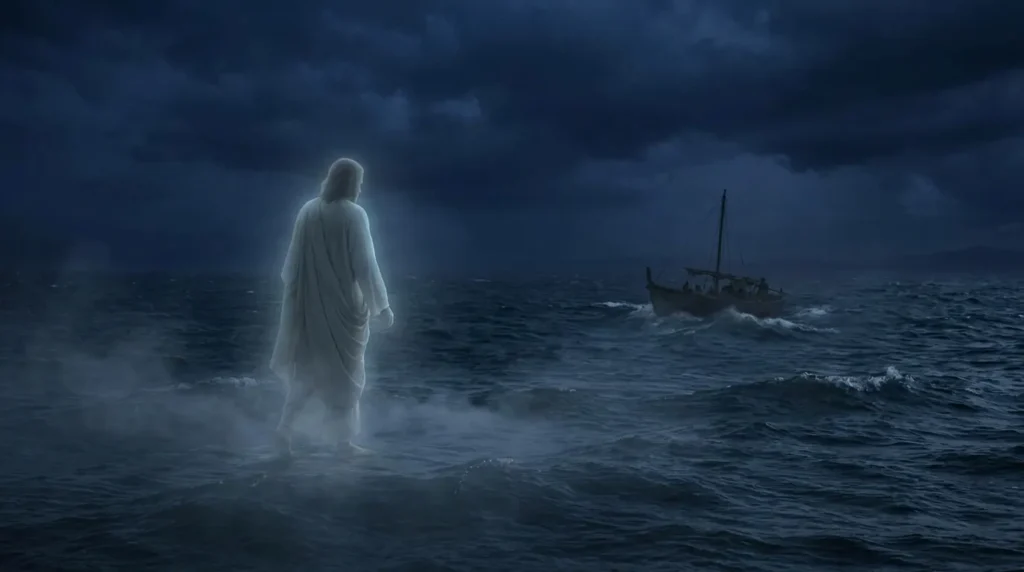
The phrase “Ghost of Galilee” is not a formal biblical title for Jesus. It comes from the account of Jesus walking on the water in the Gospels.
Matthew 14:22–33, Mark 6:45–52, and John 6:16–21 describe this event. Matthew and Mark specifically tell us that the disciples became afraid when they saw Jesus walking on the sea.
Matthew 14:26 says that when the disciples saw Him, they were troubled and said, “It is a ghost!” Jesus immediately spoke to them and said, “Take courage! It is I. Don’t be afraid.”
The point is important. Jesus was not presenting Himself as a ghost. The disciples were afraid because they did not recognize Him.
Their fear came before understanding.
This makes the story a powerful picture of how people can react when God works in ways they do not expect.
The Ghost of Galilee Meaning Through Scripture
The clearest biblical meaning comes from the story itself.
Jesus had sent His disciples across the Sea of Galilee while He went up a mountain to pray. During the night, the disciples were struggling because the wind was against them.
Then Jesus came toward them, walking on the water.
They did not expect to see Him there. Their first reaction was fear.
But Jesus did not leave them in that fear.
He spoke.
“Take courage! It is I. Don’t be afraid.” — Matthew 14:27
This gives us a simple biblical lesson:
When fear makes us uncertain, Jesus calls us back to courage and trust.
The disciples thought they were seeing something frightening. In reality, they were seeing their Lord coming to them.
Why Did the Disciples Think Jesus Was a Ghost?
The disciples were tired, frightened, and caught in a storm.
Mark 6:48 says that Jesus saw them struggling against the wind. He came toward them on the sea during the night.
When they saw Him, they did not immediately recognize Him.
From their human point of view, seeing a person walking across the water was impossible. Their minds reached for an explanation, and they assumed it was a spirit or ghost.
This reaction shows something very human.
Fear can make an unfamiliar situation seem more frightening than it really is.
The disciples had already witnessed Jesus perform miracles. Yet, when faced with a new and frightening situation, they still struggled to understand what God was doing.
Christians can experience something similar today.
You may be facing a difficult season at work, in your family, or in your personal life. You may not understand why God has allowed something to happen. Like the disciples, you may wonder what is happening.
The lesson is not that every strange experience is secretly God.
Rather, the lesson is that we should not allow fear to become our guide.
Jesus Was Not a Ghost
It is important to be biblically accurate here.
The Bible does not teach that Jesus was a ghost when He walked on Galilee.
The disciples thought they were seeing a ghost, but Jesus identified Himself.
Matthew records Jesus saying, “It is I” (Matthew 14:27).
The Greek expression can also carry the sense of “I am.” In the story, however, the immediate message is clear: Jesus was telling His frightened disciples that it was Him.
Later, after His resurrection, Jesus again showed that He was not merely a spirit.
In Luke 24:39, Jesus said:
“Look at my hands and my feet. It is I myself! Touch me and see; a ghost does not have flesh and bones, as you see I have.”
That passage is especially important for Christian teaching.
The risen Jesus is not presented as a ghost. He is presented as truly risen.
Ghost of Galilee Meaning + Hebrew Meaning
The phrase “Ghost of Galilee” does not have a special Hebrew meaning in the Bible, because the New Testament was written primarily in Greek.
However, understanding the Hebrew background of the Bible can help us understand ideas about spirit, breath, fear, and God’s presence.
One important Hebrew word is ruach (רוּחַ). It can mean spirit, wind, or breath, depending on the context.
This is interesting because the story of Jesus walking on the sea happens in the middle of strong wind and waves.
In the Old Testament, God’s Spirit is often associated with life and divine activity. For example, Genesis 1:2 describes the Spirit of God moving over the waters.
However, Christians should be careful not to claim that ruach proves Jesus was a ghost or that the Sea of Galilee story has a hidden Hebrew code. Scripture does not make that connection.
The safe biblical understanding is that the disciples mistook Jesus for a spirit-like figure because they were frightened and did not recognize Him.
The Spiritual Meaning of Jesus Walking on Water
The event carries several powerful spiritual lessons.
Jesus Comes Into the Middle of the Storm
Jesus did not wait for the storm to disappear before coming to His disciples.
He came while they were still struggling.
This does not mean God will always remove our problems immediately. It does mean that difficult circumstances do not place us outside God’s care.
You may pray for a problem to end, yet the answer may take time.
During that waiting period, remember:
God’s presence is not measured by how easy your circumstances are.
Fear Does Not Have to Control Your Faith
The disciples were afraid when they saw Jesus.
Jesus responded with reassurance.
He did not shame them for being frightened. He told them to take courage and not be afraid.
That is a comforting picture of Christ.
When fear overwhelms you, you can bring that fear to God honestly.
Jesus Is Lord Over Creation
Walking on water is not simply a strange event.
It reveals something about Jesus.
The Gospel accounts present Him as having authority over the natural world. Earlier in Matthew 8:23–27, Jesus calmed a storm, and the disciples asked, “What kind of man is this? Even the winds and the waves obey him!”
The walking-on-water account continues to reveal His authority.
Jesus is not controlled by the storm. The storm is under His authority.
What Does Peter Walking on Water Teach Us?
Matthew’s account includes an important part that Mark and John do not emphasize: Peter walks toward Jesus on the water.
Peter says, “Lord, if it’s you, tell me to come to you on the water” (Matthew 14:28).
Jesus tells him to come.
Peter steps out of the boat.
For a moment, he does something remarkable.
But then he notices the wind.
Matthew 14:30 says that when Peter saw the wind, he became afraid and began to sink.
Peter cried out, “Lord, save me!”
Jesus immediately reached out His hand.
This story offers a powerful picture of faith.
Peter’s problem was not that the storm suddenly became stronger than Jesus. His problem was that fear captured his attention.
His eyes moved from Jesus to the storm.
Yet even when Peter failed, Jesus was there to help him.
That is grace.
What Does the Story Mean for Christians Today?
The story can speak to ordinary moments of life.
Imagine a Christian who loses a job and becomes afraid about the future.
Or someone praying for a family member and seeing no immediate answer.
Or a believer facing a decision and feeling unsure about which direction to take.
These situations can feel like a storm.
The story of Galilee reminds us to ask:
- Am I allowing fear to control my decisions?
- Am I bringing my concerns to God in prayer?
- Am I testing what I believe against Scripture?
- Am I trusting Jesus even when I do not understand?
- Am I looking at Christ more than the storm?
Faith does not mean pretending that storms are not real. Faith means remembering that God is greater than the storm.
Ghost of Galilee Meaning in Dreams
Some people search for the Ghost of Galilee meaning in a dream, especially after dreaming about ghosts, water, Jesus, boats, or storms.
The Bible does show that God sometimes used dreams to communicate with people. Joseph, for example, received important dreams in Genesis. Daniel also received dreams and visions.
However, Scripture does not teach that every dream has a divine message.
This is an important distinction.
If you dream about a ghost on the Sea of Galilee, it does not automatically mean God is sending you a prophecy. The dream may reflect fear, stress, memories, spiritual questions, or things you have recently seen or thought about.
Christians should therefore test dreams against Scripture rather than building beliefs on dreams alone.
A helpful approach is to ask:
Does the Dream Agree With Scripture?
God will not give a message that contradicts His revealed Word.
If an interpretation encourages you to abandon biblical truth, it should not be accepted simply because the dream felt powerful.
What Emotions Were Present?
Pay attention to feelings such as fear, confusion, peace, guilt, or hope.
A dream may reveal what is happening inside your heart without being a supernatural message.
Does It Lead You Toward Christ?
A healthy spiritual response should move you toward prayer, wisdom, repentance, faith, and trust in God, not superstition.
What If You See a “Ghost” in Real Life?
Christians sometimes wonder whether seeing a strange figure, shadow, or unexplained image has spiritual meaning.
The Bible does teach that the spiritual realm is real. But Scripture does not give Christians permission to label every unexplained experience as a ghost or demonic activity.
Wisdom is important.
Before reaching a spiritual conclusion, consider ordinary explanations such as lighting, exhaustion, stress, illness, or misunderstanding.
Most importantly, do not let fear control you.
Psalm 23:4 gives believers a powerful reminder that even when walking through a dark valley, God is with them.
What Is the Main Biblical Message?
The central message is not about ghosts.
It is about Jesus.
The disciples were afraid because they did not recognize Him.
Jesus came near and spoke peace to them.
Peter stepped out in faith but became afraid when he focused on the storm. Jesus reached out and rescued him.
And after witnessing the miracle, the disciples worshiped Jesus and declared, “Truly you are the Son of God” (Matthew 14:33).
That is where the story leads.
Fear → recognition → faith → worship.
The miracle points beyond itself to the identity of Christ.
Biblical Lessons You Can Apply Today
The story of Jesus on the Sea of Galilee gives us several practical lessons.
- Do not let fear become your source of truth.
- Remember that Jesus can meet you in difficult circumstances.
- Test spiritual experiences against Scripture.
- Do not build doctrine on dreams or unexplained experiences.
- Keep your attention on Christ when circumstances become frightening.
- Ask God for wisdom instead of rushing to conclusions.
- Remember that failure does not put you beyond God’s grace.
- Let difficult seasons deepen your trust in God.
These lessons are useful whether your “storm” is financial pressure, family trouble, uncertainty, loneliness, or spiritual doubt.
Frequently Asked Questions
Was Jesus a ghost when He walked on the Sea of Galilee?
No. The disciples thought they were seeing a ghost, but Jesus identified Himself as Jesus. Later, Luke 24:39 clearly distinguishes the risen Christ from a ghost by emphasizing His physical resurrection.
What does “ghost of Galilee” mean?
It refers to the disciples’ frightened reaction when they saw Jesus walking on the Sea of Galilee. It is not a biblical name for Jesus or a teaching that Jesus was a ghost.
What does Galilee symbolize in the Bible?
Galilee was a major region in Jesus’ earthly ministry. It was the setting for many of His teachings, miracles, and encounters with His disciples. Its meaning should therefore be understood from its biblical history rather than from modern symbolism.
What does seeing a ghost in a dream mean spiritually?
The Bible does not provide one universal meaning for dreaming about a ghost. Such dreams may reflect fear or personal concerns. Christians should test any spiritual interpretation against Scripture and avoid treating dreams as certain messages from God.
Why were the disciples afraid of Jesus?
They did not recognize Him and thought they were seeing a ghost. Their fear was understandable because seeing someone walking on water was beyond normal human experience.
What does Peter sinking in the water teach us?
Peter’s experience shows the danger of allowing fear to take our attention away from Jesus. It also shows Christ’s mercy because Jesus immediately reached out when Peter cried for help.
Is the story of Jesus walking on water about overcoming fear?
Yes, fear is an important part of the story. But the passage goes beyond simply teaching courage. It also reveals Jesus’ authority and identity and leads the disciples toward worship.
Conclusion
The Ghost of Galilee meaning in the Bible is ultimately not about ghosts. It is about a frightened group of disciples discovering that the person approaching them in the darkness was Jesus.
They saw something they could not understand and became afraid.
Jesus came near and said, “Take courage! It is I. Don’t be afraid.”
That message still brings comfort today.
You may not understand the storm around you. You may not know what God is doing. You may even feel afraid of what lies ahead.
But you can pray.
You can open Scripture.
You can seek wise Christian counsel.
And you can keep your eyes on Jesus.
When fear speaks loudly, remember who walks with you. When the storm feels strong, remember that Christ is stronger. And when you do not understand what you see, choose Scripture, wisdom, prayer, and faith over fear.
May God give you courage in every storm, wisdom in every uncertain moment, and a deeper trust in Jesus Christ.