Death is one of the hardest parts of life. When someone we love dies, we may feel shocked, empty, or afraid. At other times, we may read about a death in the Bible, hear about several deaths, or even dream about someone dying. This can leave us asking, What do deaths in the Bible mean in the Bible?
The Bible speaks about death with honesty. It does not hide the pain of losing someone. At the same time, Scripture does not present death as the final answer for those who trust God. The Bible teaches about physical death, spiritual death, resurrection, judgment, eternal life, grief, and God’s comfort.
Death in the Bible can have different meanings depending on the passage. Sometimes it describes the end of physical life. Sometimes it points to separation from God because of sin. In other places, death becomes part of a story about judgment, sacrifice, redemption, or resurrection.
When death appears in a dream or personal experience, Christians should be careful. The Bible does contain dreams that God used to communicate with people, but not every dream is a message from God. Any spiritual interpretation should be tested against Scripture.
Most importantly, the Bible gives believers a reason for hope: Jesus Christ conquered death through His resurrection.
What Does Death Mean in the Bible?
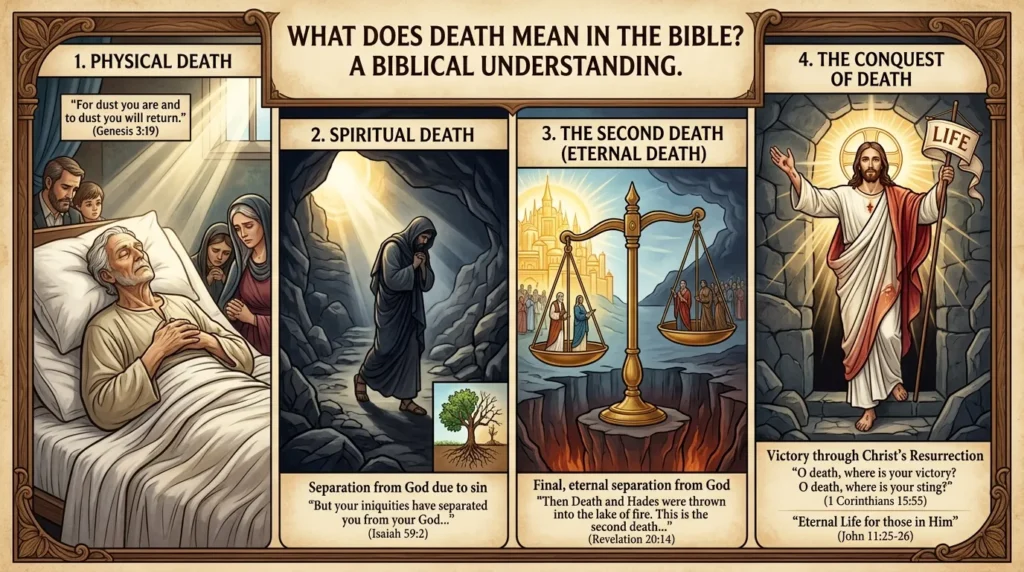
In the Bible, death usually refers to the end of physical life, but Scripture also uses death in a spiritual sense.
Genesis gives the first major biblical explanation of death. God warned Adam that disobedience would bring death (Genesis 2:17). After sin entered the world, death became part of the human condition (Genesis 3:19).
Romans 6:23 gives the basic biblical teaching clearly: the wages of sin is death, but the gift of God is eternal life in Christ Jesus.
This shows two sides of the biblical message.
- Physical death is a real part of life in a fallen world.
- Sin brings spiritual separation and death.
- God offers forgiveness and life through Christ.
- Death is not the final hope for Christians.
- The resurrection points toward God’s victory over death.
Therefore, when we ask about the deaths in the Bible meaning in the Bible, we should first look at the passage itself. A death may be describing an event, teaching about sin, showing God’s judgment, or preparing the reader to understand God’s power over death.
Death as a Picture of Human Mortality
One of the simplest meanings of death in Scripture is human mortality.
Psalm 90:12 says, Teach us to number our days, that we may gain a heart of wisdom. The psalm reminds us that human life is short and that our time should be lived with wisdom.
The Bible does not tell Christians to live in constant fear of death. Instead, the shortness of life should encourage us to value God, people, love, forgiveness, and faithful living.
James 4:14 compares human life to a vapor that appears for a little while and then disappears. The point is not hopelessness. James is teaching believers to depend on God rather than assuming that they control tomorrow.
For everyday Christian life, this can be a powerful reminder. We may spend years worrying about things that do not matter while neglecting prayer, family, kindness, and our relationship with God.
Death and Sin in Scripture
The Bible also connects death with sin.
Romans 5:12 explains that sin entered the world through one man, Adam, and death came through sin. This teaching helps explain why death is present throughout human history.
However, Christians should be careful not to assume that every individual death is a direct punishment for a particular personal sin.
Jesus rejected that kind of simple thinking in several places. In Luke 13:1–5, people told Him about Galileans who had been killed. Jesus did not say that those people were worse sinners than everyone else.
Similarly, in John 9:1–3, Jesus’ disciples asked whether a man’s blindness was caused by his own sin or his parents’ sin. Jesus did not accept their assumption.
This gives us an important lesson:
A person’s death does not give us permission to declare that God was specifically punishing that person for a particular sin.
Only God knows the full story of a person’s heart and circumstances.
Death Can Represent Spiritual Death
The Bible sometimes uses the word death to describe spiritual separation from God.
Ephesians 2:1 describes people as being dead in trespasses and sins. Paul was not saying that they had physically died. He was describing their spiritual condition apart from God’s saving grace.
This is an important biblical meaning of death.
A person can be physically alive but spiritually separated from God. Through faith in Christ, however, God brings new life.
Paul describes this transformation in Ephesians 2:4–5. Although people were dead in sin, God made them alive with Christ because of His great love and mercy.
So, spiritually speaking, death can point to:
- Separation from God
- Life controlled by sin
- The need for salvation
- The end of an old way of living
- The new life found in Christ
Death and the Hope of Resurrection
The most important Christian meaning of death is found in Jesus’ resurrection.
Jesus truly died and was buried. But the Gospel accounts explain that He rose again on the third day. His resurrection is at the heart of Christian faith.
In John 11, Jesus spoke with Martha after the death of her brother Lazarus. Jesus said, I am the resurrection and the life (John 11:25).
Lazarus was then raised from the dead. This miracle pointed beyond Lazarus himself. It revealed Jesus’ authority over death and pointed toward the greater hope of resurrection.
Paul also teaches about resurrection in 1 Corinthians 15. He explains that Christ was raised from the dead and that His resurrection gives believers hope.
Because of Jesus, death does not have the final word.
Death in the Bible Can Show God’s Judgment
Some deaths in Scripture occur in stories of divine judgment.
For example, Genesis 6–9 describes the Flood during the days of Noah. The account presents the Flood as God’s judgment on widespread human wickedness, while Noah and his family are preserved.
Other passages also describe deaths connected with judgment. These stories should be read carefully and in their biblical context.
They remind us that God is holy and that evil matters to Him. At the same time, Christians should not use these passages to make careless judgments about people who suffer or die today.
Scripture teaches God’s right to judge, but we are not given permission to act as though we know every reason behind another person’s suffering.
Death Can Lead to Redemption in the Biblical Story
The Bible contains a surprising theme: God can bring life and redemption out of situations involving death.
The clearest example is the death of Jesus.
Jesus’ crucifixion was a real death. Yet the New Testament teaches that His death was central to God’s plan of salvation.
Isaiah 53 had already spoken prophetically about the suffering servant who would bear the sins of many. The New Testament connects Jesus’ suffering and death with this redemptive message.
At the cross, what looked like complete defeat became the path to salvation.
This does not mean that every painful death has an obvious hidden purpose that we can identify. Instead, the cross teaches us something greater:
God is able to bring redemption even from the darkest circumstances.
Deaths in the Bible Meaning in the Bible Hebrew Meaning
The main Hebrew word commonly translated death in the Old Testament is מָוֶת (māweth or maveth). It refers to death or dying and appears in many passages that discuss human mortality, judgment, danger, and the limits of earthly life.
Another related Hebrew word is מוּת (mûth), meaning to die.
For example, Genesis 2:17 uses language related to dying when God warns Adam about eating from the forbidden tree. The passage connects disobedience with death.
The Hebrew understanding of death is therefore broader than simply the moment when breathing stops. In different contexts, Scripture can speak about physical death, danger that may lead to death, or death as part of judgment.
However, it is important not to force a symbolic meaning onto every appearance of the Hebrew word.
Hebrew word studies can help us understand a passage, but context remains essential. A word does not automatically carry every possible meaning every time it appears.
What Does Death Symbolize Spiritually?
Christians sometimes understand death as a spiritual symbol. Some of these ideas have clear biblical support, while others are personal interpretations.
One strong biblical picture is the death of the old life.
Romans 6:6 speaks about our old self being crucified with Christ. Paul later explains that believers should consider themselves dead to sin but alive to God in Christ Jesus (Romans 6:11).
Here, death symbolizes separation from the power and rule of sin.
This can apply to everyday Christian life.
Someone may say:
- I need to die to my pride.
- I need to die to bitterness.
- I need to stop living for approval.
- I need to surrender my old habits to Christ.
These ideas are not about physical death. They describe spiritual surrender and transformation.
Death as a Symbol of Change
In Christian teaching, death can sometimes symbolize the end of one season and the beginning of another.
For example, a person may leave an unhealthy lifestyle and begin walking closely with Christ. Someone may forgive another person after years of bitterness. Another believer may surrender a dream and trust God with a new direction.
These experiences can feel like the death of an old chapter.
The Bible supports the idea of spiritual transformation, but we should avoid saying that every life change is a divine prediction hidden in a death symbol.
A symbol can encourage reflection without becoming a prophecy.
What Does It Mean to Dream About Someone Dying?
Dreaming about death can be frightening.
A person may wake up worried that a loved one is going to die. However, a dream about death does not automatically mean that someone will physically die.
The Bible contains meaningful dreams. Joseph received dreams in Genesis, and Daniel interpreted dreams by God’s help. Joseph, the husband of Mary, also received divine guidance through dreams in Matthew 1–2.
But Scripture does not teach that every modern dream is a prophecy.
Dreams can also be influenced by:
- Stress
- Grief
- Fear
- Major life changes
- Memories
- Relationships
- Anxiety
- Daily experiences
Therefore, Christians should respond to troubling dreams with prayer rather than panic.
What Does It Mean to Dream About a Family Member Dying?
A dream about a family member dying may bring intense emotions.
Biblically, there is no universal rule saying that such a dream predicts physical death. Scripture does not give us a formula where every dream about a person’s death has one fixed meaning.
The dream may reflect fear of losing that person, a major change in the relationship, unresolved emotions, or general anxiety.
Instead of assuming the worst, ask:
What emotion did this dream bring to the surface?
You might be feeling fear, grief, guilt, love, or concern. Bring that emotion to God in prayer.
If the dream encourages you to love, forgive, pray, or appreciate someone, those are healthy responses. But do not allow fear to convince you that a dream has revealed an unavoidable future event.
What Does It Mean to Dream About Your Own Death?
Dreaming about your own death can feel especially disturbing.
Yet the Bible does not teach that this dream means you are going to die soon.
From a Christian perspective, such a dream may become an opportunity to think about your relationship with God, your priorities, and the way you are living.
Jesus repeatedly encouraged His followers to remain spiritually awake and faithful. The message is not to become obsessed with death but to live faithfully today.
If a dream causes fear, pray and remember God’s promises. Psalm 23:4 says that even when believers walk through the valley of the shadow of death, God is with them.
What Does Seeing a Dead Person Mean in a Dream?
Dreams about someone who has already died are common, especially after loss.
For someone grieving, the dream may bring memories, sadness, comfort, or unfinished feelings.
Christians should avoid automatically claiming that the dead person has returned to communicate a message. Scripture warns against attempting to communicate with the dead, including in Deuteronomy 18:10–12.
Instead, bring the experience to God.
You can remember the person with gratitude while placing your hope in the Lord. If grief is deep, talking with a trusted Christian, pastor, counselor, or loved one can also be helpful.
How Should Christians Respond to Death?
The Bible gives believers practical guidance for facing death and grief.
Grieve Honestly
The Bible does not command Christians to pretend that death does not hurt.
John 11:35 records that Jesus wept when He came to the tomb of Lazarus. This is deeply comforting. Tears are not a sign of weak faith.
Grief and faith can exist together.
Look to God for Comfort
Psalm 34:18 says that the Lord is near to the brokenhearted.
When someone dies, simple prayers can be enough:
- God, help me through today.
- Give me strength when I feel weak.
- Comfort my family.
- Help me trust You.
- Teach me to live wisely.
God does not require perfect words.
Remember the Resurrection
Christian hope rests on Jesus.
1 Thessalonians 4:13–14 tells believers not to grieve like people who have no hope. This does not mean Christians do not grieve. It means their grief is shaped by the hope of resurrection.
Christian hope is not the denial of death. It is confidence that death will not have the final victory.
What Can Death Teach Us About Life?
Biblical teaching about death can actually help us live better.
Value Your Time
Psalm 90:12 encourages wisdom because our days are limited.
Do not wait forever to tell people you love them. Do not postpone forgiveness when reconciliation is possible. Do not assume you will always have tomorrow.
Live With Eternal Perspective
Jesus taught His followers to value treasures in heaven rather than living only for earthly possessions (Matthew 6:19–21).
Death reminds us that material things do not last forever.
Our relationship with God matters far more.
Choose Faith Over Fear
Death can create fear about the future. Scripture repeatedly directs believers toward trust.
Romans 8:38–39 teaches that neither death nor life can separate believers from God’s love in Christ Jesus.
That is one of the strongest promises Christians can hold onto during difficult seasons.
Does Every Death in the Bible Have a Hidden Spiritual Meaning?
No.
This is an important point.
Some deaths in Scripture carry clear theological meaning because the biblical writer explains their purpose. Others are historical events within a larger story.
We should not assume that every name, number, death, or detail contains a secret spiritual code.
Likewise, Christians should be cautious about claims that every death-related dream predicts a future event.
A good approach is:
- Read the passage in context.
- Look for what Scripture actually says.
- Compare interpretations with the wider Bible.
- Pray for wisdom.
- Avoid superstition.
- Do not claim certainty where Scripture is silent.
This approach protects us from fear and keeps our focus on God’s revealed truth.
Bible Verses About Death and Hope
Several passages offer comfort when thinking about death.
John 11:25–26 points believers to Jesus as the resurrection and the life.
Psalm 23:4 reminds us that God is present even in the darkest valley.
Romans 8:38–39 teaches that death cannot separate believers from God’s love in Christ.
1 Corinthians 15:54–55 looks forward to the final victory over death.
Revelation 21:4 gives a beautiful picture of the future when God will wipe away every tear and death will be no more.
These passages show the larger biblical story. Death is real, grief is real, and suffering is real—but God’s victory is greater.
What Should You Do After a Troubling Death Dream?
If you have recently dreamed about death, do not immediately assume something terrible will happen.
Instead:
- Pray calmly.
- Read Scripture.
- Consider what emotions the dream brought up.
- Avoid treating the dream as a guaranteed prophecy.
- Ask whether there is a practical issue you need to address.
- Talk with a mature Christian if the dream continues to trouble you.
- Trust God’s wisdom instead of fear.
If the dream causes severe anxiety or affects your sleep and daily life, seeking support from a qualified mental-health professional can also be wise. Getting help does not mean you lack faith.
Frequently Asked Questions
What is the main biblical meaning of death?
The Bible presents death as the end of physical life and also uses death as a picture of spiritual separation from God because of sin. Yet through Jesus Christ, believers have the hope of forgiveness, resurrection, and eternal life.
Does dreaming about death mean someone will die?
No. The Bible does not teach that every dream about death predicts a physical death. Some dreams in Scripture were messages from God, but dreams must not automatically be treated as prophecy.
What does death symbolize in Christianity?
Death can symbolize physical mortality, the seriousness of sin, spiritual separation from God, or dying to an old sinful way of life. The meaning depends on the biblical context.
What does the Hebrew word for death mean?
The Hebrew word מָוֶת (māweth/maveth) commonly means death. The related verb מוּת (mûth) means to die. Their precise meaning depends on how they are used in the passage.
Is death always a punishment for sin?
The Bible connects sin with death in a broad theological sense, but Christians should not assume that every individual death is a direct punishment for a particular sin. Jesus warned against simplistic conclusions about suffering and sin.
What does the Bible say about death for Christians?
The Bible teaches that Christians can face physical death with hope because of Christ’s resurrection. Death is not the end of God’s promises. Scripture points toward resurrection and eternal life with God.
Should Christians be afraid of death?
Death is naturally serious, and Scripture does not tell believers to pretend otherwise. But Christians are encouraged to trust God because Christ has conquered death and God’s love remains secure.
Final Thoughts
The deaths in the Bible meaning in the Bible cannot be reduced to one simple definition. Scripture presents death as part of the brokenness caused by sin, a reminder of human mortality, a reality connected with judgment, and sometimes a picture of spiritual change.
But the Bible’s message does not end with death.
It leads us to Jesus Christ.
Jesus entered human suffering. He experienced death. He was buried. Then He rose again. His resurrection gives Christians a hope that reaches beyond the grave.
If death has recently touched your life, God understands your tears. If you have had a frightening dream about death, you do not need to live in panic. Bring your fears to God, test every spiritual idea against Scripture, and seek wise support when needed.
Take time to pray today. Thank God for the people He has placed in your life. Ask Him to help you live wisely, love deeply, forgive freely, and trust Him with the future.
Death may be part of our earthly story, but for those who belong to Christ, it is not the end of the story. God’s grace, Christ’s resurrection, and the promise of eternal life give us a hope that death cannot destroy.