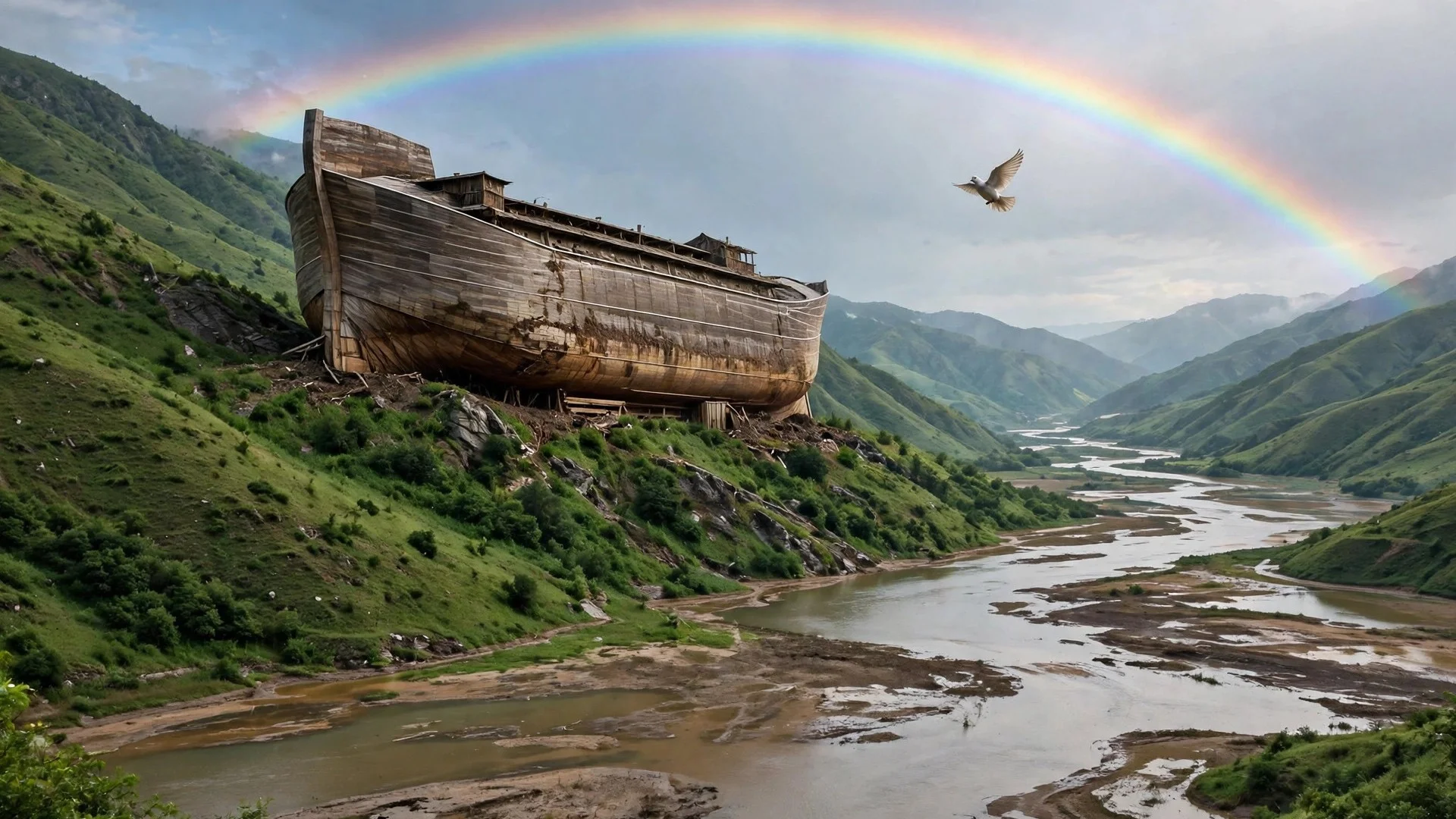
Every rainbow is a reminder before it is a decoration. After the floodwaters receded and Noah stepped onto dry ground, God did something remarkable: He bound Himself with a promise to all creation, and He hung the sign of that promise in the sky. The Noahic covenant is the first covenant named in Scripture, and it still frames how God relates to a world that keeps breaking His heart.
The Sign Comes First
Genesis 9 opens with the sign rather than the small print. “I have set my rainbow in the clouds,” God says, “and it will be the sign of the covenant between me and the earth.” A bow in the ancient world was a weapon of war. God takes the weapon, turns it upward, and hangs it in the clouds as a pledge of peace. Whenever the clouds gather, the sign appears — not because humanity earned it, but because God chose to remember His own promise.
What God Actually Promised
The promise has three strands, and each matters. First, God pledged never again to destroy all life with a flood. Second, He established the rhythm of creation — seedtime and harvest, cold and heat, summer and winter, day and night — as long as the earth endures. Third, He gave humanity a renewed charge: be fruitful, multiply, and fill the earth, and treat human life as sacred because every person bears God’s image.
The Hebrew word behind “covenant” here is berith, a binding commitment, and it appears folded into the flood story itself: before the rains ever fell, God told Noah, “I will establish my covenant with you.” The promise preceded the deliverance, and the sign followed it. God commits first; the rainbow simply makes His commitment visible.
Who Is Included
This covenant is wider than any other in the Bible. It is not made only with Noah, or only with Israel, or only with people who believe. Genesis 9:9-10 names Noah, his descendants, and “every living creature” — birds, livestock, and wild animals. The Noahic covenant is God’s promise to the whole created order. That breadth is why it still speaks to anyone who has ever watched a storm and wondered whether mercy has limits.
Why It Still Matters
The covenant does not promise that the world will stop flooding, or that suffering will end. It promises that God will not unmake His world in judgment by water again, and that His patience has a purpose: time for repentance, time for the gospel to reach the nations, time for His larger story of redemption to unfold. Peter later connects the flood to baptism and to God’s patience in Noah’s day, and the rainbow keeps pointing to the same patient God.
When you see a rainbow, you are not merely seeing weather. You are seeing a promise God made to people who had just watched the world end — and kept.
Conclusion
The Noahic covenant tells us that God’s response to a ruined world was not distance but promise. He set His bow in the clouds so that every generation would know: judgment is real, but mercy has the last word. To explore the history of this covenant further, read the Wikipedia article on the Noahic covenant.