Have you ever noticed that God often places certain people beside us at important moments in life? A friend may encourage you when your faith feels weak. A pastor may speak a word that brings hope. Or someone you barely know may help you take the next step God is calling you to take.
The Bible gives us many examples of this kind of spiritual companionship. One of the clearest examples is found in the life of the apostle Paul. When we explore Paul’s companions meaning in the Bible, we discover a powerful picture of fellowship, service, courage, encouragement, teamwork, and God’s guidance.
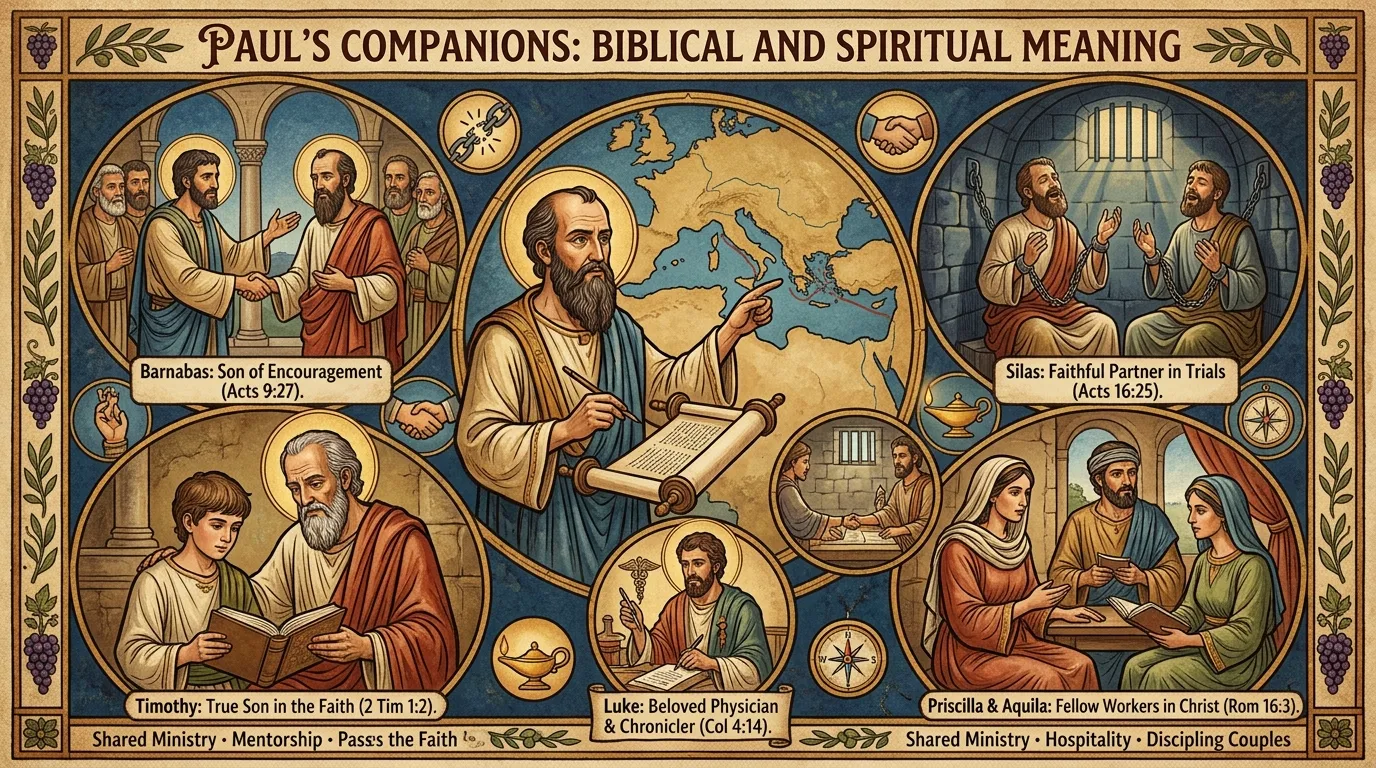
Paul did not carry out his ministry alone. God used people such as Barnabas, Silas, Timothy, Luke, Titus, Priscilla, Aquila, and many others to help spread the gospel.
Their stories remind us that God can work through relationships and faithful people to accomplish His purposes.
What Does Paul’s Companions Mean in the Bible?
The phrase Paul’s companions refers to the men and women who traveled with Paul, supported his ministry, helped establish churches, served alongside him, and shared in the work of spreading the gospel.
The book of Acts and Paul’s letters mention many of these people.
Some traveled with Paul for long periods. Others joined him for certain parts of his missionary journeys. Some provided practical help, while others served as teachers, messengers, church leaders, or fellow workers.
For example, Acts 13:2–3 describes Barnabas and Saul being set apart for missionary work by the Holy Spirit through the church at Antioch.
This shows an important biblical truth:
Christian ministry is often carried out through faithful relationships rather than through one person working alone.
Paul’s companions were not simply travel partners. Many became fellow workers in God’s mission.
Who Were Paul’s Companions?
Paul had many companions throughout his ministry. Their roles were different, and Scripture gives us different amounts of information about each person.
Barnabas
Barnabas was one of Paul’s earliest and most important ministry partners.
Acts 9:27 tells us that Barnabas helped introduce Paul to the apostles after Paul’s conversion. This was significant because many Christians were still afraid of Paul because of his earlier persecution of believers.
Barnabas believed Paul’s testimony and helped others see the change God had made in him.
Later, Barnabas and Paul were sent out together on a missionary journey in Acts 13.
Barnabas reminds us that encouragement can help someone step into God’s calling.
Silas
After Paul and Barnabas separated over a disagreement concerning John Mark, Paul chose Silas as his ministry partner.
Acts 15:40 says that Paul was commended by the believers to the grace of the Lord, and he traveled through Syria and Cilicia strengthening the churches.
Silas later shared a remarkable experience with Paul in Philippi. Acts 16:25–26 describes Paul and Silas praying and singing hymns while imprisoned. Then an earthquake opened the prison doors.
Their example teaches that faith can remain strong even during painful circumstances.
Timothy
Timothy became one of Paul’s closest spiritual companions.
Paul met Timothy during his missionary work, and Acts 16:1–3 describes Timothy joining Paul.
Paul later wrote two letters to Timothy. In 1 Timothy 1:2, Paul calls Timothy his “true child in the faith.”
Timothy’s story shows that spiritual growth often happens through discipleship, teaching, patience, and faithful example.
Luke
Luke is traditionally understood to be the author of Luke and Acts. He also appears to have traveled with Paul.
In Acts, the language sometimes changes from “they” to “we,” suggesting that Luke joined Paul’s traveling group at certain points.
Paul later mentions Luke in Colossians 4:14 as “the beloved physician.”
Luke reminds us that different gifts and professions can be used in God’s service.
Priscilla and Aquila
Priscilla and Aquila were a married couple who worked with Paul.
Acts 18:2–3 explains that Paul stayed and worked with them because they shared the trade of tentmaking.
They also helped Apollos understand the way of God more accurately, as described in Acts 18:24–26.
Their example shows that ordinary work, marriage, hospitality, teaching, and ministry can all become part of Christian service.
Titus
Titus was another trusted coworker of Paul.
Paul’s letter to Titus shows that Titus had responsibilities involving the organization and strengthening of churches.
Paul called him his “true child in our common faith” in Titus 1:4.
Titus demonstrates the importance of trustworthy Christian leadership and responsible service.
Paul’s Companions Meaning in the Bible Hebrew Meaning
The focus phrase Paul’s companions meaning in the Bible Hebrew meaning needs an important clarification.
Paul lived in the first-century Jewish and Greek world, and the New Testament was written primarily in Koine Greek, not Hebrew. Therefore, there is no special biblical Hebrew word that means “Paul’s companions.”
The New Testament commonly uses Greek words connected with ideas such as fellow worker, companion, brother, partner, and coworker.
One important Greek word is synergos, meaning fellow worker or coworker. Paul uses this kind of language when describing people who worked with him in the gospel.
For example, Romans 16 contains greetings to many people Paul calls coworkers or fellow servants.
This gives us a better biblical understanding of Paul’s companions.
They were not merely people who happened to travel with him. Many were fellow workers in the gospel.
The spiritual lesson is meaningful: God’s work is often shared among many faithful people.
Bible Verses About Paul’s Companions
Several passages help us understand the importance of Paul’s companions.
Acts 13:2–3
The believers in Antioch were worshiping and fasting when the Holy Spirit directed them to set apart Barnabas and Saul for the work God had called them to do.
This passage shows that Paul’s missionary ministry began within a community of believers.
God’s calling does not remove the need for godly fellowship and support.
Acts 15:40
Paul chose Silas and departed after being commended by the believers to the grace of the Lord.
This verse highlights the role of Christian community in sending and supporting ministry workers.
Acts 16:25
Paul and Silas were praying and singing hymns at midnight while in prison.
Their situation was difficult, but their worship continued.
This teaches us that companionship can strengthen faith during trials.
Acts 18:26
Priscilla and Aquila took Apollos aside and explained the way of God more accurately.
This is an excellent example of loving correction and spiritual instruction.
Christian companions should not only comfort us. They should also help us grow in truth.
Colossians 4:14
Paul mentions Luke, whom he calls a beloved physician.
This brief reference shows Paul’s appreciation for faithful people who served beside him.
2 Timothy 4:11
Near the end of Paul’s life, he writes, “Luke alone is with me.”
The verse carries an emotional weight.
Even Paul, a great apostle, experienced seasons when companions were absent. Yet God continued to sustain him.
The Spiritual Meaning of Paul’s Companions
The Bible does not give one secret symbolic meaning for Paul’s companions. However, their stories can offer several biblically grounded spiritual lessons.
Fellowship
Paul’s life demonstrates the value of Christian fellowship.
God created His people to live in relationship with one another. Ecclesiastes 4:9–10 teaches that two are better than one because they can help each other when one falls.
A faithful Christian companion can pray with you, correct you, encourage you, and remind you of God’s promises.
Encouragement
Barnabas is especially connected with encouragement.
His name is associated with encouragement in Acts 4:36.
He helped Paul at a time when Paul needed someone to believe in the transformation God had brought about.
This teaches us that encouragement can become a powerful ministry.
You may never preach to thousands of people, but your encouragement could strengthen someone’s faith.
Spiritual Accountability
Priscilla and Aquila show another side of Christian companionship.
They helped Apollos understand God’s truth more accurately.
Healthy Christian relationships include loving accountability.
A good spiritual friend does not simply agree with everything you say. Instead, they help you remain faithful to Scripture.
Partnership in God’s Work
Paul repeatedly described other believers as coworkers.
This means the Christian life is not only about receiving from others. It is also about serving together.
One person may teach. Another may organize. Another may give. Another may encourage. Another may pray.
Different gifts can serve one gospel purpose.
What Can Paul’s Companions Symbolize in a Dream?
Some Christians may dream about Paul, his companions, or a group of missionaries and wonder whether the dream has spiritual meaning.
The Bible does contain examples of God communicating through dreams. However, Scripture does not teach that every dream is a message from God.
Therefore, Christians should be careful.
A dream involving Paul’s companions could personally remind someone of themes such as:
- Christian fellowship
- spiritual encouragement
- missionary service
- discipleship
- perseverance
- teamwork
- God’s faithfulness
- the need for wise counsel
But these should be understood as possible reflections, not guaranteed prophetic meanings.
The Bible gives us a clear standard for testing spiritual ideas.
First John 4:1 tells believers to test the spirits to see whether they are from God.
Likewise, Isaiah 8:20 points God’s people back to God’s revealed truth.
A dream should never be used to override Scripture.
If a dream encourages something that contradicts God’s Word, the dream should not be treated as divine guidance.
What Does It Mean to Dream About Traveling With Paul’s Companions?
Dreams about traveling with Paul’s companions may naturally bring thoughts of spiritual journeys and Christian community.
From a biblical perspective, travel is an important theme in Acts because Paul and his companions physically traveled to preach the gospel and strengthen churches.
However, Scripture does not provide a fixed dream dictionary saying that traveling with Paul always means one specific thing.
Instead, consider the biblical themes surrounding the people and events in the dream.
Ask yourself:
- Am I being reminded of the importance of Christian fellowship?
- Do I need wise spiritual counsel?
- Is God teaching me to serve others?
- Have I been trying to handle everything alone?
- Do I need encouragement during a difficult season?
- Is there someone I should encourage or forgive?
- Does the dream lead me toward Christ and Scripture?
These questions can help you reflect without turning the dream into superstition.
What Does Paul’s Companions Mean in Real Life?
You do not need to be a missionary traveling from city to city to experience the lesson of Paul’s companions.
You may see the same principle in ordinary Christian life.
Imagine someone starting a new ministry at church. They may have a strong desire to serve, but they feel nervous and inexperienced.
A mature Christian encourages them.
Another person helps them learn.
Someone else prays for them.
Another person quietly handles practical needs.
Together, they accomplish something one person could not easily do alone.
This is similar to the pattern we see throughout Paul’s ministry.
God often uses people to strengthen people.
What Paul’s Companions Teach Us About Christian Friendship
Paul’s relationships offer practical guidance for choosing and becoming good Christian friends.
Choose Friends Who Strengthen Your Faith
Proverbs 27:17 says that iron sharpens iron.
A good Christian friend should help you become more faithful to Christ.
That does not mean they must be perfect.
It means their influence should generally move you toward truth, wisdom, humility, love, and obedience.
Learn to Encourage Others
Barnabas shows how powerful encouragement can be.
Perhaps someone in your church feels forgotten.
Perhaps a young believer doubts whether they can serve God.
Perhaps a friend is quietly struggling.
A simple message, prayer, conversation, or act of kindness may give them strength.
Accept Wise Correction
Priscilla and Aquila did not publicly shame Apollos. They helped him understand God’s way more accurately.
This gives us a model for correction that is truthful but loving.
Do Not Expect Everyone to Stay Forever
Paul’s ministry also included separation and difficult relationships.
Paul and Barnabas eventually went separate ways because of disagreement about John Mark, as recorded in Acts 15:36–41.
This reminds us that Christian relationships can be complicated.
Faithfulness to God does not mean every relationship will remain unchanged.
Did Paul Need His Companions?
Paul was called by God, but that did not mean he was meant to work alone.
His life shows a beautiful balance.
God was Paul’s ultimate source of strength, but God also provided people who could serve, encourage, teach, travel, pray, and suffer alongside him.
This is important for Christians today.
Depending on God does not mean refusing help from God’s people.
Sometimes God answers a prayer through another believer.
A person may pray for courage and receive it through a friend’s encouragement.
Someone may ask God for wisdom and receive counsel from a mature Christian.
Someone may feel lonely and discover that God has placed a caring church family around them.
Lessons From Paul’s Companions for Today
The stories of Paul’s companions give us several practical lessons.
- Do not try to walk the Christian life alone.
- Value faithful Christian friendships.
- Encourage people who are growing in faith.
- Accept correction when it agrees with Scripture.
- Use your gifts to serve others.
- Pray for people who serve God.
- Stay faithful during difficult seasons.
- Remember that different people have different roles.
- Let disagreements be handled with wisdom and grace.
- Keep Christ and Scripture at the center of every spiritual relationship.
Frequently Asked Questions
Who was Paul’s closest companion?
The Bible does not officially name one person as Paul’s single closest companion throughout his entire ministry.
However, Barnabas, Silas, Timothy, and Luke played especially important roles at different stages of Paul’s life and ministry.
Timothy appears to have had a particularly close spiritual relationship with Paul, as seen in Paul’s letters to him.
Who traveled with Paul in the Bible?
Several people traveled with Paul at different times, including Barnabas, Silas, Timothy, Luke, Titus, and others.
Acts shows that Paul’s companions changed as his missionary ministry developed.
What do Paul’s companions teach Christians?
They teach Christians about fellowship, teamwork, discipleship, encouragement, perseverance, service, and spiritual accountability.
Their stories show that God’s work can involve many people with different gifts.
Why did Paul have so many companions?
Paul’s ministry involved extensive travel, preaching, teaching, church strengthening, correspondence, and leadership.
Having companions allowed different believers to contribute their gifts and helped strengthen the churches.
What is the spiritual meaning of seeing Paul’s companions in a dream?
There is no biblical rule giving Paul’s companions one fixed dream meaning.
Such a dream may prompt reflection on themes such as fellowship, service, encouragement, discipleship, or perseverance. However, Christians should test all spiritual impressions against Scripture and should not treat a dream as automatically coming from God.
A Biblical Prayer for Christian Companionship
Lord, thank You for the people You place in our lives.
Help us recognize faithful friends who encourage us to follow You. Give us wisdom to receive correction, humility to admit when we are wrong, and courage to encourage others.
Teach us to serve without seeking attention. Help us use our gifts for Your glory.
When we feel alone, remind us that You have not abandoned us. When we face difficult relationships, give us patience, grace, and wisdom.
Help us remain faithful to Your Word and keep our eyes on Jesus.
Amen.
Final Thoughts
The story of Paul’s companions meaning in the Bible is ultimately a story about God’s faithfulness.
Paul had a powerful calling, but God did not ask him to walk alone. Barnabas encouraged him. Silas suffered beside him. Timothy learned and served with him. Luke faithfully accompanied him. Priscilla and Aquila helped teach others.
Their lives remind us that God often strengthens His people through other people.
If you are in a season of loneliness, ask God for wise and faithful Christian community. If you already have supportive people around you, thank God for them.
And if you are wondering whether you can make a difference, remember that not every important servant of God stood at the front.
Some traveled.
Some taught.
Some encouraged.
Some prayed.
Some opened their homes.
Some simply stayed faithful.
God sees every act of faithful service.
As you reflect on Paul’s companions, ask God to show you where you can encourage someone, receive wise counsel, serve faithfully, and walk more closely with Christ.
You may not know the full purpose of every relationship in your life today. But you can trust the God who guided Paul and his companions.
God is still faithful, and He is able to guide your steps as you follow Him.