Imagine being arrested for something you did not do. You are beaten, chained, and treated as if you have no rights. Then, at the right moment, you reveal something important: you are a Roman citizen.
This is what happened to the apostle Paul.
The story of Paul as a Roman citizen meaning in the Bible teaches us much more than a fact about ancient Rome. It shows how God can use a person’s background, rights, position, and life experience to protect them and open doors for the gospel.
Paul’s Roman citizenship did not make him more valuable than other people. Instead, God used this part of his earthly identity as part of Paul’s mission.
Let’s look at what Scripture says and what Christians can learn from Paul’s story today.
What Does Paul as a Roman Citizen Mean in the Bible?
Paul was a Roman citizen, and this gave him certain legal rights under Roman law. These rights became important during several difficult moments in his ministry.
In Acts 16:35–39, Paul and Silas were imprisoned in Philippi after being beaten without a proper public trial. When the authorities later wanted to release them quietly, Paul objected.
He said:
“They have beaten us publicly, uncondemned, men who are Roman citizens, and have thrown us into prison.” — Acts 16:37
The officials became afraid when they learned that Paul and Silas were Roman citizens.
Paul’s citizenship helped expose the unfair treatment they had received.
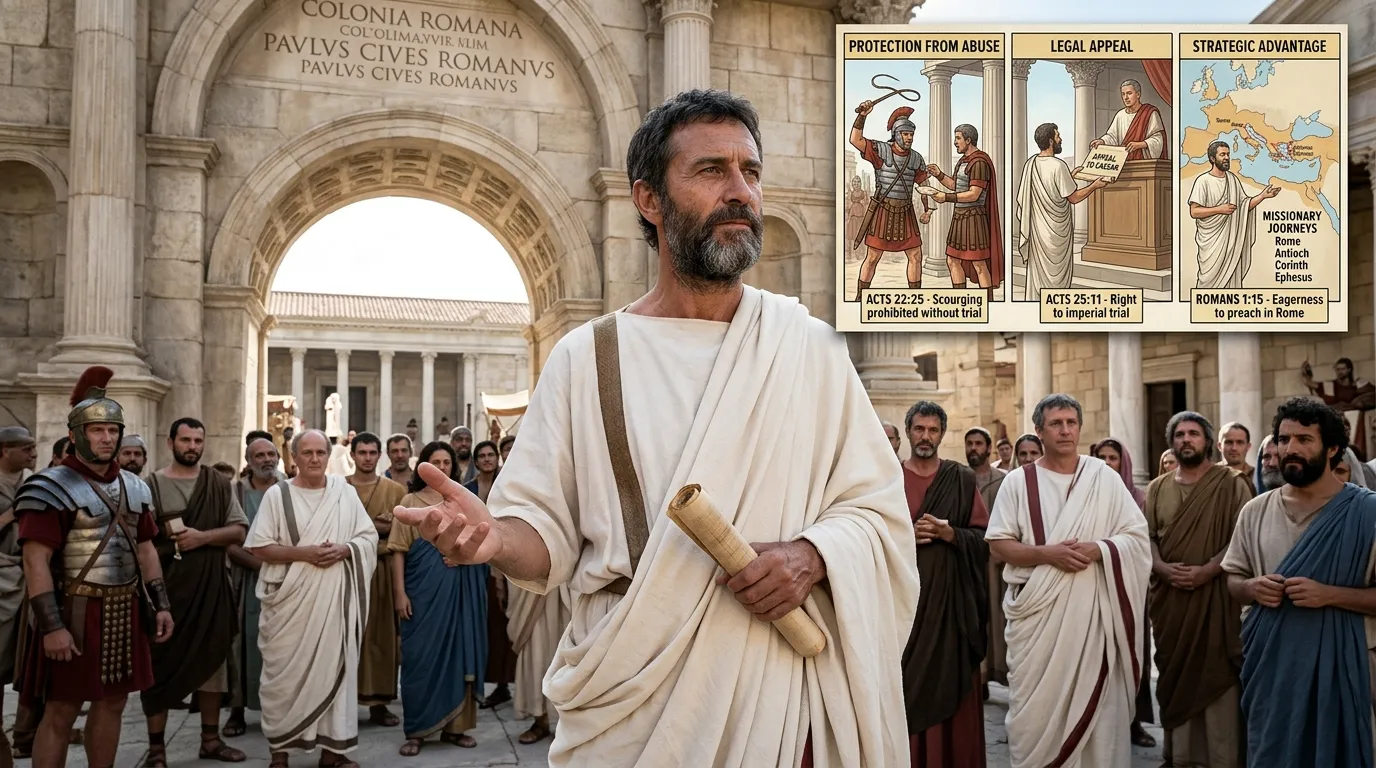
Later, in Acts 22:22–29, Paul was about to be examined by flogging when he asked whether it was lawful to flog an uncondemned Roman citizen.
The commander immediately became concerned because Roman citizenship carried legal protection.
The Bible explicitly teaches that Paul was a Roman citizen and that this citizenship gave him legal rights. It does not say that Roman citizenship itself was a special spiritual status.
The spiritual lesson comes from seeing how God worked through Paul’s circumstances.
Why Was Paul a Roman Citizen?
Scripture does not explain exactly how Paul’s family obtained Roman citizenship.
In Acts 22:28, the Roman commander tells Paul that he obtained his citizenship by paying a large amount of money.
Paul responds:
“But I was born a citizen.” — Acts 22:28
This tells us that Paul’s Roman citizenship was inherited by birth.
Paul also identified himself as a Jew and as someone trained under Gamaliel. His background was complex and valuable in different settings.
He could understand Jewish religious life while also functioning within the Roman world.
This became useful during his missionary work.
God can use parts of our background that we may not immediately understand.
Your education, language skills, family history, work experience, or place in society may become tools for serving others and sharing God’s truth.
Paul as Roman Citizen Meaning in the Bible + Hebrew Meaning
There is an important language point here.
Paul’s Roman citizenship was a legal and political status, not a Hebrew word with a special biblical meaning.
Paul was a Jew whose Hebrew name was Saul. His name appears as Saul in many early passages of Acts. In Acts 13:9, Scripture says, “Saul, who was also called Paul,” and from that point Luke generally uses the name Paul.
The Hebrew name Saul (Shaul) is commonly understood to be connected with the idea of “asked for” or “asked of God.” Paul, however, is a Roman-associated name, commonly connected with the Latin name Paulus, meaning “small” or “little.”
So, when people search for the Hebrew meaning of Paul, they should not confuse the meaning of his name with the meaning of his Roman citizenship.
The Bible’s main message is not that the name Paul contains a hidden spiritual code. Instead, Paul’s life shows God’s grace transforming a man and using him for a powerful mission.
Paul’s citizenship was part of his earthly identity. His calling came from God.
Bible Verses About Paul Being a Roman Citizen
Several passages clearly show Paul’s Roman citizenship and how he used his legal rights.
Acts 16:37–39 — Paul Defends His Rights
After Paul and Silas were beaten and imprisoned in Philippi, Paul revealed that they were Roman citizens.
The officials became afraid because they had publicly punished citizens without a proper legal process.
This passage shows that Paul did not believe using a lawful right was automatically wrong for a Christian.
He sought justice while continuing his mission.
Acts 22:25–29 — Paul Prevents an Unlawful Flogging
As soldiers prepared to examine Paul by flogging, he asked:
“Is it lawful for you to flog a man who is a Roman citizen and uncondemned?” — Acts 22:25
The soldiers stopped.
This is one of the clearest examples of Paul using his citizenship to prevent unjust treatment.
It also reminds Christians that faith does not require us to ignore legitimate legal protections.
Acts 23:11 — Jesus Encourages Paul
After Paul’s testimony caused conflict in Jerusalem, the Lord stood beside him and said:
“Take courage, for as you have testified to the facts about me in Jerusalem, so you must testify also in Rome.” — Acts 23:11
This verse is especially important when considering Paul’s Roman citizenship.
Paul’s citizenship did not create God’s plan. God was already directing Paul’s mission toward Rome.
His legal status became one of the circumstances God used along the way.
Acts 25:10–12 — Paul Appeals to Caesar
When Paul was facing legal pressure, he declared:
“I appeal to Caesar.” — Acts 25:11
Because Paul was a Roman citizen, he had the right to make this appeal under the circumstances.
His appeal eventually moved his journey toward Rome.
God’s purpose continued even through courts, prisons, opposition, and political systems.
What Is the Spiritual Meaning of Paul’s Roman Citizenship?
The Bible does not directly say, “Paul’s Roman citizenship symbolizes this spiritual truth.”
Therefore, we should be careful.
However, Christians can draw several faith-based lessons from the story.
God Can Use Your Circumstances
Paul’s citizenship was something he had from birth.
He did not necessarily choose it as a missionary strategy.
Yet God used it.
This can encourage us when we wonder why certain parts of our lives matter.
Perhaps your job puts you around people who need encouragement. Perhaps your education gives you a way to teach others. Perhaps your personal experiences help you understand someone who is hurting.
God can work through ordinary parts of your story.
Faith and Wisdom Can Work Together
Paul trusted God, but he also acted wisely.
He prayed, preached, reasoned, defended himself, and used legal rights when appropriate.
This is an important balance.
Christian faith does not mean refusing every practical solution. Sometimes wisdom means knowing when to speak, when to remain silent, when to seek help, and when to use lawful protection.
Your Identity Is Bigger Than Your Social Status
Paul had several identities.
He was Jewish. He was a Roman citizen. He was educated. He was an apostle of Jesus Christ.
Yet his deepest identity was connected to Christ.
In Philippians 3:7–8, Paul explains that the things he once considered important became secondary compared with knowing Christ.
This is a powerful reminder for Christians today.
Your job, nationality, education, income, social position, or legal status does not determine your ultimate worth.
Your value rests in God.
Did God Give Paul Roman Citizenship for His Mission?
We should answer this carefully.
Scripture does not directly say that God caused Paul to be born a Roman citizen for the purpose of his missionary journey.
However, Scripture clearly shows God guiding Paul’s ministry.
In Acts 23:11, Jesus tells Paul that he will testify in Rome.
In Acts 27:23–24, during Paul’s dangerous journey by sea, an angel tells him that he must stand before Caesar.
By the end of Acts, Paul reaches Rome and continues preaching.
So, while we should not claim more than Scripture says, we can see a strong biblical pattern:
God remained sovereign over Paul’s circumstances, even when Paul faced injustice, danger, imprisonment, and political uncertainty.
Paul as a Roman Citizen and Christian Courage
Paul’s citizenship also helps us understand biblical courage.
Courage does not mean that a person never feels afraid.
Paul experienced danger many times.
In 2 Corinthians 11:24–27, he describes beatings, imprisonment, shipwrecks, hunger, danger, and many other hardships.
Yet he continued serving Christ.
His Roman citizenship sometimes protected him, but it did not prevent suffering.
This is important because Christians should not assume that God’s protection always means avoiding hardship.
Sometimes God protects us from a trial.
Sometimes He gives us strength to walk through it.
Paul’s life demonstrates both realities.
What Can Christians Learn From Paul’s Use of Roman Law?
Paul’s example provides practical lessons for believers.
Christians Can Seek Justice
Paul did not simply accept unlawful treatment when he had a legitimate way to challenge it.
This shows that seeking justice is not necessarily a lack of faith.
Christians can respectfully use lawful systems and seek protection when they are treated unfairly.
Christians Should Not Abuse Their Rights
Paul’s goal was not personal revenge.
His larger mission remained the spread of the gospel.
This gives us a useful question:
Am I using my rights to serve God’s purposes, or only to protect my pride?
Wisdom considers both truth and motive.
Christians Can Remain Faithful Under Pressure
Paul’s legal status did not make his life easy.
He still faced prison and danger.
His example teaches us to keep trusting God even when circumstances become difficult.
What Does Paul’s Roman Citizenship Teach Us About God’s Sovereignty?
One of the most encouraging themes in Acts is God’s sovereignty.
Paul experienced circumstances that seemed chaotic.
He was arrested.
He was accused.
He was beaten.
He was imprisoned.
He faced storms.
Yet the gospel continued moving forward.
This does not mean every painful event was good. Scripture never requires us to call injustice good.
Instead, it shows that God is able to work through circumstances that humans do not control.
Romans 8:28 gives a related promise:
“And we know that for those who love God all things work together for good.”
This does not mean every event is good. It means God can work for good even through painful events.
What Does Paul’s Story Mean for Your Life Today?
Paul’s story can speak to ordinary Christian life.
Imagine losing a job and wondering whether your skills still matter.
You may feel that a part of your life has become useless.
Paul’s story reminds us that God can use abilities and experiences in ways we cannot yet see.
Or perhaps you are dealing with unfair treatment.
Paul’s example shows that you can pray, seek wisdom, speak truth, and use appropriate legal or community support while still trusting God.
Maybe you are entering a new season and do not understand why God has allowed certain experiences.
You do not have to understand everything before you trust Him.
God can use pieces of your story that you do not yet understand.
Does Paul’s Roman Citizenship Have a Meaning in Dreams?
Some Christians wonder whether dreaming about Paul, Rome, citizenship, or legal protection carries a special spiritual message.
The Bible does contain examples of God using dreams in certain situations. However, not every dream is a message from God.
Scripture gives us an important standard for discernment.
1 John 4:1 says:
“Beloved, do not believe every spirit, but test the spirits to see whether they are from God.”
Therefore, if you dream about Paul or Roman citizenship, do not automatically assume that God is giving you a prophecy.
Instead, reflect prayerfully.
A dream might cause you to think about:
- Calling: Are you asking God how you can serve Him?
- Justice: Are you dealing with unfair treatment?
- Courage: Are you afraid to speak the truth?
- Identity: Are you placing too much value on status?
- Purpose: Are you wondering how God can use your life experiences?
These are possible reflections, not guaranteed interpretations.
Scripture must remain the final authority, not a dream.
Paul as a Roman Citizen: Key Lessons for Christians
Paul’s story gives us several practical truths to carry into daily life.
- God can use your background for His purposes.
- Faith and practical wisdom can work together.
- Seeking justice can be consistent with Christian faith.
- Earthly status does not determine spiritual worth.
- God can guide us through difficult circumstances.
- Christian courage means remaining faithful under pressure.
- Our rights should be handled with wisdom and humility.
- God’s purpose can continue even when our circumstances look uncertain.
- Dreams and personal experiences should always be tested against Scripture.
- Our deepest identity is found in Christ, not in social position.
Frequently Asked Questions About Paul as a Roman Citizen
Was Paul really a Roman citizen?
Yes. Scripture clearly identifies Paul as a Roman citizen. In Acts 22:28, Paul says that he was born a citizen.
Why was Paul’s Roman citizenship important?
His citizenship gave him legal protections. He used those protections when he was unlawfully beaten or threatened with punishment, as recorded in Acts 16 and Acts 22.
Did Paul use his Roman citizenship for selfish reasons?
The Bible does not present Paul’s actions as selfish. He used his legal rights while continuing his mission to proclaim Christ.
What was Paul’s Hebrew name?
Paul was also called Saul. Acts 13:9 says, “Saul, who was also called Paul.” Saul is the name associated with his Jewish background, while Paul became the name Luke commonly used later in Acts.
What does Paul mean in Hebrew?
Strictly speaking, Paul is not a Hebrew name. It comes from the Latin Paulus, commonly understood as meaning “small” or “little.” Saul is the name associated with Paul’s Jewish background.
Did Paul’s citizenship prove that God specially favored him?
No. Roman citizenship was a legal status, not proof of greater spiritual value. Paul still suffered greatly for the gospel.
What is the spiritual meaning of Paul’s Roman citizenship?
Scripture does not give a fixed symbolic meaning. However, Paul’s story can encourage Christians to see how God can use our circumstances, abilities, and earthly opportunities while guiding us toward His purposes.
Final Thoughts: Trust God With Every Part of Your Story
The story of Paul as a Roman citizen in the Bible is ultimately not about Roman law.
It is about a man who belonged to Christ and continued His mission through prison, injustice, danger, storms, and uncertainty.
Paul’s citizenship was one part of his earthly story. God used it, but Paul’s true hope was not Rome, legal status, or human power. His hope was Jesus Christ.
That same truth can encourage you today.
You may not understand why God has allowed certain experiences in your life. You may wonder how your skills, background, struggles, or opportunities could ever serve a greater purpose.
Keep trusting Him.
God sees the whole story when you can only see one page.
Pray for wisdom. Seek truth in Scripture. Use your opportunities faithfully. Stand for what is right with humility, and remember that your worth does not come from your position in this world.
Like Paul, you can continue walking forward in faith, knowing that God is able to guide your steps and use your life for His glory.