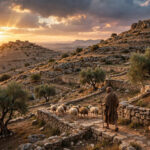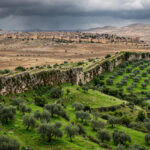
“Bethlehem” means “house of bread.” And the book of Ruth opens with the bitter irony that there was “a famine in the land” — in the house of bread, there was no bread (Ruth 1:1). A man named Elimelech — “my God is king” — took his family and left the house of bread for Moab, chasing food. He died there. His sons died there. His widow Naomi came home empty, asking to be called Mara — “bitter.”
That is the Bible’s way with famine: it is never just about empty fields. Every famine in Scripture is a portrait — of testing, of warning, of provision, of return. Walk through the gallery of the Bible’s great famines, and each one preaches its own sermon. Together, they preach one: God is present in the lean years, and the lean years are never the end of the story.
Abraham’s Famine: The Test at the Border
It came almost immediately. God had just promised Abram the land — “to your offspring I will give this land” (Genesis 12:7) — and “there was a famine in the land” (12:10). The ink on the promise was barely dry. Abram’s response? He “went down to Egypt to sojourn there.” No prayer recorded. No waiting. Just a strategic retreat — which unraveled into the Sarah-and-Pharaoh debacle (12:11-20).
The lesson is uncomfortable: the first test after a promise is often whether you will trust the Promiser when the circumstances contradict Him. Abram failed it. God rescued him anyway — Pharaoh sent him away loaded with gifts (12:16, 20), grace covering the failure. But the famine exposed something: a faith strong enough to leave Haran was not yet strong enough to stay in Canaan when the rains failed.
Contrast his son. A generation later, “there was a famine in the land, besides the former famine that was in the days of Abraham” (Genesis 26:1). Isaac started for Egypt too — and God stopped him: “Do not go down to Egypt… dwell in this land… and I will be with you” (26:2-3). Isaac stayed. And “Isaac sowed in that land and reaped in the same year a hundredfold” (26:12) — in the famine year. The son passed the test the father failed. Famines reveal; they also disciple. What tested Abraham trained Isaac.
Joseph’s Famine: The Dream That Fed Nations
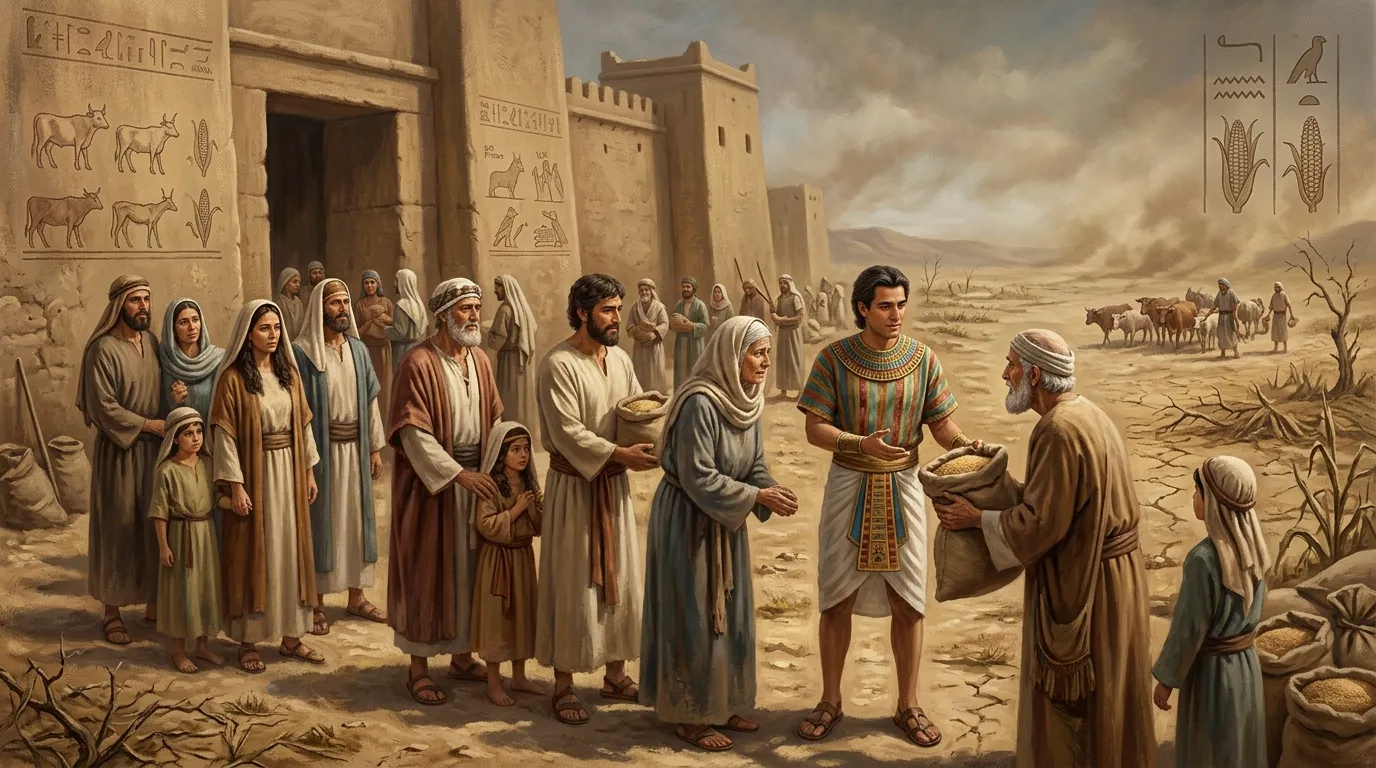
The most famous famine in the Bible began as a dream — Pharaoh’s dream of seven fat cows devoured by seven lean, seven full ears swallowed by seven thin (Genesis 41:1-7). Joseph’s interpretation was blunt: “There will come seven years of great plenty… but after them there will arise seven years of famine” (41:29-30). And his counsel was practical: store during the plenty; survive during the famine.
Three sermons in this famine. First: God warns before He wounds. The famine did not arrive unannounced; heaven sent a fourteen-year forecast. “God has revealed to Pharaoh what he is about to do” (41:28) — judgment with a warning label is mercy. Second: wisdom is stewardship. Joseph’s plan — store a fifth in the good years (41:34) — is the Bible’s theology of preparation: trust God and fill the barns. Faith is not passivity. Third: God writes straight with crooked lines. The famine that Joseph predicted became the instrument that saved his family — the brothers came to Egypt for grain (42:1-3), and Joseph could finally say: “God sent me before you to preserve life… it was not you who sent me here, but God” (45:7-8). The famine was the mechanism of reunion. What looked like judgment on the land was, for one family, the road home.
Ruth’s Famine: The Road Back to Bread
Return to Bethlehem, house of bread, emptied by famine. Elimelech’s solution was geography: leave the land, find food in Moab. It ended in three graves. Naomi’s solution, years later, was return: “she arose… to return from the country of Moab, for she had heard… that the LORD had visited his people and given them food” (Ruth 1:6).
The famine preaches here by contrast. Leaving the place of promise led to death; returning to it led to life — to Boaz’s field, to gleaning among the sheaves, to a marriage, to a son named Obed, “the father of Jesse, the father of David” (4:17). The house of bread had bread again. And the famine that emptied it became the opening chapter of the Messiah’s genealogy (Matthew 1:5). God does His finest work in the fields of famine. The emptiest chapters often precede the fullest.
Elijah’s Famine: Ravens, a Widow, and a Jar That Never Emptied
“As the LORD, the God of Israel, lives, before whom I stand, there shall be neither dew nor rain these years, except by my word” (1 Kings 17:1). Elijah announced the famine — three and a half years of it (Luke 4:25) — as judgment on Baal worship. (Baal was supposedly the storm god; a drought was a theological argument.) And then God fed His prophet through the judgment He had announced: ravens brought bread and meat morning and evening at the Kerith brook (17:6), and when the brook dried, a widow’s jar of flour and jug of oil “were not spent” (17:14-16).
The sermon: judgment and provision can flow from the same hand at the same time. The land was under discipline; the prophet was under care. The widow — a Gentile, down to her last meal — became the channel of miracle because she obeyed first: “make me a little cake of it” first, Elijah said, and she did (17:13). The jar emptied itself into obedience and never ran dry. Famines test generosity as much as faith: the miracle came not to the hoarder but to the giver.
Elisha’s Famine: “By This Time Tomorrow”
The siege-famine of Samaria was the Bible’s grimmest: “a donkey’s head was sold for eighty shekels of silver” (2 Kings 6:25) — and worse followed, too dark to detail. Into this horror Elisha spoke the most audacious promise in the famine gallery: “Tomorrow about this time a seah of fine flour shall be sold for a shekel… in the gate of Samaria” (7:1). Abundance, overnight, at the city gate.
The king’s officer scoffed: “If the LORD himself should make windows in heaven, could this thing be?” (7:2). Elisha’s reply was terrible: “You shall see it with your own eyes, but you shall not eat of it.” And so it happened — the Arameans fled in a God-sent panic, the camp was plundered, food flooded the market — and the scoffing officer was trampled at the gate (7:16-20). The famine ended in a day; the cynic’s unbelief ended him. The lesson stands as a warning over every dark season: do not mock the promise because you cannot see the mechanism. God’s “tomorrow” does not need your understanding — only, for your sake, your faith.
The Famine of the Word
The prophets saw a famine worse than any crop failure. “Behold, the days are coming, declares the Lord GOD, when I will send a famine on the land — not a famine of bread, nor a thirst for water, but of hearing the words of the LORD” (Amos 8:11). People would “stagger from sea to sea… to seek the word of the LORD, but they shall not find it” (8:12).
This is the famine gallery’s final portrait — and its most searching. Physical famines drive people to God; the famine of the Word is what happens when people have driven God away and discover the silence. It is the famine of neglected Bibles, unprayed prayers, and churches entertained but not fed. The cure is the same as the prevention: “Man shall not live by bread alone, but by every word that comes from the mouth of God” (Matthew 4:4). Feed on the Word now, in the years of plenty, and no famine — of bread or of hearing — will find you empty.
And the New Testament adds the church’s answer to famine: generosity. When Agabus prophesied “a great famine over all the world” (Acts 11:28), the disciples at Antioch did not hoard — “each according to his ability, determined to send relief to the brothers living in Judea” (11:29). The first church’s famine response was not panic but sharing. That is still the prescription: in lean years, the people of God do not clutch; they open their hands — and discover, like the widow of Zarephath, that the jar does not empty. For the historical record of the most famous biblical famine — Joseph’s seven lean years — Wikipedia’s article on the seven years of famine gathers the biblical account alongside its ancient Near Eastern context.