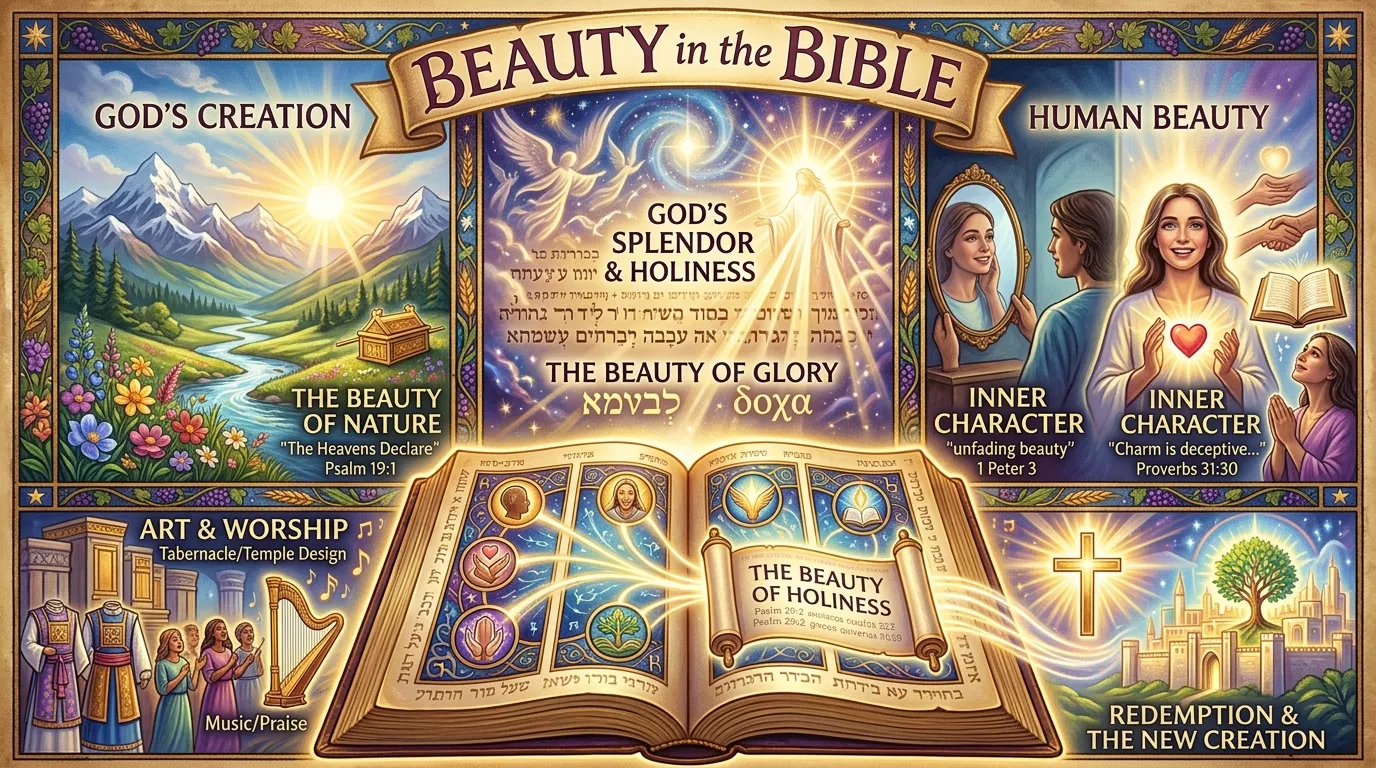
The Bible refuses to give a simple answer about beauty — and that refusal is the answer. Scripture will not join the world’s two lazy options: it will not worship beauty as the highest good, and it will not despise beauty as a worthless trap. Instead it holds both truths at once, the way you hold a gift in open hands: beauty is a genuine good, created by God — and a genuine danger, corrupted by sin. Lose either half and you lose the Bible’s wisdom entirely.
This double vision runs through the whole canon. The same book that warns “charm is deceitful, and beauty is vain” (Proverbs 31:30) also pauses, again and again, to note that Sarah was beautiful, Rachel was beautiful, Joseph was beautiful, David was beautiful, Esther was beautiful — recording their attractiveness the way it records their courage or wisdom, as a simple fact about people God used. Beauty in the Bible is neither idol nor enemy. It is a created gift, good in the Giver’s hand and dangerous in grasping ones.
Beautiful People in a True Story
Start with the record, because it surprises the stereotype that Scripture is anti-beauty. Sarah was so beautiful that Abraham feared kings would kill him to take her — twice (Genesis 12:11, 14; 20:2). Rachel is described as “beautiful in form and appearance” (Genesis 29:17), and Jacob loved her at first sight. Joseph inherited the family looks — “handsome in form and appearance” (Genesis 39:6) — a detail the narrative includes without apology. David was “ruddy and had beautiful eyes and was handsome” (1 Samuel 16:12). Abigail was “discerning and beautiful” (1 Samuel 25:3) — brains and beauty in the same verse, no conflict implied. Esther was “beautiful in form” (Esther 2:7), and her beauty became the instrument of a nation’s rescue.
Why does the Bible bother telling us this? Partly because it is honest history — these people were beautiful, and the record keeps the fact. But partly because it is making a quiet theological point: God is not embarrassed by beauty. He made it. The opening chapter of Genesis calls the whole created order — sunsets and symmetry included — “very good” (Genesis 1:31). Physical attractiveness is part of the “very good,” a genuine gift of the Giver of every good gift (James 1:17). The church has sometimes acted as though holiness requires homeliness, as if God prefers His people plain. The Bible never says that. It says beauty is real, God made it, and — like every good gift — it needs wisdom to handle.
Esther’s story is the showcase. Her beauty won a pagan king’s favor, and that favor positioned her to expose a genocide: “who knows whether you have not come to the kingdom for such a time as this?” (Esther 4:14). Beauty, stewarded with courage and fasting, became a rescue operation. The gift was not the problem. The gift, surrendered to God, was the solution.
The Warning Label: Charm Is Deceitful
But every gift in a fallen world comes with a warning label, and beauty’s is printed in large type. The Bible’s most quoted sentence on the subject is also its most sobering: “Charm is deceitful, and beauty is vain, but a woman who fears the LORD is to be praised” (Proverbs 31:30). The Hebrew word translated “vain” is hebel — vapor, breath, the same word Ecclesiastes uses for the fleetingness of all earthly things. Beauty is hebel: real, but vaporous; present today, gone tomorrow. To build your identity on it is to build on mist.
Proverbs sharpens the warning with an image no one forgets: “Like a gold ring in a pig’s snout is a beautiful woman without discretion” (Proverbs 11:22). The gold is real — the proverb does not deny the beauty — but the setting ruins it. Beauty without character is not neutral; it is wasted glory, precious metal in a place that cannot honor it. The verse indicts not the beautiful but the undiscerning: the tragedy is a genuine gift worn by an unworthy life.
Scripture shows the warning lived out. Absalom was famously handsome — “in all Israel there was no one so much to be praised for his handsome appearance” (2 Samuel 14:25) — and his beauty became the vehicle of his vanity, his rebellion, and his death, his glorious hair tangling in the oak branches (2 Samuel 18:9). The king of Tyre, in Ezekiel’s lament, was “the signet of perfection, full of wisdom and perfect in beauty” — until “your heart was proud because of your beauty” (Ezekiel 28:12, 17). The pattern is unvarying: beauty received is a gift; beauty worshiped — especially self-worshiped — becomes a curse. The serpent’s oldest lie, “you will be like God” (Genesis 3:5), finds a willing audience in every mirror.
This is why the New Testament warns against the cultivation of beauty as identity. “Do not let your adorning be external — the braiding of hair and the putting on of gold jewelry, or the clothing you wear” (1 Peter 3:3). Peter is not banning hairstyles; he is dethroning them. The problem is never the gold. The problem is the heart that says this is who I am, this is my worth, this is my power. Beauty as decoration: fine. Beauty as deity: fatal.
The Beauty That Does Not Fade
Against the vapor of hebel-beauty, Scripture sets a beauty with a different half-life. “But let your adorning be the hidden person of the heart with the imperishable beauty of a gentle and quiet spirit, which in God’s sight is very precious” (1 Peter 3:4). Imperishable — the exact opposite of vapor. A gentle and quiet spirit does not wrinkle, sag, or go out of style. It is beautiful at twenty and beautiful at ninety, and it is beautiful in God’s sight, which is the only sight that finally matters.
This is the Bible’s great redefinition, and it begins with God’s own values. When Samuel went to anoint a king and was dazzled by Eliab’s impressive appearance, God corrected the prophet’s aesthetics: “Do not look on his appearance or on the height of his stature… For the LORD sees not as man sees: man looks on the outward appearance, but the LORD looks on the heart” (1 Samuel 16:7). The verse does not say appearance is evil; it says appearance is not the criterion. God’s beauty standard is cardiac, not cosmetic.
What does cardiac beauty look like? The Bible sketches it in lives, not in mirrors: Abigail’s wisdom under pressure (1 Samuel 25), Ruth’s loyal love in the fields (Ruth 1-2), Mary’s ponderings in her heart (Luke 2:19), Dorcas “full of good works and acts of charity” (Acts 9:36). And supremely, Christ Himself — of whom Isaiah said there was “no beauty that we should desire him” (Isaiah 53:2), yet whose character draws the worship of heaven. If the most beautiful Person who ever lived was not physically striking, then beauty was never mainly about the body. It was always about the person — and persons are beautified from the inside out.
Adorning the Doctrine: Beauty as Witness
There is a final, surprising turn in the Bible’s teaching: beauty — rightly ordered — becomes evangelism. Paul tells bondservants to be submissive and honest “so that in everything they may adorn the doctrine of God our Savior” (Titus 2:10). Adorn — the word means to decorate, to make beautiful. A life of integrity beautifies the gospel it carries. The doctrine is true on its own; the adorned life makes it attractive.
This reframes the whole question. The issue was never “is beauty good or bad?” The issue is what your life is making beautiful. A gentle spirit makes the gospel beautiful. A generous life makes God’s character beautiful to watching neighbors. A church marked by love makes Christ beautiful to a watching world — “by this all people will know that you are my disciples, if you have love for one another” (John 13:35). The most important beauty treatment in Scripture is not applied to the face but to the conduct: “women should adorn themselves… with what is proper for women who profess godliness — with good works” (1 Timothy 2:9-10). Good works are the cosmetics of godliness, and they never run, streak, or fade.
So receive beauty as the gift it is — in a sunset, in a face, in the mirror, without guilt and without worship. Heed the warning label: charm deceives, beauty vaporizes, and the heart that builds on either is building on mist. Cultivate the imperishable kind, the hidden person of the heart, the gentle and quiet spirit God calls precious. And then spend that beauty the way Esther spent hers: not on yourself, but on the rescue of others. That is what beauty is for — not to be admired, but to adorn: to make the doctrine of God our Savior lovely in the eyes of a world that desperately needs to see it.
The Bible’s most famous portrait of this wisely-ordered beauty — the woman whose worth outshines vapor — is the subject of Wikipedia’s article on Proverbs 31, which surveys the passage’s text, interpretations, and cultural influence.










