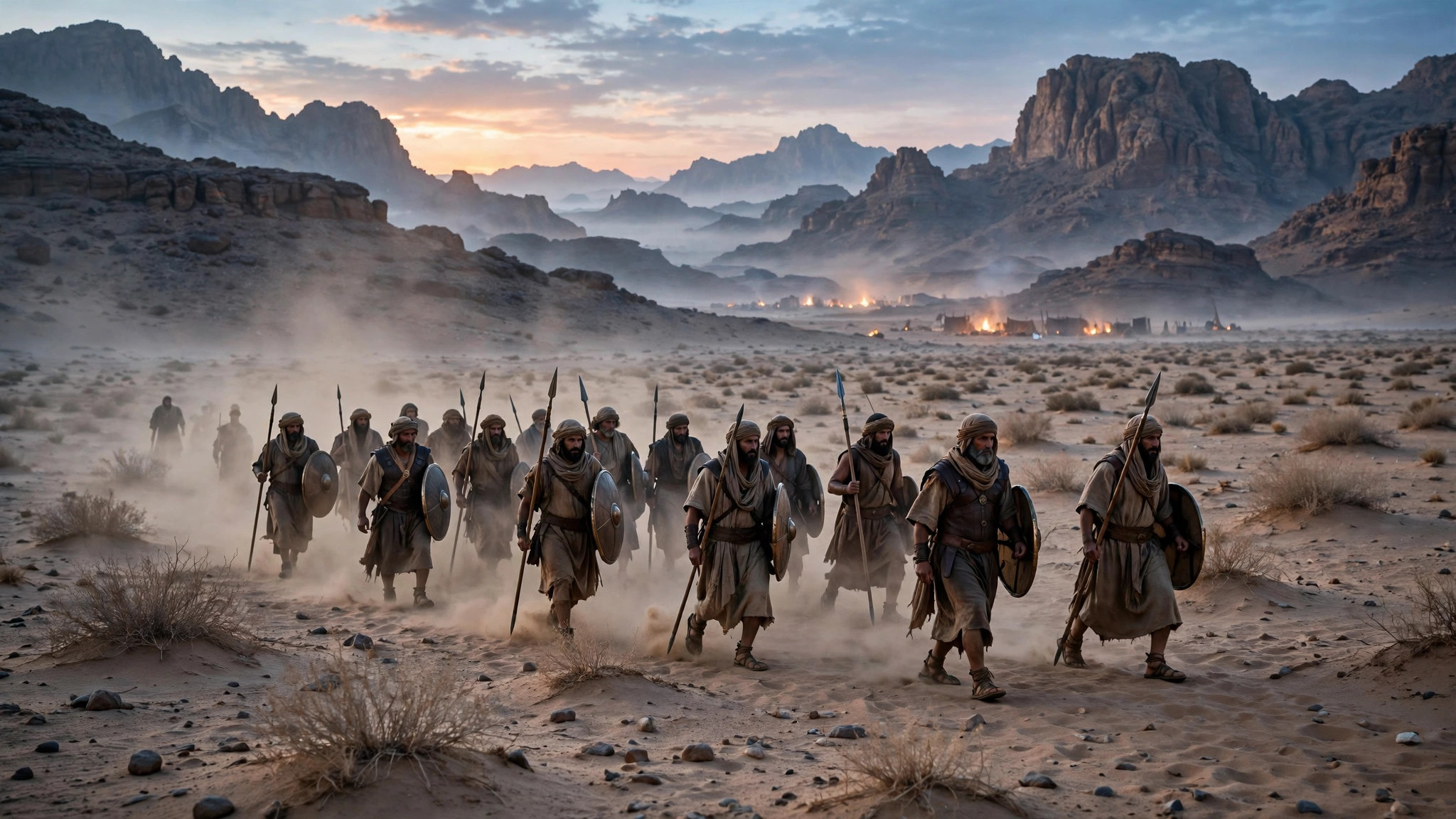
Between Egypt and the Promised Land stretched forty years of desert — and it was not a peaceful walk. Israel faced ambushes, rebellions, plagues, and full-scale battles in the wilderness. The wilderness wars in the Bible reveal something profound: God often does his deepest work in his people not in seasons of comfort, but in seasons of conflict. The wilderness was Israel’s battlefield and God’s classroom.
If you are walking through a hard season right now — opposition at work, conflict at home, spiritual attack you cannot quite name — the wilderness wars have a message for you. You are not forgotten in the desert. You are being formed there.
The First Ambush: Amalek at Rephidim
Israel had barely left Egypt when trouble came. At Rephidim, the Amalekites attacked the stragglers at the rear — the tired, the slow, the vulnerable. Moses sent Joshua into battle while he climbed a hill with the staff of God in his hand. “As long as Moses held up his hands, the Israelites were winning, but whenever he lowered his hands, the Amalekites were winning” (Exodus 17:11). When Moses grew tired, Aaron and Hur held his hands up until sunset — and Israel won.
Deuteronomy remembers the cruelty of that attack: Amalek “attacked all who were lagging behind” (Deuteronomy 25:17-18, in substance). The lesson is timeless: the enemy strikes where we are weakest, and victory comes not from willpower alone but from intercession and community. Moses could not hold his hands up alone. He needed Aaron and Hur. Every believer needs people who will hold up their hands when they cannot.
Moses built an altar and named it “The Lord is my Banner” (Exodus 17:15). The name was the theology: in the wilderness, God himself is the flag we rally under.
The War Within: Rebellion at Kadesh and Korah
Not every wilderness war was fought against outsiders. Some of the fiercest battles were internal. At Kadesh Barnea, the spies returned from Canaan with a report of giants, and the people refused to enter the land. “We should choose a leader and go back to Egypt,” they said (Numbers 14:4, in substance). Fear became rebellion, and rebellion became a forty-year sentence: that generation would wander until it died in the desert (Numbers 14:29-34, in substance).
Then came Korah’s rebellion (Numbers 16). Korah and 250 leaders challenged Moses and Aaron: “You have gone too far! The whole community is holy” (Numbers 16:3). The earth opened and swallowed the rebels. The message was severe but clear: God appoints leadership, and resenting his order is not humility — it is pride dressed as spirituality.
The wilderness wars teach us that the most dangerous enemy is often not outside the camp but inside the heart. Fear, grumbling, and rebellion can defeat us more thoroughly than any army. “Do not grumble, as some of them did” (1 Corinthians 10:10, in substance), Paul warns — because the wilderness generation’s story was “written down as warnings for us” (1 Corinthians 10:11).
The Bronze Serpent: A Battle Won by Looking
One of the strangest episodes in the wilderness came when the people, impatient and grumbling, were bitten by venomous snakes. God told Moses to make a bronze serpent and put it on a pole: “Anyone who is bitten can look at it and live” (Numbers 21:8). Those who looked lived. Those who refused died.
It was not magic. It was a picture. Centuries later, Jesus explained it himself: “Just as Moses lifted up the snake in the wilderness, so the Son of Man must be lifted up, that everyone who believes may have eternal life in him” (John 3:14-15). The wilderness war against the serpents was won not by fighting but by looking — by faith in God’s provided remedy. Every spiritual battle since has followed the same pattern: we do not save ourselves; we look to the One lifted up for us.
The Kings of the East: Sihon and Og
As Israel approached Canaan from the east, two Amorite kings blocked the way: Sihon of Heshbon and Og of Bashan, a giant whose bed was famously thirteen feet long. Israel asked for peaceful passage; both kings refused and attacked. God gave both into Israel’s hands (Numbers 21:21-35, in substance).
These victories mattered enormously. They gave Israel its first territory — the Transjordan lands — and its first proof that the giants of Canaan could be beaten. The same God who defeated the kings of the east would defeat the kings of the west. “Do not be afraid,” God told Moses before the battle with Og, “for I have delivered him into your hands” (Numbers 21:34, in substance). Fear is the wilderness war’s first battlefield; God’s promise is the weapon that wins it.
The Final War: Midian and the Seduction of Compromise
The last wilderness war was the most insidious. The Midianites, following Balaam’s advice, seduced Israel into idolatry and immorality at Baal Peor. It was not an army that nearly destroyed Israel — it was a party. Twenty-four thousand died in the plague that followed (Numbers 25, in substance). The lesson is sobering: the enemy who cannot defeat you in open battle will try to seduce you into compromise. Many believers survive persecution and fall to pleasure.
Israel’s response, under God’s command, was a war of judgment against Midian (Numbers 31, in substance). It was a harsh chapter — and a reminder that sin is not a trifle. The wilderness wars were not only about territory. They were about holiness: a people being purged of Egypt, of idolatry, of compromise, so they could enter the land as a people set apart.
The Pattern of Every Wilderness War
Across all these battles, a pattern emerges. First, the enemy attacks at the point of weakness — the rear of the column, the moment of fear, the season of impatience. Second, human strength is never enough; Israel wins when God fights for them. “The Lord will fight for you; you need only to be still” (Exodus 14:14). Third, the real battle is always about trust: will Israel believe God’s promise, or will it retreat to Egypt?
Paul picks up the same pattern for Christians: “Our struggle is not against flesh and blood, but against the rulers, against the authorities, against the powers of this dark world and against the spiritual forces of evil in the heavenly realms” (Ephesians 6:12). The wilderness generation fought Amalekites and Amorites; we fight temptations, lies, and spiritual opposition. The weapons are different, but the Commander is the same.
What the Wilderness Wars Mean for Your Battle Today
First, expect battles in the wilderness. The wilderness is not a detour from God’s plan — it is part of it. “God did not lead them on the road through the Philistine country, though that was shorter” (Exodus 13:17, in substance), because they were not ready. The long road was the training ground.
Second, find your Aaron and Hur. No one wins wilderness wars alone. Moses needed hands held up; Joshua needed an army; Israel needed intercessors. If you are fighting alone, you are fighting at a disadvantage God never intended.
Third, remember that God fights for you. “If God is for us, who can be against us?” (Romans 8:31). The wilderness wars were never won by Israel’s strength. They were won by God’s presence — the pillar of cloud by day and fire by night (Exodus 13:21), the manna in the morning, the water from the rock. The God who was with them in the desert is with you in yours.
Fourth, keep your eyes on the pole. When the serpents bite — when guilt, fear, or addiction strikes — the answer is not to try harder but to look to Christ, lifted up for you. “Everyone who believes may have eternal life in him” (John 3:15).
The Wilderness as a Place of Tender Speech
It would be a mistake to think the wilderness was only a battlefield. It was also a place of tenderness. Through Hosea, God said of his unfaithful people, “I will allure her into the wilderness and speak tenderly to her” (Hosea 2:14, in substance). The wilderness is where God speaks softly — away from the noise of Egypt, away from the distractions of the crowd, in a place where his voice is the only one left.
Moses understood this. When God offered to send Israel into the land without his presence, Moses refused: “If your Presence does not go with us, do not send us up from here” (Exodus 33:15). The wilderness without God’s presence is a wasteland. The wilderness with his presence is a sanctuary. The difference between a desert and a holy place is not the landscape. It is the presence.
That is why the wilderness wars, for all their violence, were also acts of love. God was not punishing Israel by keeping them in the desert. He was protecting them from a land they were not ready for, and forming them into a people who could possess it. “Be alert and of sober mind. Your enemy the devil prowls around like a roaring lion looking for someone to devour” (1 Peter 5:8) — and it is in the wilderness, where we learn to watch and pray, that we become ready to stand. The desert is God’s training ground, and his tenderness is the training.
The God of the Wilderness Goes With You
The wilderness wars ended with Israel camped on the edge of the Promised Land, battle-tested and ready. The desert had not destroyed them. It had forged them. The same God who led them through forty years of war walks with you through your wilderness. The battles are real. The Commander is greater. And the land ahead is worth every step. For historical background on the book that records these campaigns, the Wikipedia article on the Book of Numbers offers a helpful overview.










