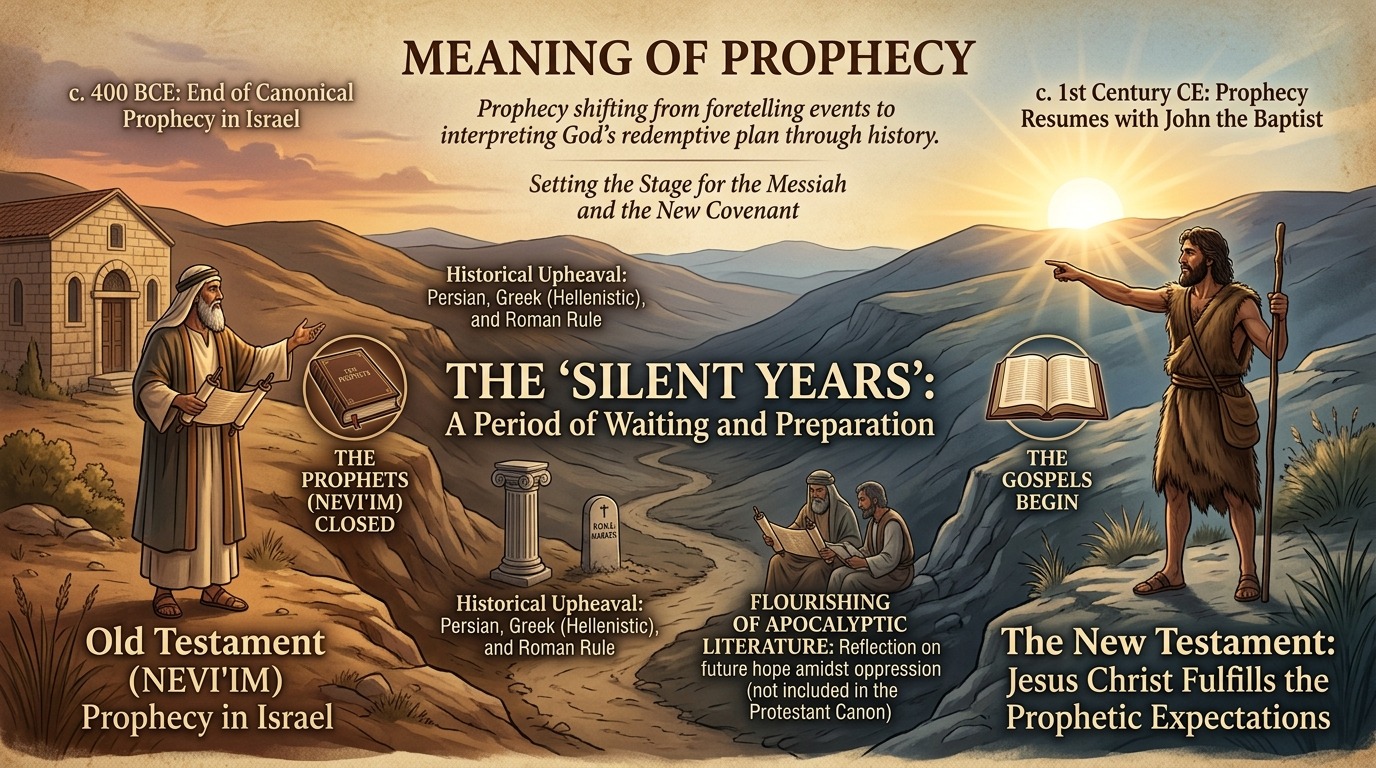
The Old Testament ends with a promise and then — silence. Malachi, the last of the prophets, closes with God’s pledge: “See, I will send the prophet Elijah to you before that great and dreadful day of the LORD comes” (Malachi 4:5). Then the voice stops. No new prophet rises. No new book is written. For roughly four hundred years, heaven seems to go quiet — the period often called the “silent years” or the intertestamental period. Generations were born, lived, and died without hearing a fresh word from God. It is one of the most theologically loaded silences in history, because what looks like divine absence turns out, on inspection, to be divine preparation. The silence was not empty. It was a workshop.
What Actually Happened in the Silence
The four centuries between Malachi and Matthew were anything but uneventful — they were among the most turbulent in Jewish history. When the Persian Empire fell to Alexander the Great (333 BC), the ancient world changed overnight. Alexander’s conquests spread Greek language and culture across the East; after his death, his empire fractured, and Judea became a tug-of-war prize between the Ptolemies of Egypt and the Seleucids of Syria.
The darkest chapter came under the Seleucid king Antiochus IV Epiphanes (175–164 BC). Determined to Hellenize the Jews by force, he banned circumcision, Sabbath observance, and temple sacrifice — and then committed the act Daniel had foreseen centuries earlier: he erected a pagan altar over the altar of burnt offering and sacrificed a pig on it, the “abomination that causes desolation” (Daniel 11:31; 1 Maccabees 1:54). It was the nearest thing to the end of Judaism the world had seen.
Instead it sparked a revolt. The Maccabean uprising — led by the priest Mattathias and his sons, especially Judas Maccabeus — recaptured Jerusalem, cleansed the temple, and restored sacrifice (the event commemorated in Hanukkah, which Jesus Himself observed, John 10:22). A century of fragile Jewish independence under the Hasmoneans followed, decaying into civil war — until Rome arrived. Pompey took Jerusalem in 63 BC, and by the time of Christ, Judea groaned under Roman occupation and the paranoid, murderous reign of Herod the Great. That is the world into which the silence finally broke: occupied, divided, longing — and ready.
The World Being Readied
Here is the remarkable thing: every one of those upheavals was laying track for the gospel. Consider what the “silent” centuries produced. A common language. Alexander’s conquests made Koine Greek the lingua franca of the Mediterranean world — the very language in which the New Testament would be written, precise enough for theology and common enough for fishermen. The Hebrew Scriptures were translated into Greek (the Septuagint), putting the Old Testament into the hands of the Gentile world. Roads and peace. Rome built the roads and enforced the Pax Romana — the first era in history when a traveler could move from Jerusalem to Rome in relative safety. Paul’s missionary journeys were possible because Caesar’s legions kept the highways. Synagogues and dispersion. Jews scattered across the empire built synagogues in every major city — each one a ready-made audience of God-fearing Gentiles and a pulpit from which Paul would preach Christ (Acts 13:5; 17:2). The dispersion meant that when Pentecost came, “God-fearing Jews from every nation under heaven” were already in Jerusalem to hear it (Acts 2:5).
Paul names the logic outright: “When the set time had fully come, God sent his Son” (Galatians 4:4). The set time. The silence had a schedule. God was not late; He was preparing — a language for the message, roads for the messengers, synagogues for the audiences, an empire for the stage, and a people whose long ache for deliverance had never been sharper. The four hundred years were not a divine shrug. They were stagecraft.
Prophecy Didn’t Stop — It Was Being Fulfilled
There is a second, deeper truth about the silent years: prophecy didn’t cease; it was coming true. Daniel’s visions — given centuries earlier — read like a newsreel of the intertestamental period. The ram and the goat of Daniel 8 (Medo-Persia and Greece), the little horn of Daniel 8:9–14 (Antiochus Epiphanes, almost universally agreed by scholars), the detailed “kings of the North and South” of Daniel 11 tracing the Ptolemaic-Seleucid wars with eerie precision — all of it unfolded during the silence. The generation living through those events didn’t need a new prophet; they needed to open Daniel.
And the longest fuse of all was still burning: Daniel’s seventy weeks (Daniel 9:24–27), the prophecy that times the coming of “the Anointed One” to the very generation in which Jesus appeared. When the silence finally broke — with an angel’s announcement to an old priest in the temple (Luke 1) — it broke exactly on Daniel’s schedule. The quiet centuries were the sound of prophecy being fulfilled in real time. God had spoken enough. He was now doing what He had spoken.
The Books Written in the Silence
The silent years were quiet in one specific sense — no new canonical prophecy — but they were not literarily silent. Jewish writers produced a rich body of literature during these centuries, and knowing about it fills out the world of the New Testament. The books of 1 and 2 Maccabees record the revolt against Antiochus Epiphanes in vivid detail — they are our primary historical source for the darkest and bravest chapter of the intertestamental period. Sirach (Ecclesiasticus) offers wisdom in the tradition of Proverbs. The Wisdom of Solomon meditates on justice and immortality. Tobit and Judith tell edifying stories of faithfulness under foreign rule.
Honesty requires the denominational footnote: Protestants do not regard these books as Scripture — they are the Apocrypha, valuable for history but not authoritative for doctrine — while Catholics and Orthodox include most of them in their canons as deuterocanonical. But whatever one’s canon, the history they record is real, and the New Testament world they illuminate is the world Jesus walked into. When Paul writes about the resurrection, when Hebrews mentions those “tortured, refusing to be released” (Hebrews 11:35), when Jesus celebrates Hanukkah — the background is Maccabean.
There is a lesson in this for how we read God’s silences. Even when heaven seemed quiet, God’s people were still writing, still remembering, still reasoning about His ways. The community of faith kept the story alive through the centuries without a fresh word — sustained by the old words, faithfully transmitted. Synagogues preserved the Torah; scribes copied it with reverent precision; families told the stories. When the silence broke in Bethlehem, it broke upon a people who still knew the promises — because they had kept them, carefully, through four hundred years of quiet. Faithfulness in the silence is what makes recognition possible when the silence ends.
What the Silence Teaches
The intertestamental silence preaches to everyone living in their own quiet season — praying without answers, waiting without signs, wondering if heaven has gone mute. Its lessons are three. Silence is not absence. The Jews of 200 BC felt abandoned; they were being positioned. God’s quiet is not God’s indifference. The workshop is always running, even when the announcements stop. Waiting is part of the plan, not a failure of it. Four hundred years of waiting ended in a manger in Bethlehem. Your waiting — for healing, for direction, for the promise to ripen — is not wasted time; it is preparation time, and God wastes nothing. Trust the last word until the next one comes. Malachi’s final promise — Elijah coming before the great day — was enough to carry faithful Jews through four centuries. God’s last word to you is enough to carry you until His next one. “Be still, and know that I am God” (Psalm 46:10) was never a call to passivity; it is a call to confident stillness, the kind that knows the silence has a schedule.
And then, after four hundred years, the silence broke — not with a prophet, but with a baby’s cry. “The people walking in darkness have seen a great light” (Isaiah 9:2) — the prophecy Isaiah spoke before the silence became the reality that ended it. Every quiet season in God’s people ends the same way: not with an explanation, but with an arrival. For the historical overview of this period — the empires, the Maccabees, the literature written between the testaments — see the Wikipedia article on the intertestamental period; for the meaning that steadies waiting hearts, remember that the longest silence in Scripture ended in Bethlehem — and your silence has a Bethlehem too.










