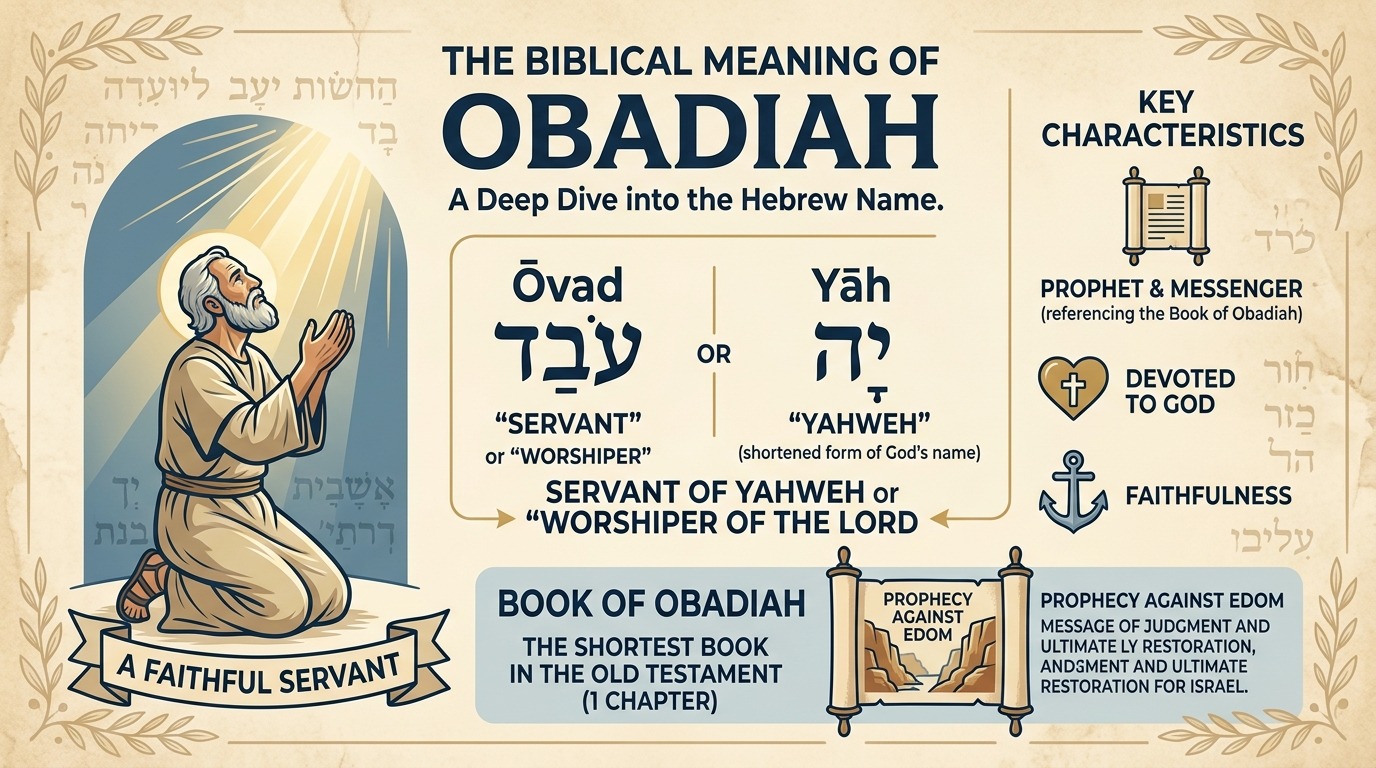
It is the shortest book in the Old Testament — twenty-one verses, one chapter, readable in five minutes. Its author is a man we know nothing about except his name. And its subject is a nation most readers have never thought about. Yet Obadiah carries a message as large as any in the prophets: pride goes before a fall, God judges the nations, and “the kingdom will be the LORD’s.” Small book, enormous theology — and a warning that still searches every heart that has ever looked down on someone else.
The Servant of Yahweh
“The vision of Obadiah.” That is all the introduction we get — no king’s reign, no hometown, no genealogy. The name itself is the biography: Obadyah, “servant of Yahweh” (or “worshiper of Yahweh”). In an age when many Israelites hedged their bets with Baal, the prophet’s parents named their son as a confession: we serve the LORD. At least a dozen Obadiahs appear in the Old Testament — including the palace official who hid a hundred prophets from Jezebel (1 Kings 18) — but the prophet’s identity is lost to history. Perhaps fittingly: the servant’s name matters more than the servant’s fame. The message is everything; the messenger is a shadow.
The book’s date is debated, but its occasion is clear from its content: the fall of Jerusalem. When Babylon destroyed the city (586 BC), Judah’s neighbor and kin — Edom — did not merely watch. They cheered, they looted, they cut down fugitives. Obadiah is God’s response to that betrayal: a prophecy against Edom and a promise to Israel, delivered in twenty-one burning verses.
Edom: The Brother Who Became the Enemy
To feel Obadiah’s weight, you have to know the family history. Edom was descended from Esau; Israel from Jacob — twin brothers, and the rivalry never died. When Israel came up from Egypt and asked permission to pass through Edomite territory, Edom refused with an army at the border (Numbers 20:14–21). For centuries the enmity simmered: wars under Saul, David, and Jehoram; revolts and reprisals.
Then came Jerusalem’s darkest day, and Edom’s true colors showed. Psalm 137 — written from the Babylonian exile — remembers it with anguish: “Remember, LORD, what the Edomites did on the day Jerusalem fell. ‘Tear it down,’ they cried, ‘tear it down to its foundations!'” (Psalm 137:7). Obadiah is more specific: Edom “stood aloof” while strangers carried off Jerusalem’s wealth; worse, they “entered the gates” of the city, “cast lots” for its people, looted its goods, “stood at the crossroads to cut down their fugitives,” and “handed over their survivors in the day of their trouble” (Obadiah 1:11–14). Eight times in four verses the phrase “in the day of” tolls like a bell — the day of Jerusalem’s trouble, and Edom made it worse. This was not neutrality; it was fratricide with a smile. Brother turned predator.
The Eagle’s Nest: Pride Before the Fall
Obadiah diagnoses Edom’s disease in the book’s most famous line: “The pride of your heart has deceived you, you who live in the clefts of the rocks and make your home on the heights, you who say to yourself, ‘Who can bring me down to the ground?'” (Obadiah 1:3).
The geography explains the arrogance. Edom occupied the rugged mountains of Seir — a natural fortress of red-rock cliffs, narrow defiles, and the legendary rock city of Sela (later Petra), accessible only through a winding canyon. Edom’s security felt geological: who can bring me down? God’s answer is withering: “Though you soar like the eagle and make your nest among the stars, from there I will bring you down” (1:4). Height is no defense against heaven. Every fortress humanity builds — military, financial, technological, intellectual — is a cleft in the rock, and the God who made the rocks is not impressed by them.
Note the psychology: “the pride of your heart has deceived you.” Pride is not just arrogance; it is self-deception. It tells the climber the mountain cannot fall, the rich man his wealth cannot fail, the powerful nation its dominance cannot end. Edom believed its own press release. Obadiah’s warning is universal: whatever your “clefts of the rocks” are — the advantages you count on, the strengths you trust instead of God — they are precisely where pride nests, and precisely where judgment will find you.
The Day of the LORD: “As You Have Done”
The book’s moral center is a principle as old as Scripture and as current as today’s news: “The day of the LORD is near for all nations. As you have done, it will be done to you; your deeds will return upon your own head” (Obadiah 1:15). The lex talionis of history — what goes around comes around, but with divine authorship. Edom looted Jerusalem; Edom will be looted. Edom cut down fugitives; Edom’s own survivors will find no refuge. “They will be as if they had never been” (1:16) — the most total erasure pronounced on any nation in the prophets.
And history obliged. Within a few centuries, Edom was overrun by Nabatean Arabs, its people pushed westward into the Negev, its name fading from the map. By the time of Christ, the Edomites — now called Idumeans — were a subject people, and their most famous son, Herod the Great, was a Roman puppet. The eagle’s nest is empty; Petra is a tourist site. “As you have done, it will be done to you” is not a threat. It is a description of how God’s world works.
But the principle cuts both ways, and Obadiah knows it. “The day of the LORD is near for all nations” — not just Edom. Every nation, every person, every reader stands under the same moral law: cruelty returns, pride falls, deeds come home. The book’s warning against Edom is simultaneously a warning to everyone tempted to Edom’s sins — which is everyone.
“The Kingdom Will Be the LORD’s”
Yet Obadiah does not end with Edom’s grave. The final verses turn to Israel’s restoration: “But on Mount Zion will be deliverance; it will be holy, and Jacob will possess his inheritance” (1:17). The house of Jacob will be a fire, the house of Joseph a flame, and the house of Esau stubble (1:18) — the reversal complete. The exiles will return and possess the lands; “deliverers will go up on Mount Zion to govern the mountains of Esau.”
And the book’s last sentence is its largest: “And the kingdom will be the LORD’s” (1:21). Seven Hebrew words, and they swallow every empire. Edom’s kingdom fell. Babylon’s kingdom fell. Rome’s kingdom fell. Every “cleft of the rocks” humanity has trusted has crumbled — but the kingdom of the LORD stands, because it was never built on cliffs. It is built on the character of God: just enough to judge Edom, merciful enough to restore Jacob, sovereign enough to have the last word over both.
Obadiah’s meaning, in twenty-one verses: pride deceives, cruelty returns, and God reigns. The servant of Yahweh, nameless to history, delivered a message history cannot forget — because every generation builds its eagle’s nest, and every generation needs to hear: from there, he will bring you down. And for everyone crushed under someone else’s pride, the promise stands just as sure: on Mount Zion there will be deliverance, and the kingdom will be the LORD’s.
Edom’s Last Chapter: Herod
Obadiah pronounced Edom’s erasure — “as if they had never been” (1:16) — but the Edomites did not vanish overnight. Pushed westward by Nabatean Arabs, they settled in the Judean south, became known as Idumeans, and were eventually absorbed into Judea. And then history delivered its final irony: the most famous Idumean of all seized the throne of David.
Antipater the Idumean rose to power under Rome, and his son Herod — Herod the Great — was crowned “King of the Jews” by the Roman Senate in 40 BC. An Edomite, a descendant of Esau, ruling over the descendants of Jacob. The ancient rivalry reached its grotesque climax in Matthew’s Gospel: hearing of a newborn “king of the Jews,” Herod ordered the massacre of Bethlehem’s infants (Matthew 2:16) — Esau’s heir trying to murder Jacob’s ultimate heir, the child of Micah’s prophecy. The attempt failed; the child escaped to Egypt and returned. Edom’s last bid for supremacy ended in a slaughtered nursery and an empty tomb it could not seal. “The kingdom will be the LORD’s” — Obadiah’s final sentence — outlasted them all.
For the historical background — Edom’s geography, the Babylonian destruction of Jerusalem, and the book’s place among the Minor Prophets — the Wikipedia article on the Book of Obadiah is a helpful place to read further.










