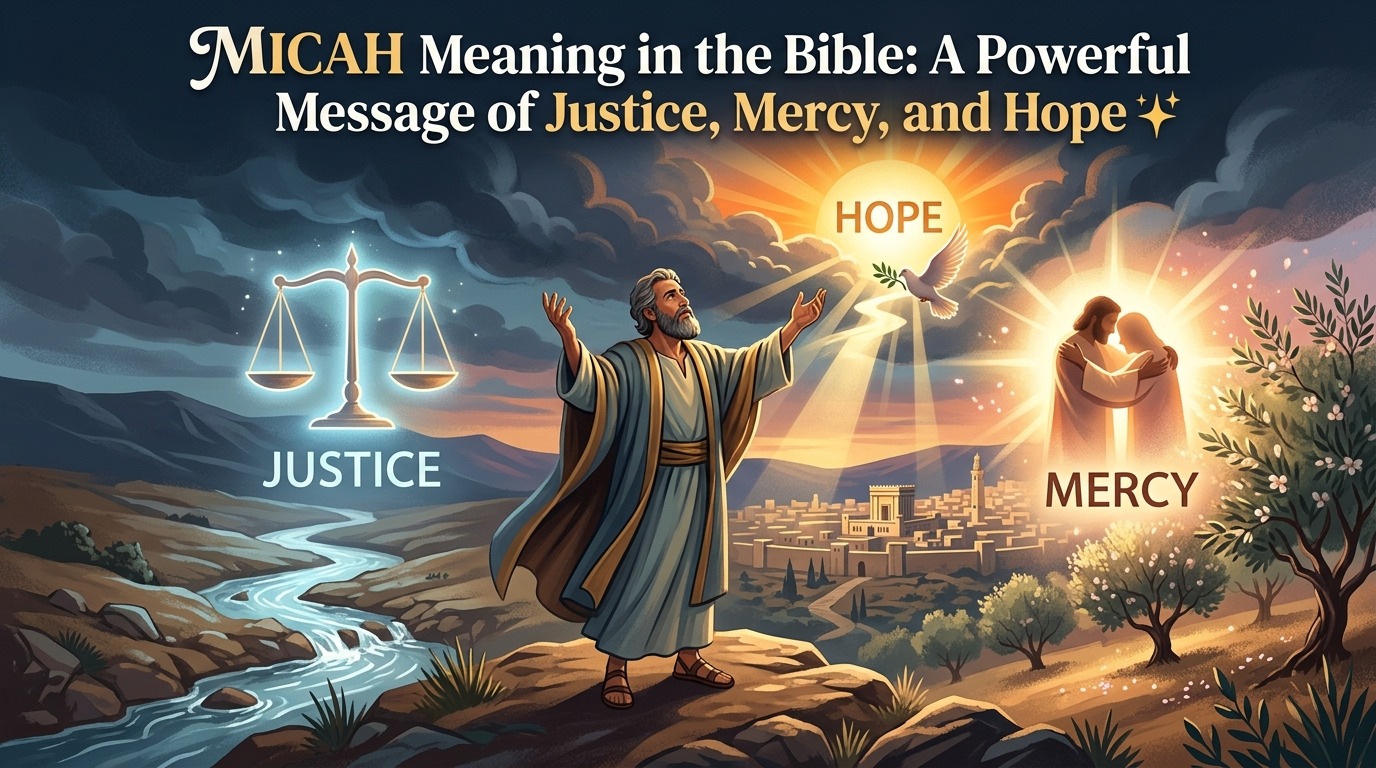
His name is a question: Mikah — “Who is like the LORD?” It hangs over his entire prophecy like a title page, because everything Micah says is an answer to it. Who is like the LORD? Not the corrupt judges taking bribes. Not the prophets preaching for pay. Not the empires devouring nations. The LORD alone — just in judgment, merciful in forgiveness, faithful in promise. Micah ministered in Judah during the reigns of Jotham, Ahaz, and Hezekiah (Micah 1:1), the same turbulent era as Isaiah, and watched the northern kingdom fall to Assyria while warning Judah it could be next. His book is short — seven chapters — but it contains one of the most quoted verses in the Old Testament and one of its most precise prophecies of Christ.
The Courtroom: “What Does the LORD Require?”
The book’s center of gravity is chapter 6, staged as a divine lawsuit. God calls the mountains and hills as witnesses — creation itself empaneled as jury — and brings his case against Israel: “My people, what have I done to you? How have I burdened you? Answer me” (Micah 6:3). Then the prosecution rests its evidence, and it is devastating in its tenderness: I brought you up out of Egypt; I redeemed you from slavery; I sent Moses, Aaron, and Miriam; I frustrated Balak’s curses and turned them to blessing (6:4–5). “My people, remember.” The case is not built on Israel’s failures but on God’s faithfulness — which makes the failures inexcusable.
The people’s imagined response is painfully relatable — the instinct to negotiate with rituals: “With what shall I come before the LORD?… Shall I come before him with burnt offerings, with calves a year old? Will the LORD be pleased with thousands of rams, with ten thousand rivers of olive oil? Shall I offer my firstborn for my transgression?” (6:6–7). More religion. Bigger sacrifices. Escalating the externals while the heart stays untouched — the perennial human strategy for managing guilt without repentance.
Then the verse that made Micah immortal: “He has shown you, O mortal, what is good. And what does the LORD require of you? To act justly and to love mercy and to walk humbly with your God” (Micah 6:8). Three phrases, and the whole of practical religion. Act justly — do right in your dealings, especially toward the powerless. Love mercy — not merely show it when convenient but love it, make kindness your delight. Walk humbly with your God — the daily, unshowy companionship of a creature with its Creator. Justice, mercy, humility: the vertical and the horizontal, the public and the private, held together. Jesus would later distill the law the same way — love God, love neighbor (Matthew 22:37–40) — and rebuke the Pharisees for tithing mint while neglecting “the more important matters of the law — justice, mercy and faithfulness” (Matthew 23:23). Micah 6:8 is the Old Testament in one sentence.
Corrupt Leaders: When the Watchmen Are Wolves
Micah’s sharpest anger is reserved not for the pagan nations but for Judah’s own leaders. Chapter 3 is a blistering indictment: “you who hate good and love evil; who tear the skin from my people and the flesh from their bones” (3:2) — the rulers as cannibals, devouring the flock they were appointed to protect. The prophets “proclaim ‘peace’ if they have something to eat, but prepare to wage war against anyone who refuses to feed them” (3:5) — truth for sale to the highest bidder. Priests “teach for a price” (3:11).
And the leaders’ complacency is the most damning detail: “they lean on the LORD and say, ‘Is not the LORD among us? No disaster will come upon us'” (3:11). They commit evil while claiming God’s favor — using religion as a shield against the consequences of irreligion. Micah’s verdict: “Therefore because of you, Zion will be plowed like a field, Jerusalem will become a heap of rubble, the temple hill a mound overgrown with thickets” (3:12). A century later, when the elders of Judah wanted to execute Jeremiah for prophesying Jerusalem’s fall, other elders quoted this exact verse to save him — “Micah of Moresheth prophesied in the days of Hezekiah… and Hezekiah did not put him to death” (Jeremiah 26:17–19). Micah’s words outlived him by generations, still defending prophets.
Bethlehem: The Ruler From the Smallest Town
But judgment is never Micah’s last word — and here the book takes its most astonishing turn. To a nation facing the Assyrian war machine, Micah announces: “But you, Bethlehem Ephrathah, though you are small among the clans of Judah, out of you will come for me one who will be ruler over Israel, whose origins are from of old, from ancient times” (Micah 5:2).
Bethlehem — a village too small to matter, David’s birthplace, five miles from Jerusalem. From there will come the ruler — and his “origins are from of old, from ancient times,” literally “from days of eternity.” A human birthplace and an eternal origin in one verse: the God-man, seven centuries before the manger. When Herod’s scholars were asked where the Messiah would be born, they quoted Micah 5:2 without hesitation (Matthew 2:5–6). The prophecy goes on: “He will stand and shepherd his flock in the strength of the LORD… And he will be our peace” (5:4–5). The shepherd-king from the little town — the answer to the wolf-leaders of chapter 3.
This is Micah’s pattern throughout: judgment, then hope; the wound, then the bandage. Chapters 4–5 paint the future in glowing colors — the mountain of the LORD’s temple raised above the hills, nations streaming to it, swords beaten into plowshares (4:1–3, echoing Isaiah 2). The “who is like the LORD” of his name finds its answer: no one judges like him, and no one restores like him either.
“He Delights in Mercy”
The book’s final paragraph is one of the most beautiful closings in the prophets. After seven chapters of lawsuit and lament, Micah ends in wonder: “Who is a God like you, who pardons sin and forgives the transgression of the remnant of his inheritance? You do not stay angry forever but delight to show mercy” (Micah 7:18). The name’s question becomes the closing confession. Who is like the LORD? No one — in mercy.
“You will again have compassion on us; you will tread our sins underfoot and hurl all our iniquities into the depths of the sea” (7:19). The image is total: sins not filed away, not suspended, but drowned — hurled into the sea’s depths, where no one can retrieve them. It is the Old Testament’s “as far as the east is from the west” (Psalm 103:12), the promise the New Testament will fulfill at the cross. And the book’s last line reaches back to the beginning: “You will be faithful to Jacob, and show love to Abraham, as you pledged on oath to our ancestors in days long ago” (7:20). The God who judges is the God who keeps his promises — to Abraham, to David, to Bethlehem, to us.
Micah’s meaning, then, is his name asked and answered. Who is like the LORD? No god judges evil the way he does — thoroughly, fearlessly, beginning with his own people’s leaders. And no god forgives the way he does — delighting in mercy, treading sins underfoot, keeping ancient promises to unworthy heirs. Act justly, love mercy, walk humbly: that is what he requires. And he delights to show mercy: that is who he is. The question is the answer.
Two Prophets, One Crisis
Micah did not minister alone. His career overlapped Isaiah’s — both prophesied in Judah during the reigns of Jotham, Ahaz, and Hezekiah, both watched Assyria devour the northern kingdom, both warned Jerusalem. And the overlap produced one of Scripture’s most remarkable moments: Micah 4:1–3 and Isaiah 2:2–4 contain nearly identical prophecies — “they will beat their swords into plowshares and their spears into pruning hooks.” Two prophets, the same vision, the same words. Either one borrowed from the other, or both drew from a common source; either way, the duplication is God’s emphasis. The future he is promising is certain.
The two complement each other beautifully. Isaiah soars — the throne room, the Servant, the cosmic scope. Micah grounds — the bribed judge, the stolen field (Micah 2:2), the farmer’s grievance. Isaiah speaks to kings in palaces; Micah, from the country town of Moresheth, speaks for the villagers crushed by those kings’ policies. Together they model the full range of prophecy: the majestic and the mundane, the cosmic and the concrete. God’s word comes in both registers, because God’s people live in both.
For the historical context of Micah’s ministry — the Assyrian crisis, the reigns of Jotham, Ahaz, and Hezekiah, and the book’s literary structure — the Wikipedia article on Micah the prophet offers a solid overview.










