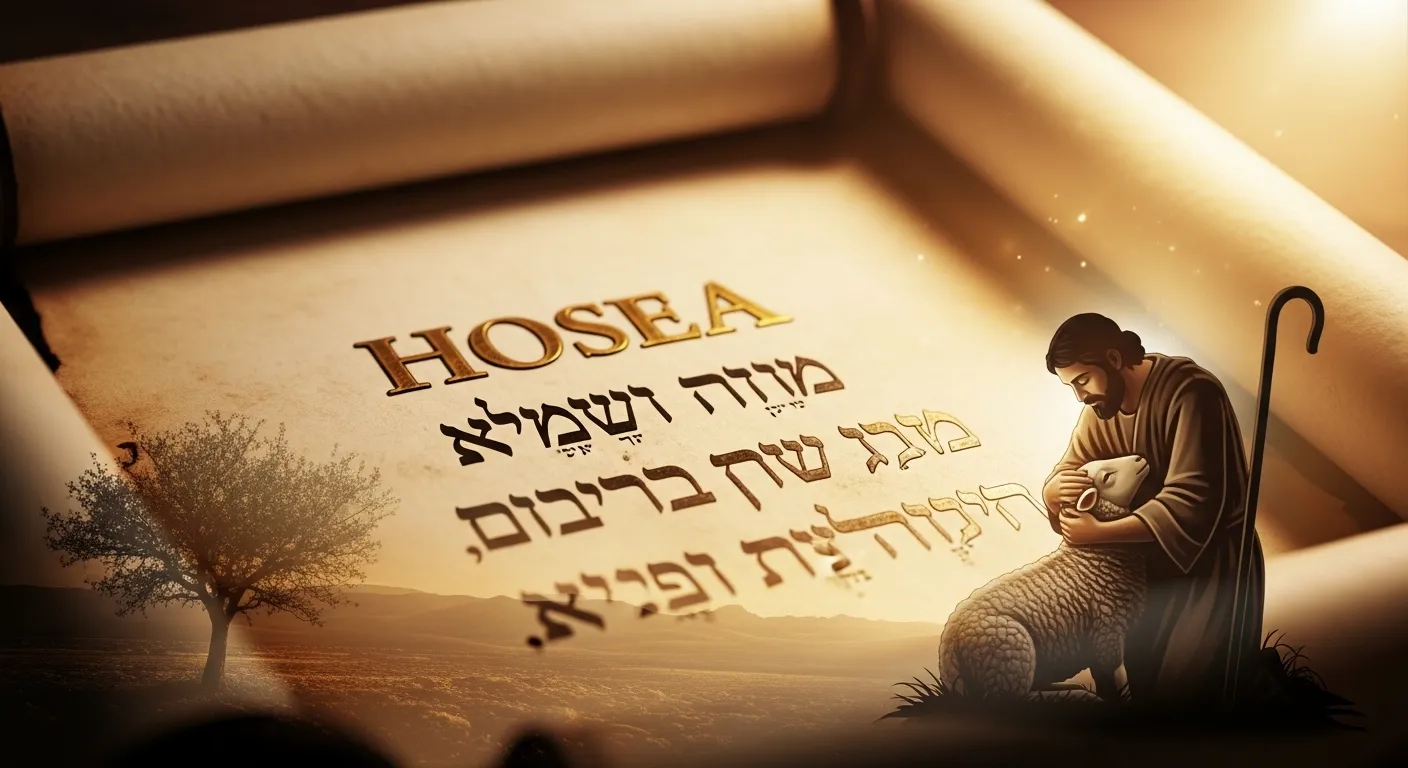
No prophet received a stranger assignment. “Go, marry a promiscuous woman and have children with her,” God told Hosea, “for like an adulterous wife this land is guilty of unfaithfulness to the LORD” (Hosea 1:2). It is the most shocking opening line of any prophetic book — and the most revealing. God did not merely give Hosea a message about Israel’s unfaithfulness. He made him live it. Hosea’s marriage would become a walking, weeping parable of the gospel: a husband who keeps loving a wife who keeps leaving, because that is what God is like. His very name announced the theme — Hoshea, “salvation,” the same root as Joshua and Jesus. The prophet named Salvation would embody the God who saves.
Act One: The Wedding
Hosea married Gomer, daughter of Diblaim (Hosea 1:3). The text does not romanticize it. Gomer would prove unfaithful — whether she was already promiscuous at the marriage or became so, scholars debate; what matters is what the marriage meant. Every other prophet preached with words. Hosea preached with his home. His neighbors didn’t need a sermon on Israel’s spiritual adultery; they could watch it at Hosea’s house.
The genius of the enacted parable is that it bypasses arguments and goes straight to the heart. Israel’s idolatry was not, in their minds, a big deal — Baal worship was the respectable religion of the age, the god of rain and fertility, the sensible choice for farmers. Hosea’s marriage forced the nation to feel what they were doing. Every time Gomer left, Israel was meant to see itself leaving. Every time Hosea waited, Israel was meant to see God waiting. Theology you can argue with; a broken marriage you can only weep over. God chose the weeping.
Act Two: The Children With Terrible Names
Then came the children, and God named them like headlines. The first son: Jezreel — named for the valley where Jehu’s dynasty had seized power through bloodshed, a name announcing that God would “punish the house of Jehu for the massacre at Jezreel” and “put an end to the kingdom of Israel” (Hosea 1:4–5). The second, a daughter: Lo-Ruhamah — “not loved,” or “no mercy”: “I will no longer show love to Israel, that I should at all forgive them” (Hosea 1:6). The third, a son: Lo-Ammi — “not my people”: “you are not my people, and I am not your God” (Hosea 1:9).
Imagine growing up with those names. Every school roll call was a sermon. Every introduction — “this is Not-Loved, and this is Not-My-People” — was a reminder that the covenant was broken and judgment was coming. It is the bleakest baby-naming in Scripture, and it was deliberate: God wanted Israel to hear, in the most personal terms possible, where their idolatry was leading. Yet even here, mercy flickers. God immediately adds that the day will come when “they will be called ‘children of the living God'” and Lo-Ammi’s verdict will be reversed: “I will say to those called ‘Not my people,’ ‘You are my people'” (Hosea 1:10; 2:23). Paul would later quote that reversal as the charter of Gentile inclusion (Romans 9:25–26). The terrible names were temporary. The mercy underneath was permanent.
Act Three: The Purchase
The book’s emotional climax comes in chapter 3 — three short paragraphs that contain one of the Bible’s most staggering scenes. Gomer had left, descended into what the text suggests was outright slavery or destitution, and God told Hosea: “Go, show your love to your wife again, though she is loved by another man and is an adulteress” (Hosea 3:1). So Hosea went to the slave market and bought back his own wife — “for fifteen shekels of silver and about a homer and a lethek of barley” (Hosea 3:2).
Read that slowly. The prophet paid the price of a slave to redeem the woman who had betrayed him — not because she deserved it, not because she had reformed, but because God told him to, “just as the LORD loves the Israelites, though they turn to other gods” (Hosea 3:1). This is redemption in its rawest form: love paying full price for the unworthy. Every element preaches Christ — the purchase price, the unworthy recipient, the love that acts before repentance. “God demonstrates his own love for us in this: While we were still sinners, Christ died for us” (Romans 5:8) is Hosea 3 in New Testament dress. The church has always seen it: we are Gomer, and Christ is the Husband who came to the slave market.
The Heart of God in Chapter 11
If chapter 3 shows God’s love in action, chapter 11 shows it in soliloquy — God thinking aloud about His rebellious people, and the result is the tenderest passage in the prophets. “When Israel was a child, I loved him, and out of Egypt I called my son… It was I who taught Ephraim to walk, taking them by the arms” (Hosea 11:1, 3). The image is a father teaching a toddler — bent over, holding small hands, catching every stumble. Then the grief: “The more they were called, the more they went away.” And then the cry that has undone readers for millennia:
“How can I give you up, Ephraim? How can I hand you over, Israel?… My heart is changed within me; all my compassion is aroused. I will not carry out my fierce anger” (Hosea 11:8–9).
This is God debating with Himself — justice demanding judgment, love refusing to let go — and love winning the argument without canceling justice. “For I am God, and not a man — the Holy One among you” (Hosea 11:9). His holiness is not the cold purity we imagine; it is a burning holiness that cannot abandon its own. Hosea 11 is the Old Testament’s clearest window into the heart that would one day weep over Jerusalem (Luke 19:41) and bleed on a cross.
The Names Reversed
Don’t miss the quietest miracle in Hosea: God takes back the terrible names. “I will plant her for myself in the land,” God says; “I will show my love to the one I called ‘Not my loved one.’ I will say to those called ‘Not my people,’ ‘You are my people’; and they will say, ‘You are my God'” (Hosea 2:23). Lo-Ruhamah becomes Ruhamah — loved. Lo-Ammi becomes Ammi — my people. The names given as verdicts are revoked as promises. What God called them in judgment, He un-calls in mercy.
This is the Bible’s pattern for every renamed sinner. Abram the childless becomes Abraham the father of many. Jacob the deceiver becomes Israel the prince with God. Simon the unstable becomes Peter the rock. And Saul the persecutor becomes Paul the apostle. God specializes in renaming — not by denying what was, but by declaring what will be. The old name described the sin; the new name describes the grace. “You will be called by a new name that the mouth of the LORD will bestow” (Isaiah 62:2).
It is worth asking what names you are still wearing. Failure. Addict. Divorced. Too far gone. Not enough. Some were given by others; some you gave yourself; some feel like verdicts from heaven. Hosea’s God says otherwise: the names of judgment are not permanent. Bring them to the One who renames, and hear what He calls you now — loved, mine, restored. “See what great love the Father has lavished on us, that we should be called children of God! And that is what we are!” (1 John 3:1). The slave-market purchase of Hosea 3 was the price; the reversed names of Hosea 2 are the receipt. You are not who you were. You are who He says you are.
The Last Word: Return
Hosea ends where every true gospel ends — with an invitation. “Return, Israel, to the LORD your God… Take words with you and return to the LORD. Say to him: ‘Forgive all our sins and receive us graciously'” (Hosea 14:1–2). God even supplies the prayer; the returning sinner doesn’t have to find the words. And the response is pure grace: “I will heal their waywardness and love them freely, for my anger has turned away from them. I will be like the dew to Israel; he will blossom like a lily” (Hosea 14:4–5).
“I will love them freely.” Not “I will love them when they prove themselves.” Freely — the Hebrew suggests spontaneity, generosity without calculation. The book that began with “marry a promiscuous woman” ends with dew and lilies. That is the trajectory of grace: from the slave market to the garden, from Lo-Ammi to “my people,” from judgment deserved to love freely given.
Hosea’s meaning in the Bible is the meaning of relentless love — the love that marries knowing betrayal is coming, names the children honestly, pays the slave price gladly, weeps over the rebels tenderly, and waits at the end of the road with open arms. If you have ever wondered whether you have wandered too far, Hosea’s answer is God’s answer: return. He has already paid for you. For background on the prophet’s historical setting and the book’s composition, see the Wikipedia article on Hosea; for the love that will not let you go, read the book itself — and come home.










