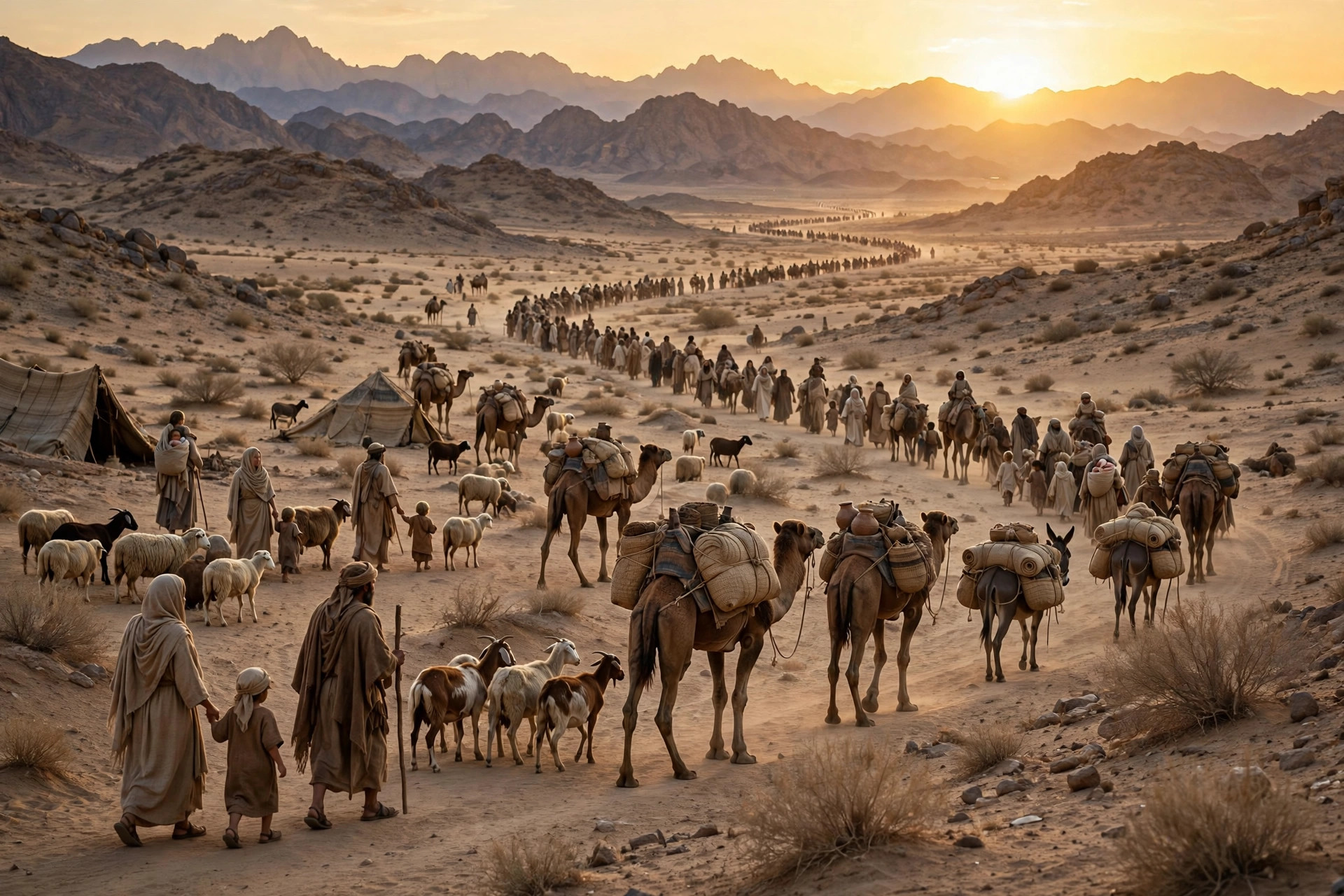
Everyone is on a journey. Some journeys we choose; others are chosen for us. Some begin with a suitcase packed in hope, and some begin with chains broken in the night. The Bible understands this better than any book ever written, because the story of Israel is, from first to last, a story of movement — leaving, wandering, weeping, returning. Migration is not a footnote in Scripture; it is the thread that stitches Genesis to Revelation. To read the Bible honestly is to read about a people always on the road: called out of Ur, down to Egypt, up out of slavery, through the wilderness, into the land, out into exile, back home again, and finally scattered and regathered across the earth. And their story is our story, because the same God who moved Israel is moving in the lives of His people still.
The Call That Started It All: Abraham’s Departure
Long before there was a nation called Israel, there was a man named Abram living comfortably in Ur of the Chaldeans. Then came the voice: “Get out of your country, from your family and from your father’s house, to a land that I will show you” (Genesis 12:1). That single command launched the first great migration of the Bible — a migration with no map, no timeline, and no return ticket. Abraham obeyed. He “went out, not knowing where he was going” (Hebrews 11:8), and in that act of faith a pattern was set that would define his descendants forever: God moves, and His people follow.
The Hebrew Bible has a beautiful word for this kind of journey: aliyah, “ascent.” The pilgrims sang it as they climbed toward Jerusalem — “I was glad when they said to me, ‘Let us go into the house of the LORD'” (Psalm 122:1). Every true migration of God’s people is an ascent in some sense, even when the road goes down into a valley first. Abraham’s obedience teaches the first great truth of Israel’s migration story: God initiates redemptive movement. He calls, He leads, He promises — “I will bless you and make your name great” (Genesis 12:2) — and the blessing travels with the traveler.
Down to Egypt: When the Temporary Becomes Permanent
A famine drove Abraham’s grandson Jacob and his household down to Egypt — seventy people in all (Genesis 46:27), welcomed by Joseph, settled in Goshen. What looked like a temporary refuge became a four-hundred-year stay. The family prospered, and “the children of Israel were fruitful and increased abundantly, multiplied and grew exceedingly mighty; and the land was filled with them” (Exodus 1:7). Seventy migrants became a nation.
This is one of the Bible’s quiet warnings: temporary solutions have a way of becoming permanent seasons. What we enter as shelter can become bondage if we are not watchful. Israel learned in Egypt that a people can forget who they are when they settle too comfortably in a foreign land — yet even there, even under the taskmasters’ lash, God was using migration to shape identity. A family was becoming a nation. A people were learning who their God was, and He was preparing them for the greatest deliverance in their history. The journey is transformation, even the parts we would never have chosen.
Out of the House of Bondage: The Defining Migration
Then came the night that defined a people forever. After plagues that humbled the gods of Egypt, the LORD brought Israel out “with a mighty hand” (Exodus 13:9) — the phrase Scripture repeats like a drumbeat. The waters parted, the people walked through on dry ground, and Pharaoh’s army drowned behind them (Exodus 14). The Exodus is the defining migration of the Bible, the reference point for everything that follows. Whenever Israel forgot who God was, the prophets reminded them: He is the One who brought you out of Egypt (Hosea 13:4).
The Exodus is more than history; it is a picture of salvation itself. The apostle Paul looks back at the crossing of the sea and the cloud that covered them and says the people were “baptized into Moses in the cloud and in the sea” (1 Corinthians 10:2). The movement from slavery to freedom, from bondage to covenant, is the gospel in miniature: God does the delivering, and His people walk through on dry ground. But the Exodus also reveals the second great truth of Israel’s story: God goes with His people. He did not point them toward Canaan and wish them luck. “The LORD went before them by day in a pillar of cloud to lead the way, and by night in a pillar of fire to give them light” (Exodus 13:21-22). On the road with God, no traveler walks alone.
The Long Road Between: Forty Years in the Wilderness
Freedom came fast; maturity came slowly. At the edge of the Promised Land, fear won the vote. Ten spies spread panic, the people wept and wished themselves back in Egypt, and God declared the sentence: “Your carcasses shall fall in this wilderness… For forty years… you shall bear your guilt” (Numbers 14:33-34) — a year for every day the spies had searched the land. The wilderness wanderings were born of unbelief, and Scripture is honest about it.
The wilderness was not only punishment; it was preparation. There God fed them manna every morning (Exodus 16), drew water from rock, and “humbled you and tested you, to know what was in your heart” (Deuteronomy 8:2). The wilderness is where God matures His people — where the slave mentality is unlearned and trust is built one day’s provision at a time. And through it all, the cloud and the fire never left. When the waters rose and the fire burned, God spoke the promise that every wandering believer still clings to: “When you pass through the waters, I will be with you; and through the rivers, they shall not overflow you. When you walk through the fire, you shall not be burned” (Isaiah 43:2). The journey is transformation: God used forty years of circling to turn a crowd of ex-slaves into a covenant people ready for the land.
To Babylon in Chains: The Grief of Exile
Centuries later, Israel made the tragic journey in reverse. After generations of idolatry and ignored prophets, Jerusalem fell. In 586 BC the Babylonians destroyed the temple and dragged the people away in chains (2 Kings 25). This migration had no pillar of fire, no song of deliverance — only tears. “By the rivers of Babylon, there we sat down, yea, we wept when we remembered Zion” (Psalm 137:1).
Exile — galut — is what happens when a people drift from God long enough that judgment finally catches them. But here is the wonder: even in exile, God was not finished. Daniel rose to counsel kings in Babylon; Esther saved her people from the palace in Persia. Exile cannot exile God. He is present in Babylon as surely as in Jerusalem, and He is present in our own exiles too — the seasons when our choices have carried us far from where we meant to be. And the exile was temporary and redemptive. “No chastening seems to be joyful for the present, but painful; nevertheless, afterward it yields the peaceable fruit of righteousness” (Hebrews 12:11). Even in judgment, a promise was smuggled inside: “For I know the thoughts that I think toward you, says the LORD, thoughts of peace and not of evil, to give you a future and a hope” (Jeremiah 29:11). God judges but restores. Scattering is never His last word.
The Road Home: Return and Rebuilding
Seventy years after the fall of Jerusalem, Cyrus king of Persia issued a decree that still startles: the exiles could go home and rebuild the temple (Ezra 1:1-4). Scripture is explicit about why: “The LORD stirred up the spirit of Cyrus.” Wave after wave of returnees made the long journey back — Zerubbabel leading the first, Ezra bringing the Law, Nehemiah rebuilding the walls.
The Hebrew word for it is shuv — “turn, return” — the very root of repentance. Every homecoming in the Bible carries this double meaning: turning back toward a place and turning back toward a Person. God promised it Himself: “I will be found by you, says the LORD, and I will bring you back from your captivity” (Jeremiah 29:14). And Jesus’ parable of the prodigal — the father running to meet the returning son (Luke 15:20) — preaches the same sermon: the road home is always open.
Sometimes God migrates us not to change our address but to change our hearts. A missionary family I once heard of moved across the ocean certain that God had called them to change a nation — only to discover, years later, that He had moved them mainly to change them. That is the pattern of every migration in Israel’s story. The geography mattered, but the transformation mattered more.
Scattered and Gathered: The Migration Still Underway
Israel’s story does not end with the return from Babylon. Jesus warned that the people would be “led away captive into all nations” (Luke 21:24) — and history proved Him right. Yet the prophets insist the scattering is not the final chapter. “He will set up a banner for the nations, and will assemble the outcasts of Israel, and gather together the dispersed of Judah from the four corners of the earth” (Isaiah 11:12). “I will gather you from all the nations… and I will bring you into your own land” (Ezekiel 36:24). This is kibbutz galuyot — the ingathering of the exiles — and Ezekiel’s vision of dry bones breathing back to life (Ezekiel 37) remains one of the most hope-drenched pictures in all of Scripture: God can reassemble what history has scattered.
But the greatest migration of all is still underway, and it is larger than one nation. John saw it: “a great multitude which no one could number, of all nations, tribes, peoples, and tongues, standing before the throne” (Revelation 7:9). The God who called Abraham out of Ur, who led Israel out of Egypt, who brought the exiles home from Babylon, is gathering a people from every nation, tribe, and tongue — and this final migration ends not in a land but in His presence. Scattering is never God’s last word. Gathering is. Every departure in Israel’s story was moving toward this: a homecoming for the whole world, kept by a God who keeps His promises across centuries.
A Traveler’s Rules for the Road
- Follow God’s leading, not the crowd’s panic — when fear shouted “let us return to Egypt,” the faithful chose the cloud’s direction instead (Numbers 14:4).
- Pack light — leave “Egypt” at the border — the golden calf was Egypt smuggled into freedom; some baggage must be abandoned to travel well (Exodus 32).
- Trust daily provision — manna could not be hoarded, only gathered morning by morning; grace works the same way (Exodus 16).
- Remember Egypt with gratitude, not nostalgia — recall what God delivered you from, but never romanticize the chains (Deuteronomy 8:2).
- Care for the foreigner among you — because you know the heart of a stranger, having been strangers yourselves (Leviticus 19:34).
If you want the broader historical picture of this people and their journeys, see the Wikipedia entry on the Israelites.










