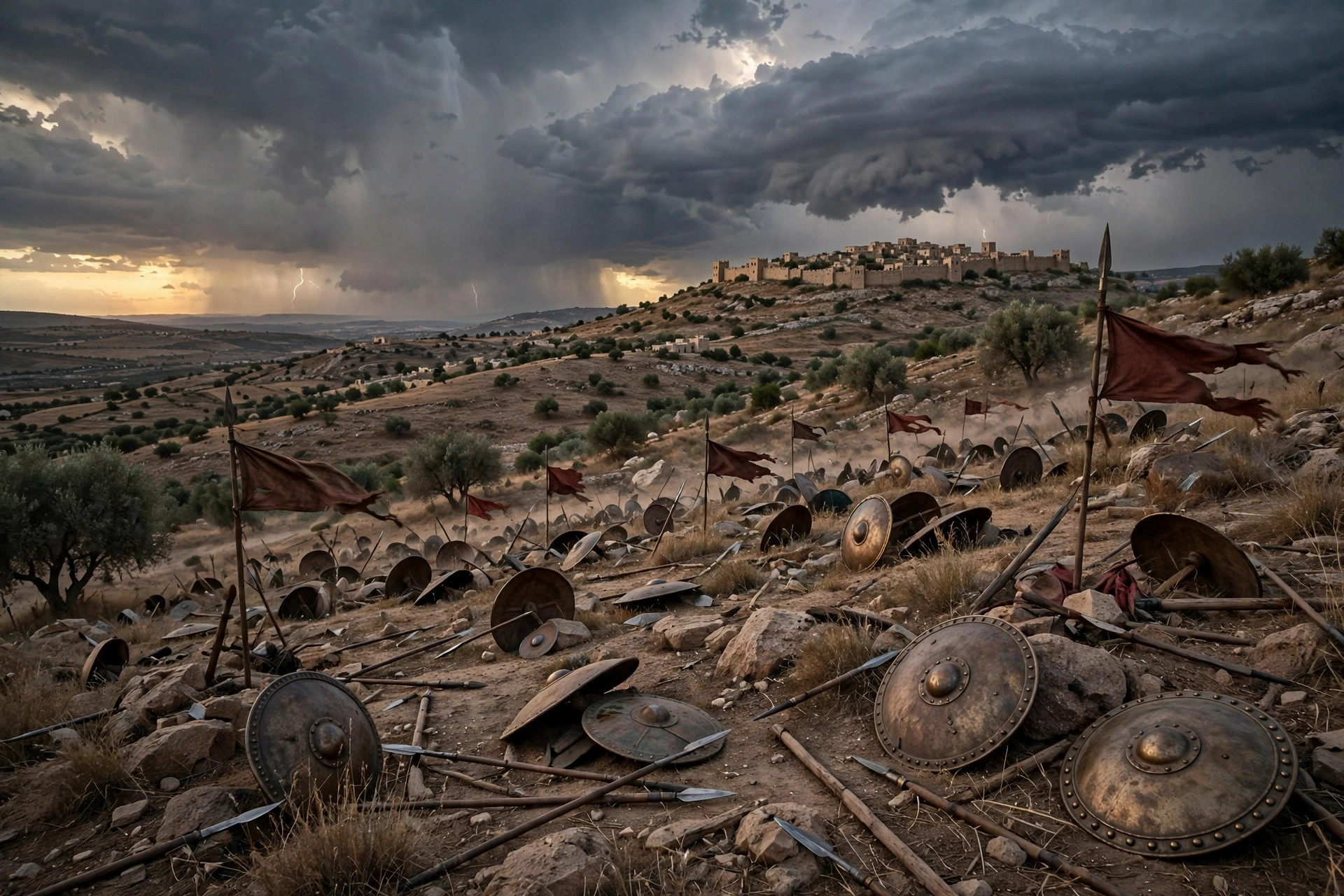
Let’s not pretend. The first time you read the book of Joshua slowly — cover to cover — you will flinch. Cities burned. Kings executed. Entire populations struck down “with the edge of the sword.” So here is the honest question: can you read Joshua without flinching? You shouldn’t be able to. But the harder question is not whether the wars are brutal. It is whether God is good. These are not stories of what men did in God’s name and later regretted — God Himself gave the orders. So let’s put the evidence on the table, like a court examining a record. The record is uncomfortable. Examine it anyway.
The uncomfortable record
The conquest of Canaan under Joshua is among Scripture’s most intense and misunderstood passages. Joshua 1 through 24 describe a campaign of staggering scope: Jericho’s walls collapse, Ai burns, the southern and northern coalitions break, and Joshua 12 closes with a roll call of thirty-one defeated kings. Deuteronomy 20:16–17 records the standing order for these cities: leave alive “nothing that breathes.” The Bible does not hide the body count or offer a footnote of apology. And the sequel is awkward: Israel never finished the job, and Judges opens with the compromise that followed — Canaanites among Israel, intermarriage, idols on the high places. Refuse to shrink these wars. The Bible never calls them pretty. What it calls them is just. Now we have to ask why.
Four hundred years of patience
Go back to Abraham, around 2000 BC. God promised him this land — “To your offspring I will give this land” (Genesis 12:7) — and added a detail most readers miss. In Genesis 15, God told Abraham his descendants would wait four hundred years, and gave the reason in one sentence: “the sin of the Amorites has not yet reached its full measure” (Genesis 15:16). God was not waiting because He was weak or forgetful. He gave the Amorite peoples four centuries of mercy — four hundred years of sunrises, harvests, and chances. Judgment was scheduled. But it was scheduled with patience.
What filled those centuries? The Canaanite cultures descended into practices Scripture calls abominations: child sacrifice — “they even burn their sons and their daughters in the fire to their gods” (Deuteronomy 12:31) — ritual immorality, sorcery and divination. Leviticus 18 draws the line: “the land became unclean, so I punished it for its sin, and the land vomited out its inhabitants” (Leviticus 18:24–25). This was not tribal hatred. God judged the Canaanites the same way He later judged Israel itself for the identical sins — exile and destruction. The standard was moral, not tribal. The delay was mercy, not indifference.
What the war was FOR
Miss what the war was for and you will misread every verse. The Hebrew vocabulary of the conquest is precise. The verb that beats like a drum through these chapters is yarash — to take possession, to inherit, to dispossess. It is the language of an estate, not a raid. When God said Israel would yarash the land, He spoke as a Father settling an inheritance — ground already deeded to Abraham centuries earlier, held in trust until judgment day. Israel was not aggressing; Israel was inheriting, after the current tenants’ four-hundred-year lease expired under judgment.
The second word is harder: cherem — “devoted to destruction,” set apart wholly for God. Whatever fell under the cherem belonged to God, and God ordered its destruction. This is the word behind the totality of the judgment: not ethnic hatred but divine judgment executed through a human army. Deuteronomy 9:4–5 strips away any illusion of Israelite merit: “It is not because of your righteousness… but on account of the wickedness of these nations, the LORD your God will drive them out before you.” God’s verdict on Israel’s self-righteousness, delivered in advance: you did not earn this.
Which is why the conquest cannot be franchised. It was limited to one time, one place, one people: the Canaanites, in the land promised to Abraham, in the generation of Joshua. No later generation received a standing order to repeat it, and no other nation was ever given such a commission. The conquest was a unique judicial act of God in history — not a template for human violence.
Jericho as worship
Then the war begins — as a liturgy. Jericho is the first city, and the battle plan is absurd by every military standard: march around the walls once a day for six days, seven times on the seventh, priests carrying the ark and blowing trumpets, then shout. No battering rams. No siege towers. Just worship, walking in circles, and a shout that brought the walls down (Joshua 6). The point: this victory would be His, not theirs. Israel’s assignment was obedience, not strategy.
And in the middle of the first judgment comes the first mercy. Rahab — a Canaanite prostitute — had heard what God was doing and believed: “the LORD your God, He is God in heaven above and on earth beneath” (Joshua 2:11). She hid the spies, hung the scarlet cord in her window, and when Jericho fell her household was spared (Joshua 6:25). The New Testament holds her up as a model of faith (Hebrews 11:31), and Matthew’s genealogy places Rahab the Canaanite in the bloodline of Jesus (Matthew 1:5). Christians have long read the scarlet cord as a foreshadowing of Christ’s blood: the same color, the same message — judgment is coming, but whoever shelters under this sign will live. Even in the fiercest chapter of the conquest, God was already preaching the gospel.
Ai — the battle lost before it was fought
Jericho’s triumph was followed by Ai’s humiliation — and the defeat had nothing to do with the enemy. Flushed with victory, Israel sent a small force against little Ai and was routed; thirty-six men died, and “the hearts of the people melted in fear and became like water” (Joshua 7:5). Joshua fell facedown, and God’s answer was blunt: “Israel has sinned… That is why the Israelites cannot stand against their enemies” (Joshua 7:11–12). The cause was one man’s hidden disobedience: Achan had taken devoted things from Jericho and buried them under his tent, violating the cherem. One secret sin, and the whole army lost its covering. When his guilt was exposed and judged, the ban lifted, and Ai fell to an ambush the second time (Joshua 8). The conquest did not run on Israel’s courage or numbers; it ran on God’s presence. The battle of Ai was lost before it was fought — lost in the tent, in the heart, in the hidden compromise. Where God was honored, walls fell. Where He was robbed, armies fled.
And the sun stood still
At Gibeon comes the moment that still stops readers cold. With daylight running out, Joshua prayed the boldest prayer in the Old Testament: “Sun, stand still over Gibeon, and you, moon, over the Valley of Aijalon” (Joshua 10:12). The text records the answer without embarrassment: “The sun stopped in the middle of the sky and delayed going down about a full day” (Joshua 10:13). Theologians have debated the mechanism for centuries; the meaning is not debated: “Surely the LORD was fighting for Israel!” This was never Israel’s war. It was God’s, and He was not shy about showing up in it.
The same signature appears centuries later at the Valley of Elah, when David faced Goliath declaring, “The battle is the LORD’s” (1 Samuel 17:47) — human weakness, divine strength, victory credited to God alone. And when the campaigns ended, the verdict was recorded in one sweeping sentence: “So the LORD gave Israel all the land He had sworn to give their ancestors, and they took possession of it and settled there” (Joshua 21:43). Every promise made to Abraham, kept. Four hundred years of patience, fulfilled.
From sword to Spirit
Then the New Testament redirects it. Christians are not called to physical holy war. When Peter drew his sword, Jesus ordered him to put it away: “all who draw the sword will die by the sword” (Matthew 26:52). The early church never raised an army for the gospel. The warfare was reframed entirely: “Our struggle is not against flesh and blood, but against the rulers, against the authorities, against the powers of this dark world” (Ephesians 6:12). The weapons changed too: “The weapons we fight with are not the weapons of the world… they have divine power to demolish strongholds” (2 Corinthians 10:4–5). The conquest’s vocabulary survived, but its battlefield moved — from Canaanite cities to human hearts.
Even the inheritance language carries over. The New Testament word for inheritance is klēronomia — and it now points at something the conquest only foreshadowed: the Holy Spirit “is a deposit guaranteeing our inheritance” (Ephesians 1:14), “an inheritance that can never perish, spoil or fade… kept in heaven for you” (1 Peter 1:4). The land was the down payment; the kingdom is the full estate. And here is the warning the conquest leaves the church: Israel’s incomplete obedience left strongholds standing. “You have not obeyed Me,” the Angel of the LORD said at Bokim; “they will become thorns in your sides” (Judges 2:1–3). The Canaanites Israel tolerated became the idols Israel worshiped. Compromise never stays contained. The conquest generation won the land; the next generation lost the plot — not on a battlefield, but in the slow drift of disobedience.
Was God unjust in commanding the conquest?
No — but only if you read the whole record. God is the judge of all the earth (Genesis 18:25), and judges judge. The Canaanites received four centuries of mercy before judgment, and their practices — child sacrifice, ritual evil — filled the measure (Deuteronomy 12:31). God applied the identical standard to Israel itself, exiling His own people for the same sins (2 Kings 17). A judge who punishes the same crimes in His own people cannot be accused of favoritism. The conquest is the story of a holy God judging sin — and then grafting a believing Canaanite, Rahab, into the Messiah’s own family line. Justice and mercy, side by side.
Do these wars justify violence today?
No. The conquest was a one-time, one-place, one-people judicial act of God — commissioned directly, limited to the Canaanites, in the land promised to Abraham, in Joshua’s generation. No Christian, no nation, no movement has ever received such a commission, and the New Testament forbids the sword for the faith (Matthew 26:52). Every attempt to use Joshua as a license for violence rips the text from its covenant context. The wars of the Old Testament were God’s judgment in history; the warfare of the New Testament is spiritual (Ephesians 6:12). Citing Joshua to justify killing today is not following the Bible — it is defying it.
What is the main spiritual lesson?
God’s patience is long but not infinite — and His judgment, when it comes, is both just and escapable by faith. The conquest teaches three things: take sin seriously, because God does — the judgment that fell on Canaan foreshadows the judgment coming on all unrepentant sin (Revelation 20). Receive mercy while it is offered — Rahab believed and lived. And fight the real war — not against flesh and blood, but against the strongholds in your own heart (2 Corinthians 10:4–5). The promised land wars are not a manual for violence. They are a warning about judgment and an invitation to grace.
For the wider historical background of these campaigns, the Wikipedia overview of Jericho is worth a read.










