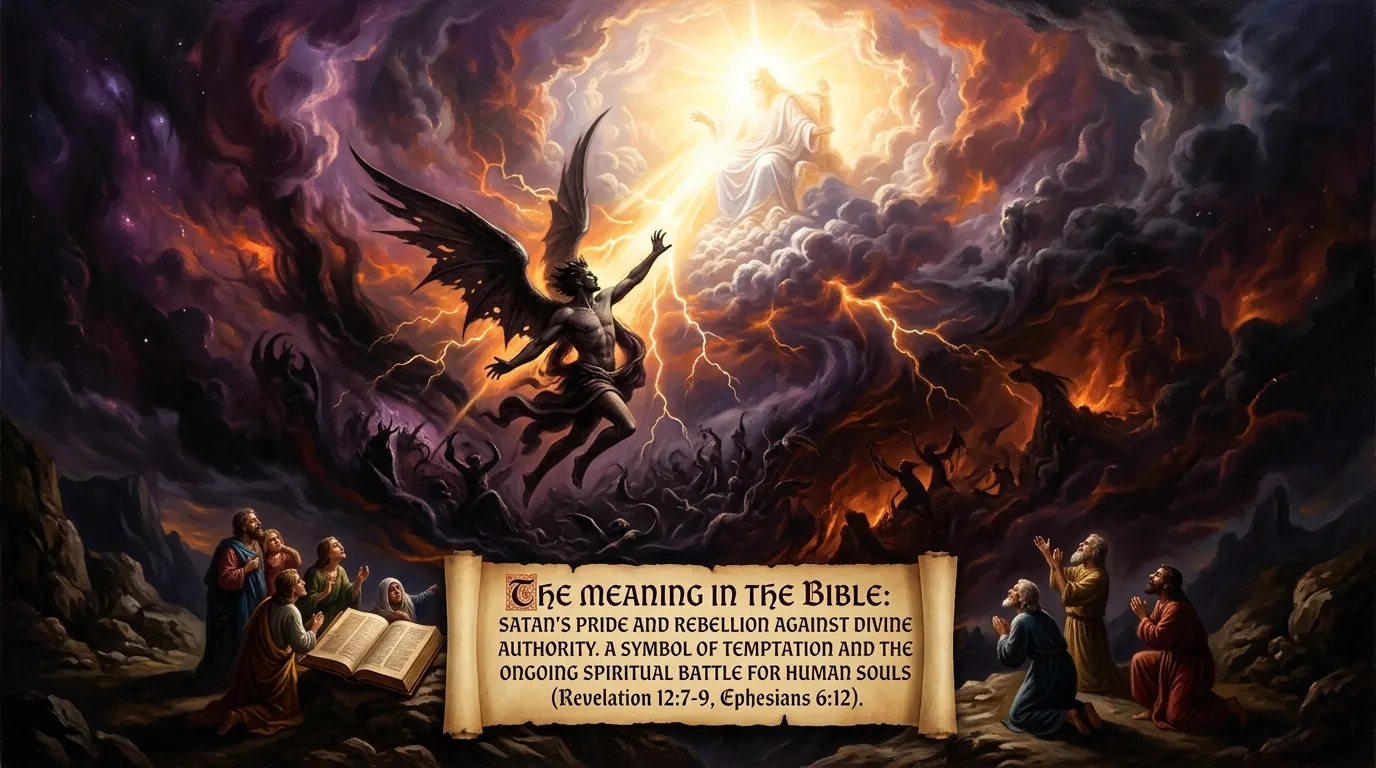
Imagine two armies of equal strength, locked in a war whose outcome is uncertain. That is how many people picture the conflict between God and the devil — a cosmic tug-of-war, with humanity as the rope. It is a vivid picture. It is also entirely wrong. The Bible never describes the devil as God’s equal, His rival, or His opposite. Satan is a creature. God is the Creator. The war between them was never a fair fight, and its outcome was never in doubt.
That does not mean the devil is harmless. Scripture calls him a liar, a tempter, an accuser, and a roaring lion. He does real damage. But his opposition to God is not the opposition of a rival king. It is the opposition of a rebel subject — dangerous to his fellow subjects, powerless against the throne. Understanding that distinction is the difference between fear and faith.
The Courtroom in Heaven: Job
The clearest picture of Satan’s relationship to God is in Job 1–2. Satan appears among the “sons of God” who present themselves before the LORD, and God asks him where he has been. Satan answers with an accusation: Job serves God only because God has blessed him. Take the blessings away, and Job will curse God to His face.
Notice the dynamics. Satan does not storm heaven. He does not issue demands. He appears, he accuses, and he waits for permission. God sets the limits: “Behold, all that he has is in your hand. Only against him do not stretch out your hand” (Job 1:12). Later: “Behold, he is in your hand; only spare his life” (Job 2:6). Satan can do nothing to Job that God has not permitted, and nothing beyond the boundary God has drawn. The accuser operates on a leash.
The Hebrew word satan means adversary or accuser, and in Job it functions almost as a job title: the one who brings charges. Satan’s opposition to God takes the form of prosecution. He accuses God’s people before God, hoping to prove that their faith is a fraud and that God’s grace is wasted. The book of Job answers the accusation: Job suffers terribly, and still says, “Though he slay me, I will hope in him” (Job 13:15). The accusation fails. The leash holds.
The Wilderness: A Temptation, Not a Contest
Matthew 4 records Satan tempting Jesus in the wilderness after forty days of fasting. Three temptations: turn stones to bread, throw Yourself from the temple, worship me and I will give You the kingdoms of the world. Each one is an attempt to divert Jesus from the Father’s path — to take a shortcut to satisfaction, spectacle, or power.
What is striking is how small the devil’s offers look next to who Jesus is. Satan offers the kingdoms of the world to the One who made the world. He offers bread to the One who is the Bread of Life. He quotes Scripture to the One who wrote it. Jesus answers each temptation with Scripture, and finally dismisses him: “Be gone, Satan! For it is written, ‘You shall worship the Lord your God and him only shall you serve'” (Matthew 4:10). Satan leaves. He does not leave because he was outmuscled. He leaves because he was outranked. The creature cannot command the Creator.
The temptation story also corrects a common error: not every hardship is a direct attack from the devil. James 1:14 says temptation often comes from our own desires. Christians who blame Satan for everything — their bad decisions, their character flaws, their consequences — give him more credit than Scripture does, and take less responsibility than Scripture demands.
The Accuser and the Cross
Revelation 12:10 calls Satan “the accuser of our brothers and sisters, who accuses them day and night before our God.” Accusation is his primary weapon against believers. He does not need to destroy you if he can convince you that you are already destroyed — that your sin is too great, your failure too final, your record too stained. Condemnation is his favorite sermon, and he preaches it relentlessly.
The gospel answers accusation with justification. “There is therefore now no condemnation for those who are in Christ Jesus” (Romans 8:1). At the cross, Jesus absorbed the judgment that Satan’s accusations demanded. The accuser’s case was settled out of court — by the Judge paying the fine Himself. That is why Revelation can say that Satan was “thrown down” by “the blood of the Lamb and by the word of their testimony” (Revelation 12:10–11). The cross did not merely defeat Satan’s power. It destroyed his legal standing.
This is why the Christian’s response to accusation is not argument but appeal. When Satan says, “You are guilty,” the believer answers, “Yes — and Christ paid for it.” When he says, “You will fail again,” the believer answers, “Christ has not failed me.” The accuser has no answer to the blood. His case is closed.
The Dragon’s Defeat: Revelation
Revelation 12 describes a war in heaven: Michael and his angels fighting against the dragon, and the dragon being thrown down to earth. Revelation 20 describes the end: the devil is seized, bound, and “thrown into the lake of fire and sulfur” (Revelation 20:10). The language is violent and final, and the point is unmistakable: evil has an expiration date.
Notice who fights the dragon in Revelation 12. It is not God. God does not need to fight. He sends Michael — an angel, a creature — to deal with another creature. The Creator does not stoop to duel His own creation. The war in heaven is not a struggle between equals. It is a mop-up operation.
That is the Bible’s answer to the problem of evil’s persistence. Evil is real, and it is active, and it will continue until the appointed end. But it is not ultimate. It is not eternal. It is a defeated enemy in the interval between the cross and the final judgment — dangerous, like a cornered animal, but doomed. The Christian does not fight for victory. He fights from victory.
Living Without Fear of a Defeated Enemy
What does this mean practically? It means resisting the devil without obsessing over him. James 4:7 gives the two-part strategy: “Submit yourselves therefore to God. Resist the devil, and he will flee from you.” The order matters. Submission comes first. The person who is submitted to God does not need to be afraid of the devil, because the devil is afraid of the God in him. Resistance comes second — not by seeking out spiritual warfare, but by standing firm in truth, refusing lies, confessing sin quickly, and praying in dependence on Christ.
The Serpent’s First Attack
Satan’s opposition to God did not begin in Job or in the wilderness. It began in Eden. The serpent’s question — “Did God actually say?” — was the first attack, and its target was not Eve’s body or her circumstances. It was her trust in God’s word and God’s goodness. The serpent did not deny that God existed. He suggested that God was lying, that God was withholding something good, and that disobedience was the path to wisdom. The attack was theological before it was moral, and that pattern has never changed. Every attack since has followed the same script: undermine God’s word, question God’s character, and offer a shortcut that leads away from Him.
The result of that first attack was catastrophic — sin, shame, exile, death — and it raises the question: if God is sovereign, why did He permit it? Scripture does not give a full philosophical answer, but it gives a redemptive one. God permitted the serpent’s attack because He had already planned the answer: the seed of the woman who would crush the serpent’s head (Genesis 3:15). The first attack on God was answered with the first promise of the gospel. From Eden onward, every attack on God has been met with a promise, and every promise has been kept in Christ. The serpent struck at God’s word in the garden. God’s Word struck back — on the cross, in the empty tomb, and at the end of all things.
One final truth steadies the whole picture. The devil’s attacks, however fierce they feel, are confined to a battlefield God owns. Satan attacked Job’s family, health, and reputation — and Job ended the book worshiping. He attacked Jesus in the wilderness — and Jesus emerged to begin His ministry. He attacked the church at its birth — and the church grew. Every attack the devil has ever launched has become, in God’s hands, the occasion for greater glory. The enemy who meant to destroy Job became the backdrop for Job’s vindication. The enemy who meant to kill Jesus became the instrument of the world’s salvation. The war was never equal, and it was never close. God wins, and those who belong to Him win with Him.
It also means refusing two opposite errors. The first is underestimation: pretending Satan does not exist, ignoring temptation, and walking into traps with eyes closed. The second is overestimation: seeing a demon behind every problem, living in constant fear, and giving the devil the worship of attention that belongs to God alone. The biblical balance is sober vigilance: “Be sober-minded; be watchful. Your adversary the devil prowls around like a roaring lion, seeking someone to devour” (1 Peter 5:8) — followed immediately by, “Resist him, firm in your faith” (5:9). The lion roars. The Shepherd is greater. And the Shepherd has already won. For background on how this conflict has been pictured across Christian history, see the article on the War in Heaven and its theological interpretations.










