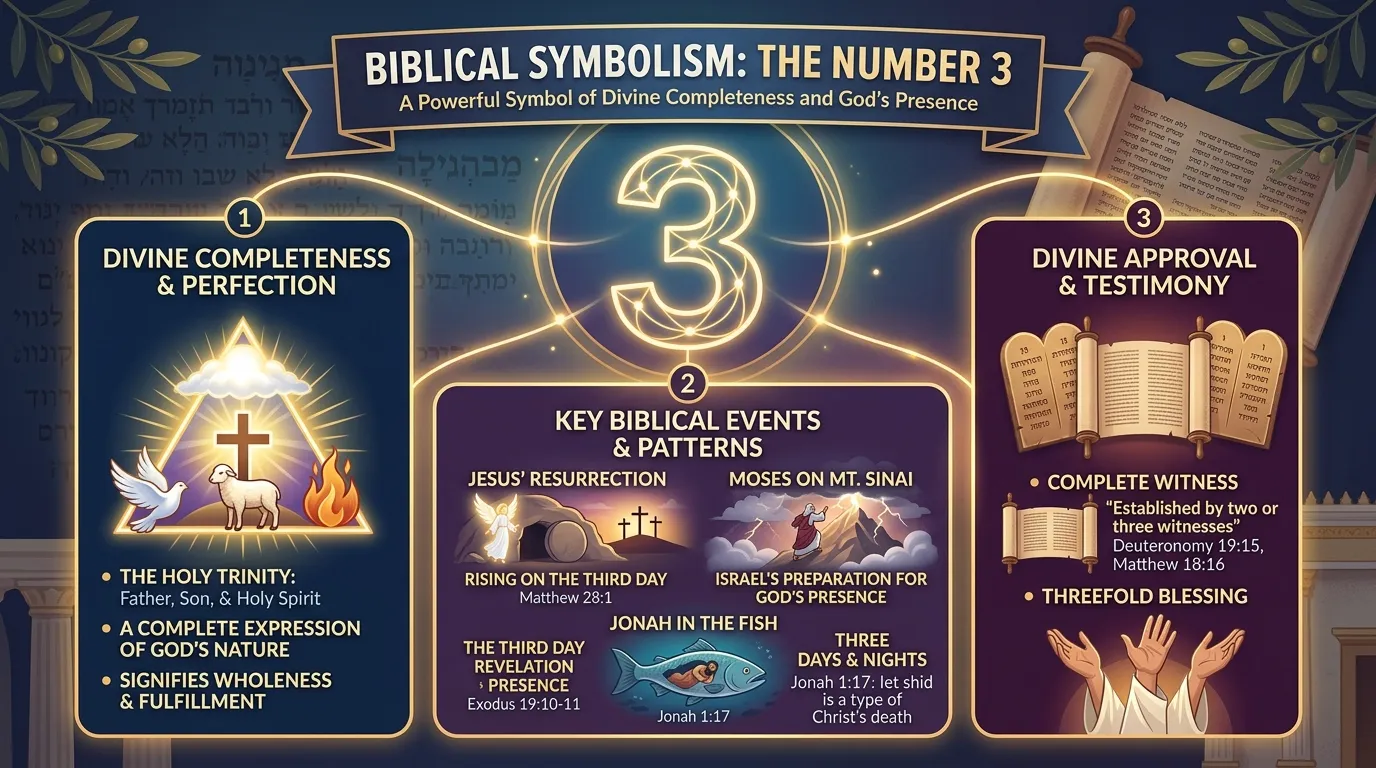
Three knocks on the door. Three days in the belly of the fish. Three denials before the rooster crowed. Three crosses on a hill outside Jerusalem. The number three pulses through Scripture like a heartbeat, appearing at the Bible’s most pivotal moments with a consistency that cannot be accidental. Among all biblical numbers, three stands out as the number of divine completeness, of fullness, of God Himself. Understanding its meaning opens a window into how Scripture patterns its greatest truths.
Biblical scholars widely recognize three as a number of completeness and perfection, of something established and confirmed. In ancient thought, three was the number of a complete whole: beginning, middle, end. Scripture takes that intuition and fills it with theological weight. When something happens three times in the Bible, it is not a coincidence. It is an emphasis. When God is revealed as three-in-one, it is the deepest truth about reality itself.
The Threes of the Trinity
The most profound three in Scripture is the nature of God Himself. The Bible reveals one God in three persons: Father, Son, and Holy Spirit. The baptismal formula commands disciples to be baptized “in the name of the Father and of the Son and of the Holy Spirit” (Matthew 28:19), one name, three persons. Paul’s benediction holds the three together: “The grace of the Lord Jesus Christ and the love of God and the fellowship of the Holy Spirit be with you all” (2 Corinthians 13:14).
The Old Testament hints at this plurality-in-unity from its first chapter: “Let us make man in our image” (Genesis 1:26). The divine “us” is not a royal plural but a whisper of the Trinity. Isaiah heard the seraphim cry “Holy, holy, holy is the Lord of hosts” (Isaiah 6:3), a threefold holiness that the church has always read as Trinitarian praise. The number three, then, is not just symbolically complete. It is theologically complete, because God Himself is three-in-one, the complete fullness of being.
The Third Day: Resurrection’s Number
No three in Scripture carries more weight than the third day. “He was raised on the third day in accordance with the Scriptures” (1 Corinthians 15:4). The resurrection did not happen on a random morning. It happened on the third day, fulfilling a pattern woven through the whole Bible.
Trace the pattern backward. On the third day of creation, dry land emerged from the waters and vegetation sprang forth, the first bursting of life (Genesis 1:9-13). Abraham journeyed three days to Mount Moriah, and on the third day he saw the place where God would provide the substitute for Isaac (Genesis 22:4). Jonah spent three days and three nights in the fish, and Jesus explicitly connected that to His own burial: “For just as Jonah was three days and three nights in the belly of the great fish, so will the Son of Man be three days and three nights in the heart of the earth” (Matthew 12:40). Israel reached Sinai on the third day, when God descended in glory (Exodus 19:11). Esther approached the king on the third day of her fast (Esther 5:1). Hosea prophesied, “After two days he will revive us; on the third day he will raise us up” (Hosea 6:2).
The pattern is unmistakable: in Scripture, the third day is the day of divine intervention, of life emerging from death’s shadow, of God’s decisive act. The resurrection is the ultimate third day, the pattern’s fulfillment. When Christians gather for worship on Sunday, the first day of the week, they are celebrating the third day after the cross, the day death was defeated.
Threes That Testify: Witnesses and Confirmation
The Mosaic law established a legal principle that echoes through the Bible: “A single witness shall not suffice… Only on the evidence of two witnesses or of three witnesses shall a charge be established” (Deuteronomy 19:15). Three witnesses meant a matter was settled, confirmed, beyond dispute. The number carried the weight of established truth.
Jesus applied this principle to church discipline: take one or two others, “that every charge may be established by the evidence of two or three witnesses” (Matthew 18:16). Paul invoked it with the Corinthians (2 Corinthians 13:1). And John applied it to the gospel itself: “There are three that testify: the Spirit and the water and the blood” (1 John 5:7-8). The testimony about Jesus is triply confirmed.
Even Peter’s story turns on three. He denied Jesus three times (Luke 22:61), and the risen Christ asked him three times, “Do you love me?” (John 21:15-17), one restoration for each denial. Threefold failure met threefold grace. The number that marked his shame became the number that marked his recommissioning. That is the gospel in miniature: God takes the number of our failure and fills it with His restoration.
Threes in Worship and Prayer
Scripture’s prayer life beats in threes. Daniel prayed three times a day, kneeling toward Jerusalem, even when it became illegal (Daniel 6:10). The psalmist resolved, “Evening and morning and at noon I utter my complaint and moan” (Psalm 55:17), three daily appointments with God. Jesus prayed three times in Gethsemane, “My Father, if it be possible, let this cup pass from me; nevertheless, not as I will, but as you will” (Matthew 26:39-44), each prayer a deeper surrender.
Paul pleaded with the Lord three times about his thorn in the flesh, and three times was enough to receive the answer: “My grace is sufficient for you” (2 Corinthians 12:8-9). There is a completeness to threefold prayer, as if the third asking settles the matter, whether the answer is yes, no, or grace-sufficient.
The tabernacle and temple also encode threes: three major annual feasts (Passover, Pentecost, Tabernacles), the three-part structure of the sanctuary (courtyard, Holy Place, Most Holy Place), the three items in the ark (the tablets, Aaron’s rod, the manna). Worship itself was architecturally Trinitarian in shape.
Completeness: Why Three Means Finished
Pull the threads together and the meaning emerges. Three in the Bible signifies divine completeness: God in His triune fullness, God’s work brought to its decisive point, testimony fully established, restoration completely accomplished. It is the number of the God who is Father, Son, and Spirit; the number of the day death died; the number of witnesses that settle a case; the number of denials that grace outnumbered.
This is why three feels so satisfying to the human heart. We are made in the image of a triune God, and completeness in threes resonates with our design. Beginning, middle, end. Faith, hope, love, “but the greatest of these is love” (1 Corinthians 13:13). The threefold cord “is not quickly broken” (Ecclesiastes 4:12).
Threes in the Life of Jesus
The Gospels are studded with threes surrounding Christ. His public ministry lasted roughly three years, a complete season of teaching, healing, and preparing. He chose an inner circle of three disciples, Peter, James, and John, for the most sacred moments: the Transfiguration (Matthew 17:1), the raising of Jairus’s daughter (Mark 5:37), and Gethsemane (Matthew 26:37). In the wilderness, He faced three temptations from Satan, answering each with Scripture (Matthew 4:1-11). On the cross, three hours of darkness covered the land (Matthew 27:45).
Even His parables use three as the number of completeness. The prodigal’s father had two sons, but the parable traditionally called “the lost chapter,” Luke 15, contains three parables of lost things: the sheep, the coin, the son, a complete picture of God’s seeking love. The three are not decoration. They are declaration: God’s work in Christ is complete, confirmed, and finished.
And the resurrection appearances follow the pattern too. Paul lists the witnesses in sequence: “he appeared to Cephas, then to the twelve. Then he appeared to more than five hundred brothers at one time” (1 Corinthians 15:5-6). Testimony upon testimony, threefold and more, establishing beyond dispute that the third day had come and death had lost.
Threefold Blessings and Warnings
Scripture loves threefold repetition for emphasis. The Aaronic benediction blesses in three lines: “The Lord bless you and keep you; the Lord make his face to shine upon you and be gracious to you; the Lord lift up his countenance upon you and give you peace” (Numbers 6:24-26). Threefold blessing for a complete people. Jeremiah warned three times over, “the temple of the Lord, the temple of the Lord, the temple of the Lord” (Jeremiah 7:4), mocking the people’s empty triple confidence in the building while their hearts were far from God. Repetition in threes signals: this is settled, pay attention.
Jesus used the pattern too. “Truly, truly, I say to you” appears throughout John’s Gospel, a doubled amen that functions like a triple seal of authority. And His great commission sends the church with triune authority behind it. When Scripture says something three times, it is not stuttering. It is underscoring.
When you notice three in Scripture, or in your own life, let it remind you of the God who completes what He starts. “He who began a good work in you will bring it to completion” (Philippians 1:6). The third day always comes. For those interested in how the number three has been regarded across cultures and mathematics as well, the Wikipedia article on the number 3 covers its wider significance, but Scripture gives it its deepest meaning: the number of the triune God and the day He conquered death.










