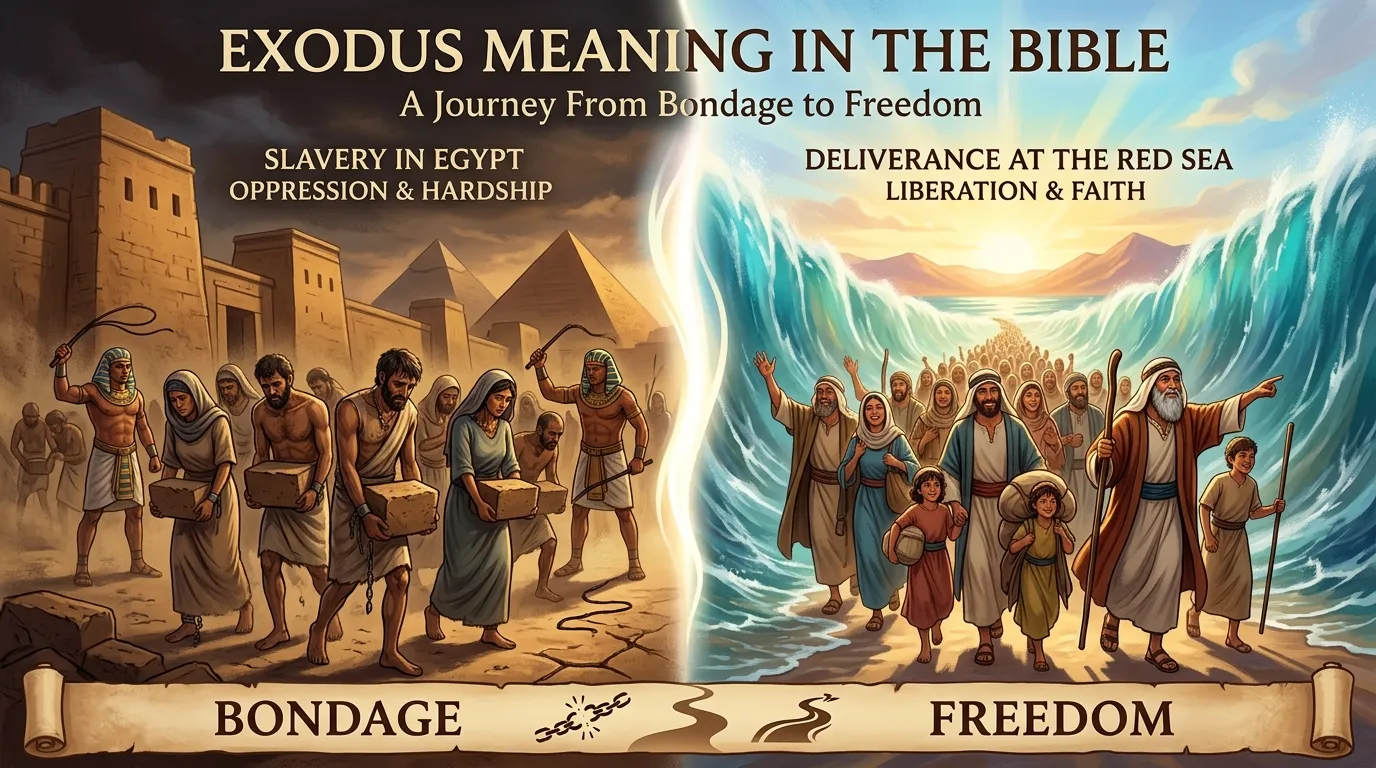
It is midnight in Egypt, and every Israelite family is awake behind a door marked with blood. Outside, a cry is rising across the land, the cry of a nation under judgment. Inside, a family eats hurriedly, sandals on their feet, staff in hand, ready to move. They have been slaves for four hundred years, and tonight everything changes. By morning they will walk out of Egypt, and the event will become the defining story of their people forever. This is the Exodus, and its meaning reaches far beyond ancient history into the heart of every believer’s life.
The word exodus comes from the Greek exodos, meaning departure or going out, literally “the way out.” The book of Exodus bears this name in the Greek translation of the Old Testament, and it fits. But the Hebrew title of the book is Shemot, “names,” drawn from its opening words, “these are the names.” Both titles are true. The Exodus is the departure of a people, and it is the story of a people God knew by name.
From Slavery to Freedom: The Story
The story begins in bondage. Joseph’s family had come to Egypt as honored guests; generations later their descendants were enslaved, their baby boys drowned in the Nile by Pharaoh’s decree (Exodus 1:22). “The people of Israel groaned because of their slavery and cried out for help. Their cry for rescue from slavery came up to God” (Exodus 2:23). God heard, God remembered His covenant, and God acted.
He raised up Moses, the Hebrew child drawn from the Nile, raised in Pharaoh’s palace, exiled to Midian, and called back through a burning bush that was not consumed. At that bush, God revealed His personal name: “I AM WHO I AM” (Exodus 3:14), Yahweh, the self-existent, covenant-keeping God. The Exodus is inseparable from this revelation. Israel was not rescued by a generic deity but by the I AM, the God who is present and faithful.
What followed was a confrontation between two powers: Pharaoh, who claimed divine authority, and Yahweh, who actually possessed it. The ten plagues systematically dismantled Egypt’s gods, the Nile, the sun, the livestock, until Pharaoh’s own firstborn died and Egypt begged Israel to leave. Then came the Red Sea, the defining miracle: “The Lord drove the sea back… and the waters were a wall to them on their right hand and on their left” (Exodus 14:21-22). Israel walked through on dry ground. Egypt’s army drowned. Moses sang, “The Lord is my strength and my song, and he has become my salvation” (Exodus 15:2). Salvation’s vocabulary was born at the seashore.
The Wilderness: Freedom’s Classroom
But leaving Egypt was only the beginning. Between Egypt and the Promised Land lay the wilderness, and the wilderness became Israel’s classroom. Here God taught a freed people how to be free. He gave them manna, bread from heaven, with strict instructions to gather only enough for each day (Exodus 16). The lesson: trust God daily. He gave them water from the rock (Exodus 17:6). He gave them the law at Sinai, not as a burden but as a gift, the constitution of a free people (Exodus 20). He gave them the tabernacle, His dwelling in their midst (Exodus 25-40).
The wilderness also exposed what freedom had not yet fixed: Israel’s heart. They grumbled about food, fashioned a golden calf, refused to enter the land, and wandered forty years until the faithless generation died (Numbers 14). The Exodus delivered their bodies from Egypt, but Egypt remained in their hearts. “In their hearts they turned back to Egypt” (Acts 7:39). This is the Bible’s most sobering lesson about liberation: geography cannot save the soul. A freed slave can still think like a slave.
Yet even in judgment, God was faithful. He sustained them forty years. Their clothes did not wear out (Deuteronomy 8:4). He led them by cloud and fire. And He brought their children into the land He had promised. The wilderness was not God’s failure. It was God’s formation, slow, painful, and ultimately effective for those who trusted Him.
The Exodus as a Pattern: Every Rescue Echoes It
One of the most remarkable things about the Exodus is how Scripture keeps reusing it. It becomes the template for understanding every divine rescue. The prophets promised a new exodus: Israel’s return from Babylonian exile would be like a second Red Sea crossing, with a highway through the wilderness and water in the desert (Isaiah 43:16-21, 48:20-21). The exiles were to see their homecoming as Exodus 2.0.
The New Testament goes further, presenting Jesus as the greater Moses leading the ultimate Exodus. At the Transfiguration, Moses and Elijah spoke with Jesus about “his departure”, literally his exodos, “which he was about to accomplish at Jerusalem” (Luke 9:31). Luke deliberately uses the Exodus word. Jesus’ death and resurrection are the true departure, the true way out, from slavery to sin into the freedom of the children of God.
Paul makes the typology explicit: “Our fathers were all under the cloud, and all passed through the sea, and all were baptized into Moses in the cloud and in the sea” (1 Corinthians 10:1-2). Baptism is the Christian’s Red Sea. The Lord’s Supper echoes the Passover meal. The church is the wilderness people, journeying toward the true Promised Land, warned by Israel’s failures and sustained by a greater Moses who never fails.
Even Revelation ends with Exodus imagery: the song of the redeemed is “the song of Moses, the servant of God, and the song of the Lamb” (Revelation 15:3). The first song sung at the Red Sea becomes the last song sung before the throne. The Exodus is not just Israel’s story. It is the shape of the whole Bible’s story.
Your Exodus: From Bondage to Belonging
This is where the Exodus stops being history and becomes personal. Every believer has an Egypt: the sin, the addiction, the fear, the past that enslaved them. Every believer has a Pharaoh: the power that said “you will never leave.” And every believer has a Red Sea moment: the point where God did what they could not do, parted what they could not part, and brought them through.
Jesus described this liberation plainly: “Everyone who practices sin is a slave to sin… So if the Son sets you free, you will be free indeed” (John 8:34-36). The Exodus from sin follows the ancient pattern. God hears the cry. God sends the deliverer. The price is paid, not in plagues on Egypt now but in blood on a cross. The sea parts. And the former slave walks out singing.
But remember the wilderness. Freedom from Egypt is not the same as arrival in Canaan. New believers often expect instant transformation and are confused by the wilderness seasons that follow: the old cravings, the grumbling, the slow formation. The Exodus teaches patience with the process. God delivers in a day what He develops over a lifetime. The manna comes daily. The cloud moves when it moves. Trust the Guide even when the route seems circular.
And remember the destination. The Exodus was never just about leaving. It was about arriving: a land, a covenant, a presence. “I will take you to be my people, and I will be your God” (Exodus 6:7). That was the goal then, and it is the goal now. Salvation is not escape from something. It is belonging to Someone. The Exodus ends, as all God’s rescues end, at home.
The Passover: The Night Everything Changed
No account of the Exodus is complete without the Passover, the night that made the departure possible. On the eve of the final plague, God instructed each Israelite household to take an unblemished lamb, slaughter it at twilight, and mark their doorposts and lintel with its blood (Exodus 12:1-13). “When I see the blood, I will pass over you, and no plague will befall you to destroy you” (Exodus 12:13). The destroyer passed over every blood-marked door. By morning, Egypt’s firstborn were dead, and Pharaoh was begging Israel to leave.
The details matter because they became permanent memorials. The lamb had to be without blemish, foreshadowing the sinless Christ. The blood had to be applied, not merely shed; salvation has always required personal appropriation, not just historical availability. The meal was eaten in haste, with unleavened bread, because there was no time for the bread to rise, a lasting reminder that deliverance comes suddenly. “This day shall be for you a memorial day, and you shall keep it as a feast to the Lord” (Exodus 12:14). Every subsequent Passover retold the Exodus to a new generation.
John the Baptist saw Jesus and cried, “Behold, the Lamb of God, who takes away the sin of the world!” (John 1:29). Paul wrote, “Christ, our Passover lamb, has been sacrificed” (1 Corinthians 5:7). The Last Supper was a Passover meal, deliberately timed, where Jesus took the ancient symbols and filled them with new meaning: “This is my body… This cup is the new covenant in my blood” (Luke 22:19-20). The Exodus meal became the communion meal. The blood on the doorposts became the blood of the new covenant. Every time believers take the bread and cup, they are celebrating their own Passover, their own Exodus.
From a midnight in Egypt to a morning at the empty tomb, the Exodus is God’s signature move: He hears, He comes, He delivers, He dwells. Whatever your Egypt is, the God of the Exodus has not changed. For background on how this foundational event has been studied historically and archaeologically, the Wikipedia article on the Exodus surveys the discussion, but the event’s deepest meaning needs no excavation: the Lord still makes a way where there is no way.










