A man limps across a river at sunrise. His hip is out of joint, his thigh is swollen, and he will never walk the same way again. But he is not running anymore. For the first time in his life, the schemer who stole his brother’s blessing and tricked his father-in-law at every turn has stopped scheming. He spent the whole night grappling with a Stranger he could not defeat and would not release, and as the sun rose he demanded one thing: “Bless me.” The Stranger’s answer was not a blessing first. It was a question: “What is your name?” And then, in place of the old name — Jacob, the heel-grabber, the deceiver — came a new one: Israel.
That moment on the banks of the Jabbok (Genesis 32) is where the most important name in the Old Testament is born. It is a name that will belong to a man, then to his twelve sons, then to a nation of millions, then to a land, and finally — in the hands of the apostles — to everyone who belongs to God by faith. If you have ever wondered what “Israel” means in the Bible, the answer is not a dictionary definition. It is a whole story: a story of wrestling, wounding, blessing, failure, and a faithfulness that outlasts all of it.
The Night Everything Changed at the Jabbok
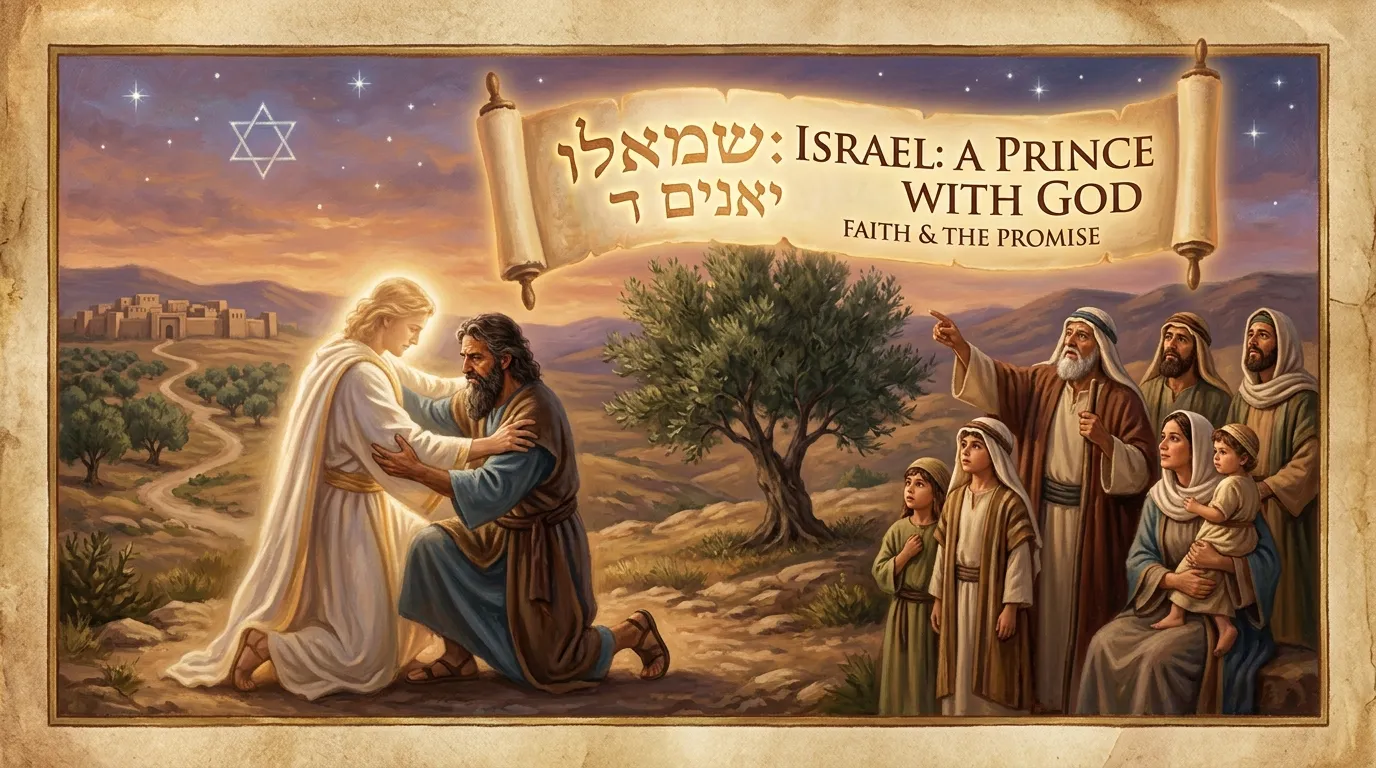
Genesis 32 gives us one of the strangest and most beautiful scenes in Scripture. Jacob is on his way home after twenty years away. Ahead of him waits Esau, the brother he cheated, marching toward him with four hundred men. Jacob has divided his family into camps, sent gifts ahead, and prayed a desperate, honest prayer. Then, alone in the dark by the river, “a man wrestled with him till daybreak” (Genesis 32:24).
Notice what does not happen. Jacob does not win. The Stranger touches his hip and it comes out of socket, and still Jacob clings on: “I will not let you go unless you bless me.” This is the turning point of Jacob’s entire life. The man who once grabbed blessings by trickery now receives blessing by surrender. He holds on not with cunning but with need — and that is exactly the posture God was after all along.
Then comes the renaming: “Your name will no longer be Jacob, but Israel, because you have struggled with God and with humans and have overcome” (Genesis 32:28). The old identity is pronounced dead. The new identity is born in the same breath. From this night forward, Scripture will use both names — Jacob for the man in his weakness, Israel for the man in his calling — and the tension between the two never fully disappears.
What “Israel” Actually Means — And Why Scholars Argue About It
The name is Hebrew: Yisra’el. Its exact meaning has been debated for centuries, and honesty requires saying so. The most common reading, following the explanation given in Genesis 32:28 itself, is “he struggles with God” or “one who wrestles with God.” Another widely held reading is “God strives” or “God prevails” — the victory belonging to God rather than to the wrestler.
Both readings preach. If it means “one who wrestles with God,” then Israel is every believer who has ever argued with heaven in the night and refused to let go. If it means “God prevails,” then Israel is the confession that in the end, God always wins the wrestling match — and His winning is our blessing, not our defeat. The text itself leans toward the first: Jacob struggled and, in the strange economy of grace, “overcame” precisely by being overcome.
What matters most is not settling the linguistics but receiving the theology: Israel is a name given to a wrestler, not to a winner. God did not wait until Jacob was polished, honest, and put-together to rename him. He renamed the man mid-limp, mid-night, mid-struggle. That is how God still names His people.
From One Man to a Whole People
Israel the man had twelve sons. Israel the family went down to Egypt seventy strong. Israel the nation came up out of Egypt as a multitude no one could count. The name stretched, and the promise stretched with it.
To this people God gave the covenant words that define the entire Old Testament: “I will take you as my own people, and I will be your God” (Exodus 6:7). Israel became the nation through whom God would reveal His law, His character, and ultimately His Messiah. The prophets never let Israel forget either side of this calling — the privilege or the responsibility. “You only have I chosen of all the families of the earth; therefore I will punish you for all your sins” (Amos 3:2). Chosenness was never favoritism; it was assignment.
And here is where the wrestling theme returns at the national level. Israel’s history reads like one long night at the Jabbok: deliverance followed by grumbling, covenant followed by idolatry, repentance followed by relapse. The nation wrestled with God for a thousand years. And God, in His stubborn mercy, would not let go of them either.
Israel’s Story Is Also Israel’s Warning
Scripture refuses to romanticize Israel. The same Bible that calls Israel God’s “treasured possession” (Deuteronomy 7:6) also records the golden calf, the rebellion at Kadesh, the kings who “did evil in the eyes of the Lord” like a grim refrain, and finally the exile — the covenant curses of Deuteronomy 28 falling like a hammer.
This is not a contradiction; it is the point. Israel’s story teaches that being chosen does not mean being exempt. Privilege intensifies accountability. The apostle Paul makes this explicit for Gentile believers: if God did not spare the natural branches, He will not spare us either if we fall into the same unbelief (Romans 11:21). Israel’s failures are preserved in Scripture as a mirror, not as a museum piece.
Yet even in judgment, the promise held. “I will not reject them or abhor them so as to destroy them completely, breaking my covenant with them. I am the Lord their God” (Leviticus 26:44). The God who renamed a deceiver at the Jabbok does not un-rename His people in Babylon. His faithfulness is the one constant in Israel’s roller-coaster history — and in ours.
The New Testament Widens the Name
Something remarkable happens in the apostles’ preaching: the name Israel begins to open outward. Paul grieves over his fellow Jews who rejected the Messiah — “I have great sorrow and unceasing anguish in my heart” (Romans 9:2) — while insisting that God’s word has not failed. Why? Because, Paul argues, “not all who are descended from Israel are Israel” (Romans 9:6). The true Israel, in his stunning redefinition, consists of those who share Abraham’s faith, whether Jew or Gentile.
He calls the church “the Israel of God” (Galatians 6:16). He describes Gentile believers as wild olive shoots grafted into the cultivated olive tree of Israel (Romans 11:17-24). The name that began with a limping patriarch now embraces every person — from every nation — who wrestles with God and clings to Him in faith. The circle did not break; it widened.
This does not erase the promises to ethnic Israel — Paul is adamant that God still has purposes for the Jewish people (Romans 11:25-29), and Christians have no business reading those chapters with arrogance. But it does mean that the deepest meaning of “Israel” was never finally about bloodlines or borders. It was about a relationship: a people who belong to the God who would not let Jacob go.
What Israel Means for the One Who Wrestles Today
So what does Israel mean in the Bible for you, tonight, in your own dark night by the river? Three things, at least.
First, wrestling with God is not the opposite of faith; sometimes it is faith. The psalms are full of complaints, questions, and midnight arguments with heaven. God did not rename Jacob “Israel the Compliant.” He honored the struggle itself. Bring your honest questions to God. Cling, even limping.
Second, God renames people in the middle of their mess. You do not have to become Israel before you meet God at the Jabbok; you meet God at the Jabbok and become Israel. New identities in Scripture are gifts before they are achievements: Abram becomes Abraham before Isaac is born; Simon becomes Peter before he understands anything. Your past does not get the final vote on your name.
Third, the blessing always comes with a limp. Jacob walked differently for the rest of his life, and the text treats that as glory, not damage. The wound was the receipt of the encounter. If you have wrestled with God over a loss, a calling, a besetting sin, or an unanswered prayer, and you came out changed but scarred — you are in good company. The limp is how Israel walks.
Israel, then, is far more than a place on a map or a headline in the news. It is the Bible’s great portrait of grace: a deceiver renamed, a family multiplied, a nation disciplined, a promise kept, and a people — from every tribe and tongue — still learning to hold on to God through the night until the blessing comes. If you’d like the broader historical background on how this people and name developed across the centuries, the Wikipedia overview of the Israelites is a helpful starting point — though it is the Scripture, not the encyclopedia, that tells you what the name means for your own soul.