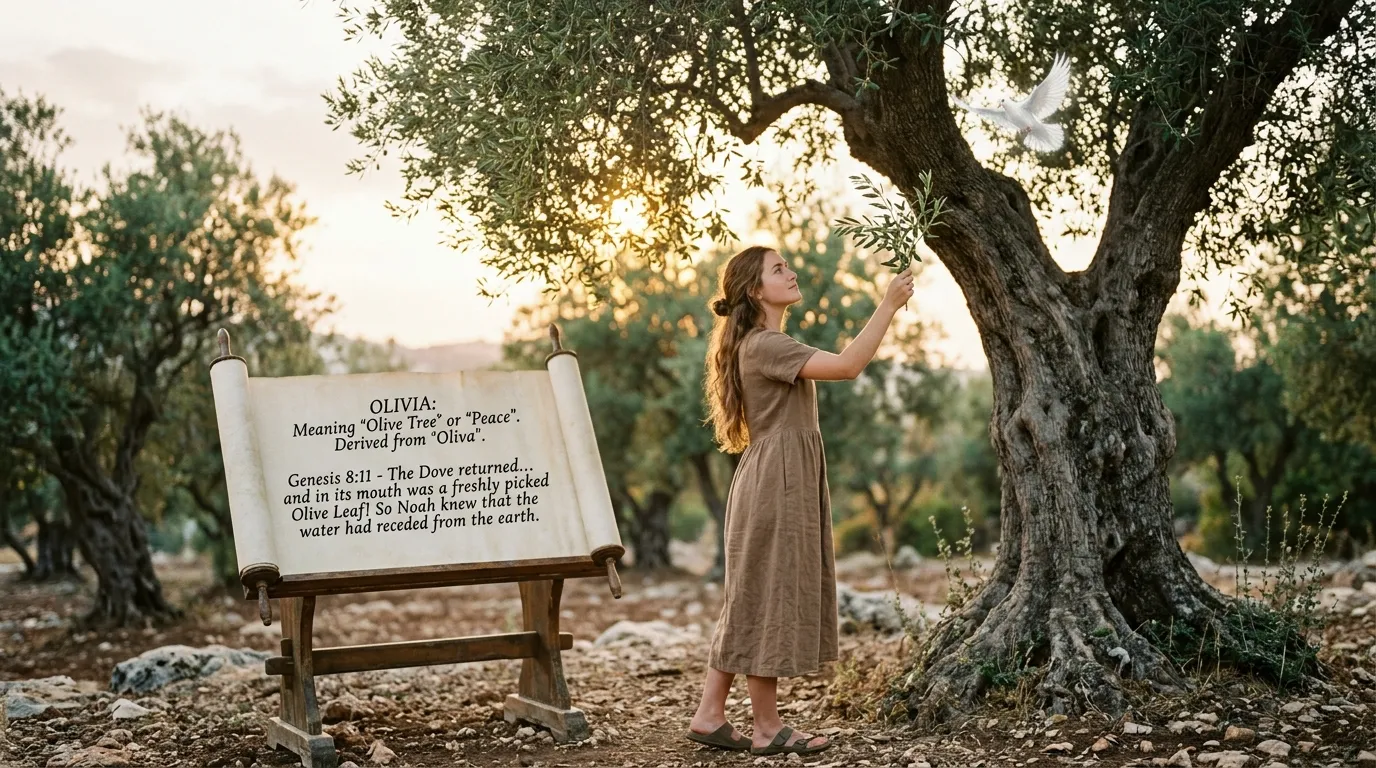
In the garden of Gethsemane, on the night before the cross, Jesus knelt among olive trees to pray. The name of that garden tells you what grew there: Gethsemane comes from the Aramaic for “oil press.” Those ancient trees — some of the olive trees on the Mount of Olives today are said to be two thousand years old, possibly shoots of the very trees that stood that night — had been crushed and pressed for their oil for centuries. It is no accident that the place of Christ’s deepest anguish was a grove of olive trees. The olive tree is one of Scripture’s richest symbols, and the name Olivia carries its meaning: from the Latin oliva, the olive tree.
Olivia never appears as a name in the Bible. But the olive tree appears everywhere — in the law, the prophets, the psalms, and the Gospels — and everywhere it appears, it preaches. Peace after judgment. Fruitfulness in hard ground. Light in darkness. Endurance across centuries. To understand what Olivia means in the Bible, then, you do not look up a person; you walk through an orchard. Every tree has a sermon.
Roots That Outlive Empires
Start with what an olive tree is. Unlike most fruit trees, the olive thrives where other trees die — in thin, rocky soil, under a burning sun, with little water. Its root system goes astonishingly deep, and its trunk grows gnarled and massive with age. Cut an olive tree down, burn it, uproot it — and it will send up new shoots from the stump. The prophet Job marveled at lesser trees, but the olive outdoes them all: it is nearly unkillable.
That is why the psalmist chose it as the picture of the blessed life: “I am like an olive tree flourishing in the house of God; I trust in God’s unfailing love for ever and ever” (Psalm 52:8). Notice the location: not flourishing in the palace, not flourishing in the marketplace — flourishing in the house of God. The olive tree’s secret is not its circumstances but its rooting. Planted near the presence of God, it flourishes in conditions that would wither anything else.
For anyone carrying the name Olivia, this is the first sermon of the olive tree: endurance is a spiritual discipline. Empires rose and fell around the olive groves of Israel — Egyptians, Assyrians, Babylonians, Romans — and the trees kept bearing. A life rooted deep in God outlasts every season that tries to end it.
The Leaf That Ended the Flood
The olive tree’s most famous moment in Scripture comes in the story of Noah. After months of water covering everything, Noah sent out a dove, and “when the dove returned to him in the evening, there in its beak was a freshly plucked olive leaf” (Genesis 8:11). That small green leaf was the first proof that the waters were receding, that judgment was ending, that life was returning.
Think about what that leaf meant. The olive tree had survived the flood — or been among the first things to grow again afterward. Either way, it became the sign that God’s wrath had a limit and His mercy had the last word. This is why the olive branch became, across all of Western culture, the universal emblem of peace. It started here, in Genesis, in the beak of a dove.
The New Testament picks up the dove imagery at Jesus’ baptism, when the Spirit descends “like a dove” (Matthew 3:16) — peace arriving again, this time to announce the beginning of a ministry that would reconcile God and humanity. So the second sermon of the olive tree is peace after judgment, hope after devastation. If your life has felt like a flood — loss, grief, a season where everything was underwater — the olive leaf is God’s way of saying the waters are going down. Morning is coming.
Oil for the Lampstand
In the tabernacle, and later the temple, the lampstand — the menorah — was to burn continually, and the fuel was specified with precision: “pure oil of pressed olives” (Exodus 27:20). Not just any oil. The olives had to be beaten and pressed to release it. Light for the house of God came from crushed fruit.
This detail keeps preaching through the whole Bible. Oil in Scripture is the consistent symbol of the Holy Spirit — the anointing oil poured on Aaron’s head (Psalm 133:2), the oil of gladness (Psalm 45:7, quoted in Hebrews 1:9), the wise virgins’ lamps full of oil in Jesus’ parable (Matthew 25:1-13). And the oil always comes the same way: by pressing.
Here is the third sermon, and it is the hardest one: what gives light has been through pressure. The olive does not apologize for the press; the press is how it becomes useful. Paul says it plainly: “we also glory in our sufferings, because we know that suffering produces perseverance” (Romans 5:3). The crushing is not the end of the story — it is the extraction of the anointing. Nobody lights a lamp with a whole olive. It is the pressed ones that burn.
Gethsemane: The Garden of the Oil Press
Now return to where we began. On the night of His betrayal, Jesus went “as usual to the Mount of Olives” (Luke 22:39), to the garden called Gethsemane — the oil press. There, among the ancient trees, He prayed in such anguish that “his sweat was like drops of blood falling to the ground” (Luke 22:44).
Read that scene with olive trees in mind and it becomes almost unbearable in its beauty. The presses of Gethsemane crushed olives to make oil. That night, the Garden pressed the Son of God, and what came out was surrender: “not my will, but yours be done” (Luke 22:42). The crushing of Christ in the olive grove is what made the anointing available to the whole world. Every olive tree in Scripture had been whispering about this night.
Paul later uses the olive tree for his most vivid picture of salvation history: Gentile believers are “a wild olive shoot” grafted into the cultivated olive tree of God’s people (Romans 11:17-24). The olive tree, once again, is the image of God’s redemptive plan — roots in the patriarchs, branches broken off in unbelief, wild shoots grafted in by grace. The tree keeps growing. The story keeps including.
The Jar That Never Ran Dry
One more olive-oil story deserves its place. In 2 Kings 4, a widow with nothing left but a small jar of olive oil came to the prophet Elisha, terrified that her sons would be taken as slaves for her debts. Elisha told her to borrow every empty jar she could find and start pouring. She poured, and poured, and the oil kept flowing until every jar was full — then it stopped. She sold the oil, paid her debts, and lived on the rest.
It is a small domestic miracle, and it carries the olive tree’s quietest sermon: God multiplies what is poured out. The widow’s little jar of oil looked like nothing. In God’s hands it became everything she needed. The olive tree does not boast about its harvest; it simply keeps producing, season after season, for whoever comes with empty jars. A life like that — generous, steady, unshowy — is the truest meaning any name could carry.
Planted, Not Picked: The Endurance Lesson
There is one more sermon, and it may be the most practical. Jeremiah contrasts two kinds of trees: the bush in the wasteland that “will not see prosperity when it comes,” and “the tree planted by the water that sends out its roots by the stream. It does not fear when heat comes; its leaves are always green. It has no worries in a year of drought and never fails to bear fruit” (Jeremiah 17:5-8).
The difference between the two trees is not the weather — both face heat and drought. The difference is the rooting. An Olivia, in the biblical symbolism of her name, is called to be the second kind of tree: planted, not picked. Picked fruit is consumed and forgotten. Planted trees feed generations. The olive tree’s fruit — its oil — healed wounds (Luke 10:34), anointed kings (1 Samuel 16:13), lit the sanctuary, and fed families. A planted life keeps giving long after the season changes.
So what does Olivia mean in the Bible? It means the olive tree, and the olive tree means this: peace that follows judgment, light that comes from pressing, roots that outlast empires, and fruit that keeps feeding others. It is a name that carries an assignment — to be, in a harsh and rocky world, a tree that flourishes in the house of God.
Whether you bear the name, love someone who does, or are considering it for a daughter, the olive tree offers the same quiet promise it offered Noah: the flood does not get the last word. If you want to explore the natural history behind the symbol — how these remarkable trees actually grow, live for millennia, and produce their oil — the Wikipedia article on the olive makes fascinating reading, and it will only deepen your appreciation for why Scripture chose this tree to carry so much meaning.










