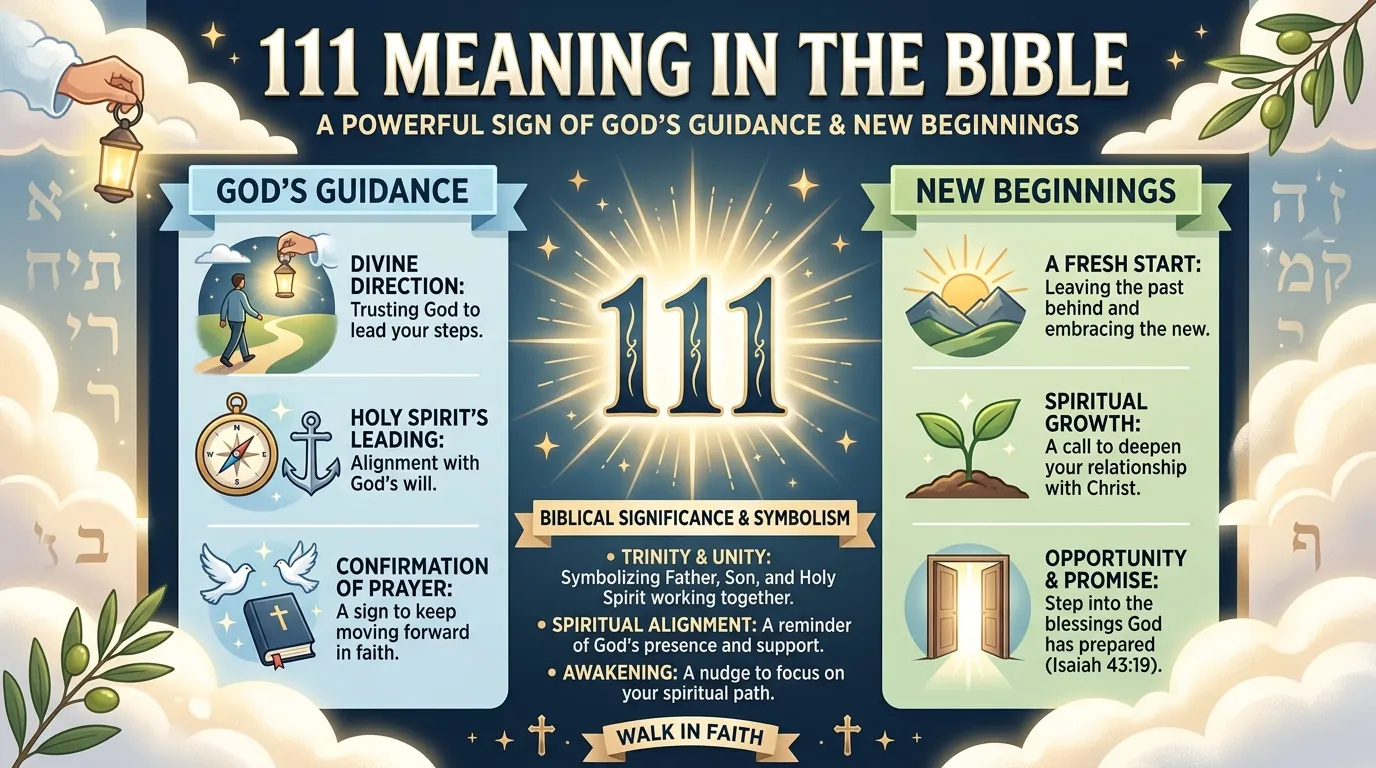
It happens on the clock first, usually. You glance over at 1:11 — morning or night, it doesn’t matter — and something in you pauses. Then it shows up on a receipt. Then a license plate. Then a page number. After the fourth or fifth time, the question forms itself: Is God trying to tell me something?
Let’s answer the most important question first, honestly: the Bible never assigns a meaning to the number 111. Not once. There is no verse that says “111 means new beginnings” or “111 is an angel number.” That idea comes from modern numerology and internet spirituality, not from Scripture. But that does not mean the question is foolish, and it does not mean the Bible has nothing to say to the person asking it. Scripture has a great deal to say about the number one — and about what to do when you sense God might be getting your attention.
What the Bible Actually Says About Numbers
God does use numbers meaningfully in Scripture — but He uses them the way a careful author uses them, not the way a fortune-teller does. Seven marks completion (the seven days of creation, Genesis 1). Forty marks testing (forty years in the wilderness, forty days of Jesus’ temptation). Twelve marks God’s people (twelve tribes, twelve apostles). Three marks completeness and divine emphasis (the threefold “holy, holy, holy” of Isaiah 6:3).
But here is the crucial distinction: biblical numbers get their meaning from their context in Scripture, not from patterns we spot in daily life. The number 40 means testing because the Bible repeatedly shows it meaning testing. Nobody in Scripture ever treats a repeated number on a clock as a coded message. When God wanted to get someone’s attention, He sent prophets, dreams with interpretations, burning bushes, and finally His Son — not timestamps.
So if you keep seeing 111, the most biblical response is not to decode it like a cipher. It is to ask a better question: Why am I noticing this, and what is God already saying to me in His Word that I might be missing?
The Power of One: The Shema
Still, the digit inside 111 — the number one — carries enormous weight in Scripture, and meditating on it is never wasted time. The cornerstone is the Shema, the confession every faithful Israelite recited daily: “Hear, O Israel: The Lord our God, the Lord is one” (Deuteronomy 6:4).
In a world crowded with gods — every nation had its pantheon, every city its patron deity — Israel’s confession was radical: there is one God. One Creator. One Lord. One throne. One will that governs all things. The number one in Scripture is the number of God’s uniqueness and supremacy. “I am the first and I am the last; apart from me there is no God” (Isaiah 44:6).
For the Christian, the oneness of God finds its fullest expression in Jesus’ own prayer: “that they may know you, the only true God, and Jesus Christ, whom you have sent” (John 17:3). And the New Testament adds the stunning claim that this one God has revealed Himself as Father, Son, and Holy Spirit — one in essence, three in person. Unity with complexity. Oneness with relationship at its heart.
Why Repetition Matters in Hebrew Thought
There is one more genuinely biblical angle to the tripled digit. In Hebrew, repetition is how you turn up the volume. English uses adjectives — very holy, most holy. Hebrew repeats the word. When Isaiah hears the seraphim cry “Holy, holy, holy is the Lord Almighty” (Isaiah 6:3), the threefold repetition is not describing three holinesses. It is declaring holiness at maximum intensity: holy beyond all measure.
Likewise, when Jesus wants to emphasize a truth, He doubles it: “Truly, truly I say to you” — amen, amen — appears twenty-five times in John’s Gospel. Repetition is Scripture’s highlighter pen.
So if a believer wants to take the repeated ones of 111 as a devotional prompt — not a doctrine, just a prompt — the biblical shape of that meditation would be something like this: one God, worthy of first place, calling for undivided attention. Not “new beginnings are coming” or “your thoughts are manifesting.” Something far better: God is one. Put Him first. Give Him your whole heart, not the leftovers. That is a message worth receiving every time you glance at a clock.
The First and the Last: Oneness at the End of the Story
Scripture’s testimony to God’s oneness does not fade as the story progresses — it crescendos. In Revelation, the risen Christ declares, “I am the Alpha and the Omega, the First and the Last, the Beginning and the End” (Revelation 22:13). The throne room of heaven, for all its thunder and multitudes, centers on one throne (Revelation 4:2). The countless angelic hosts, the elders, the living creatures — all of heaven’s diversity orbits a single center.
Paul draws the practical line from this cosmic oneness to the church’s unity: “There is one body and one Spirit… one Lord, one faith, one baptism; one God and Father of all, who is over all and through all and in all” (Ephesians 4:4-6). Seven “ones” in three verses — Paul himself uses repetition for emphasis, exactly the Hebrew instinct we noted earlier. The oneness of God is meant to produce oneness among His people. A church fractured by pride, gossip, and rivalry is living as though God were many.
This gives the person seeing 111 a devotional direction worth more than any number guide: let the “one” confront your divided heart. The divided heart — loving God and money, praying on Sunday and scheming on Monday, confessing Christ with the lips while the loves belong elsewhere — is the great enemy of the Shema. “No one can serve two masters” (Matthew 6:24). Perhaps the repeated ones are heaven’s shorthand for the oldest prayer in Israel: hear, O distracted soul — the Lord your God, the Lord is one. Give Him the whole of you.
The Bible’s Warning About Sign-Seeking
A word of caution is necessary, because Scripture is blunt about this. The Pharisees demanded a sign from Jesus, and His answer was a rebuke: “A wicked and adulterous generation asks for a sign” (Matthew 16:4). Gideon asked for signs with the fleece — and God, in patience, gave them — but Gideon’s story is the exception that proves the rule, and even Gideon acted only after God had already spoken clearly.
The deeper issue is where we place our trust. If seeing 111 brings you comfort because you take it as proof God is with you, ask yourself: what happens on the days you don’t see it? Is God less present? Has He stepped away? Of course not. “Never will I leave you; never will I forsake you” (Hebrews 13:5) does not come with a timestamp. A faith that needs daily numerical reassurance is a faith that has not yet learned to rest in God’s promises.
This is not said to shame anyone. It is said to free you. Chasing signs is exhausting, and it keeps you looking at clocks instead of looking at Christ. The Bible’s alternative is better: “Your word is a lamp for my feet, a light on my path” (Psalm 119:105). You do not need a number to find God’s guidance. You need His Word, prayer, wise counsel, and the quiet leading of the Spirit — all of them far clearer than any repeating digit.
When God Does Get Your Attention
None of this means God cannot use a repeated number to nudge you. God once spoke through a donkey (Numbers 22); He is not limited by our categories. If seeing 111 stops you mid-day and turns your thoughts toward Him, thank Him for the interruption. Then do what the interruption is inviting you to do: pray, open Scripture, examine your priorities.
Perhaps the repeated ones are God’s gentle tap on the shoulder, reminding you of the first commandment with promise and the greatest commandment of all: “Love the Lord your God with all your heart and with all your soul and with all your mind” (Matthew 22:37). All. Not a fraction. One God, one life, one devotion. That is the truest “meaning” 111 could ever carry — not because numerology says so, but because Scripture does.
So the next time the clock reads 1:11, let it be a small altar in your day: a thirty-second pause to remember that the Lord is one, that He is worthy of first place, and that His Word — not a number — is where His guidance is found, today and every day. For those curious about how the number itself has been treated in mathematics and culture through history, the Wikipedia entry on the number 111 is an interesting read; just remember that when it comes to what God is saying to you, the Bible — not the internet’s number guides — gets the final word.