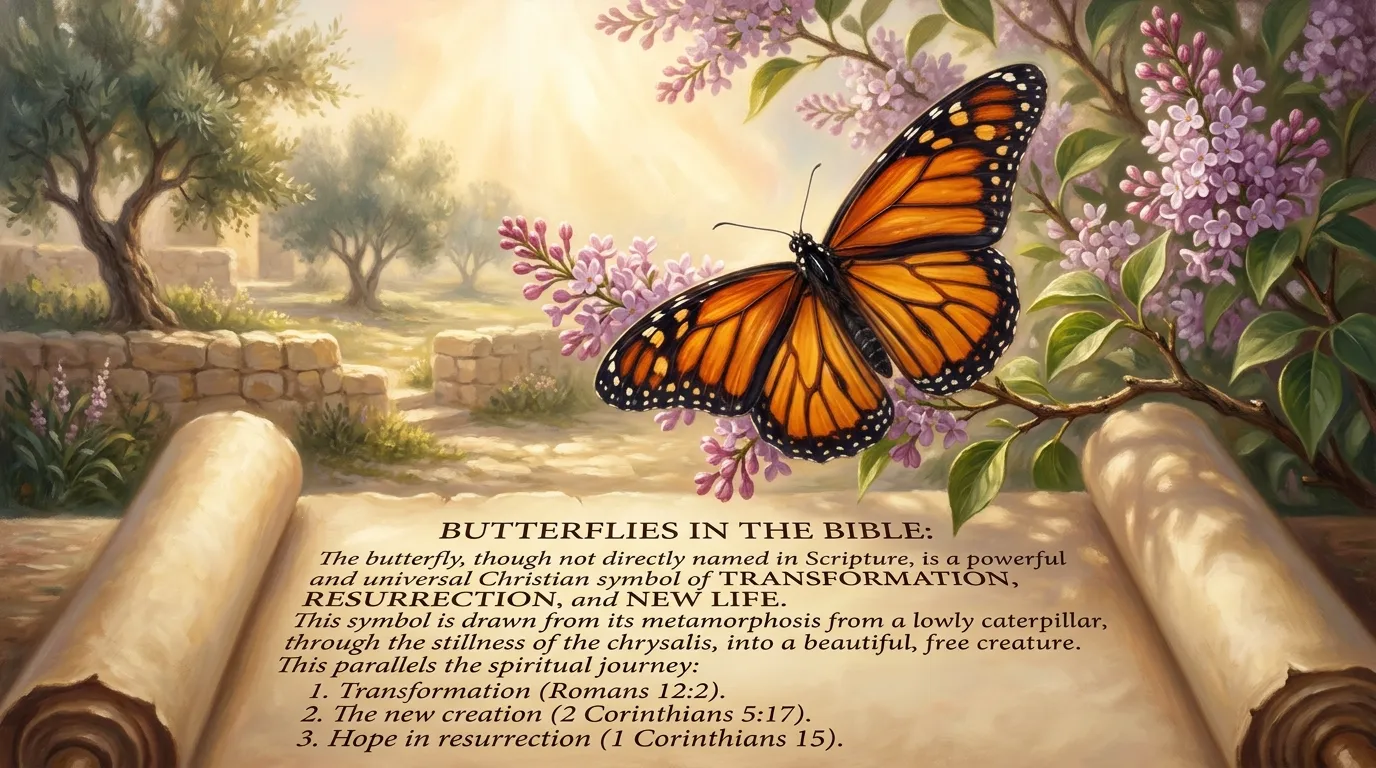
Inside the chrysalis, the caterpillar does not simply grow wings. It dissolves. Enzymes break down nearly its entire body into a nutrient soup, and from that soup, entirely new structures form — wings, legs, antennae, compound eyes — built from clusters of cells that had been waiting, dormant, since the caterpillar hatched. Biologists call them imaginal discs: the blueprint of the butterfly, hidden inside the caterpillar all along. The old body must come apart for the new one to emerge.
It is one of the most astonishing processes in nature, and here is the remarkable thing: the Bible never mentions it. The word “butterfly” appears nowhere in Scripture. Yet no image in all of creation illustrates the gospel’s central promise quite like it. Long before anyone understood metamorphosis, the apostle Paul reached for exactly this picture to describe what God does to a human soul.
The Word Paul Borrowed from the Butterfly
In Romans 12:2, Paul commands: “Do not conform to the pattern of this world, but be transformed by the renewing of your mind.” The Greek word translated “transformed” is metamorphoo — the root of our English word metamorphosis, the technical term for a caterpillar becoming a butterfly.
Paul chose that word deliberately. He could have used a word for improvement, adjustment, or repair. Instead he used the word for total, inside-out, unrecognizable change. The Christian life, in Paul’s vocabulary, is not a caterpillar with better habits. It is a different creature altogether. And notice the grammar: “be transformed” is passive. The caterpillar does not transform itself; transformation happens to it in the hidden place. So it is with us: we present ourselves to God, and He does the remaking.
The same word appears only twice more in the New Testament, and both uses are luminous. At the Transfiguration, Jesus “was transfigured” — metamorphothe — before Peter, James, and John, His face shining like the sun (Matthew 17:2). And in 2 Corinthians 3:18, Paul says believers “are being transformed into his image with ever-increasing glory.” Caterpillar, chrysalis, butterfly: the pattern runs from Christ Himself to every Christian.
Why Scripture Never Names the Butterfly
It is worth asking why the Bible, which names hundreds of animals, never names this one. Part of the answer is cultural: ancient Hebrew had no single common word for “butterfly” the way we do, and the biblical authors described the natural world in the vocabulary they had. But there may be something providential in the omission.
Because Scripture never pins the butterfly down with a definition, the image stays open — a living parable rather than a dictionary entry. The Bible does this elsewhere too: it never explains the rainbow’s physics, only its promise (Genesis 9:13-16). Some truths are given to us as pictures, not propositions. The butterfly is one of them: a sermon God preached in biology, waiting for Paul to give it words.
This also guards us against superstition. Because the Bible assigns no fixed “meaning” to butterflies, Christians are free from the anxiety of decoding every butterfly sighting. The image is an illustration of gospel truth, not a secret code. That distinction matters, and we will return to it.
The Chrysalis and the Tomb
Look closer at the parallel, because it runs deeper than wings. The caterpillar enters the chrysalis — a dark, sealed, apparently lifeless enclosure — and what emerges is unrecognizable. Sound familiar? “Unless a kernel of wheat falls to the ground and dies, it remains only a single seed. But if it dies, it produces many seeds” (John 12:24).
The New Testament’s master image of transformation is not improvement but death and resurrection. Baptism is described as burial: “We were therefore buried with him through baptism into death in order that, just as Christ was raised from the dead through the glory of the Father, we too may live a new life” (Romans 6:4). The chrysalis is a tomb with a future. The caterpillar’s dissolution is not the tragedy of the story; it is the mechanism of the miracle.
This reframes suffering in a profound way. The dark, confined seasons of life — grief, failure, waiting, the stripping away of everything familiar — feel like the end. The butterfly’s biology insists they may be the middle. What looks like dissolution may be imaginal discs at work: the blueprint of the new creation, hidden inside you all along, finally being built. “He who began a good work in you will carry it on to completion” (Philippians 1:6).
New Creation: The Butterfly’s Great Doctrine
The fullest statement of the butterfly principle is 2 Corinthians 5:17: “Therefore, if anyone is in Christ, the new creation has come: The old has gone, the new is here!” Not renovated. Not repaired. New creation — the same phrase Scripture uses for the cosmos God will one day remake (Revelation 21:5).
Notice what this means for identity. The butterfly does not spend its life apologizing for having been a caterpillar, nor does it try to crawl anymore. It lives according to what it has become. In the same way, the gospel forbids believers from living as though the old nature still defines them. “You were taught… to put off your old self, which is being corrupted by its deceitful desires; to be made new in the attitude of your minds; and to put on the new self, created to be like God in true righteousness and holiness” (Ephesians 4:22-24).
This is intensely practical. The person battling addiction, the one haunted by a shameful past, the believer who keeps failing in the same way — the butterfly preaches to all of them: your history is caterpillar history, but your identity is butterfly identity. The old has gone. Live like the new is here, because it is.
Wings in the Psalms
While the butterfly itself goes unnamed, Scripture is full of winged imagery that carries the same hope. “Those who hope in the Lord will renew their strength. They will soar on wings like eagles” (Isaiah 40:31). The psalmist longs, “Oh, that I had the wings of a dove! I would fly away and be at rest” (Psalm 55:6). And in one of the Bible’s tenderest pictures, God says of His people: “I carried you on eagles’ wings and brought you to myself” (Exodus 19:4).
Wings in Scripture mean what the butterfly’s wings mean: a mode of life the old nature could never achieve. The caterpillar cannot imagine flight; the very concept is absurd to a creature built for crawling. In the same way, “the person without the Spirit does not accept the things that come from the Spirit of God but considers them foolishness” (1 Corinthians 2:14). The new birth gives capacities the old birth could never produce — not just forgiveness, but a new kind of life.
Carried, Not Flown: Grace Before Effort
There is a subtlety in the wing imagery worth lingering on. When God describes the Exodus, He does not say Israel flew out of Egypt on its own wings. He says, “I carried you on eagles’ wings and brought you to myself” (Exodus 19:4). The wings belong to God; Israel was the passenger.
The butterfly, for all its beauty, cannot take credit for its wings either. It did not earn them, plan them, or even understand them while they were forming in the dark. Transformation — in nature and in grace — is something received before it is exercised. “It is by grace you have been saved, through faith — and this is not from yourselves, it is the gift of God” (Ephesians 2:8). First you are carried; then you learn to fly. Any gospel that reverses that order has stopped being the gospel.
A Word About Butterfly “Signs”
Many Christians report seeing butterflies at meaningful moments — after a loved one’s death, during prayer, in a season of grief — and wonder if God sent a sign. Here is a pastoral and honest answer: God is free to comfort you through anything He made, and gratitude for the comfort is always appropriate; but do not build doctrine on the sighting.
The comfort you felt was real, and thank God for it. But the meaning is not in the butterfly; it is in the gospel the butterfly illustrates. If a butterfly reminds you that God makes all things new, it has done its job — the same job a sunset or a hymn or a friend’s timely text can do. What you must not do is reverse the order: treating the creature as a messenger with coded dispatches, checking websites to decode what a yellow versus white butterfly “means.” That path leads away from Scripture’s sufficiency, not toward it. “Your word is a lamp for my feet” (Psalm 119:105) — the lamp is the Word, and the butterfly is just one of ten thousand beautiful things the Word helps you see clearly.
So watch the butterfly with wonder. Let it preach its silent sermon every time: what God starts, He finishes; what goes into the dark in faith comes out with wings. The One who engineered metamorphosis into the fabric of creation is the same One engineering it in you. If the biology itself fascinates you — the imaginal discs, the dissolution, the rebuilding — the Wikipedia article on butterflies describes the process in remarkable detail, and every detail will only magnify the God who invented it.










