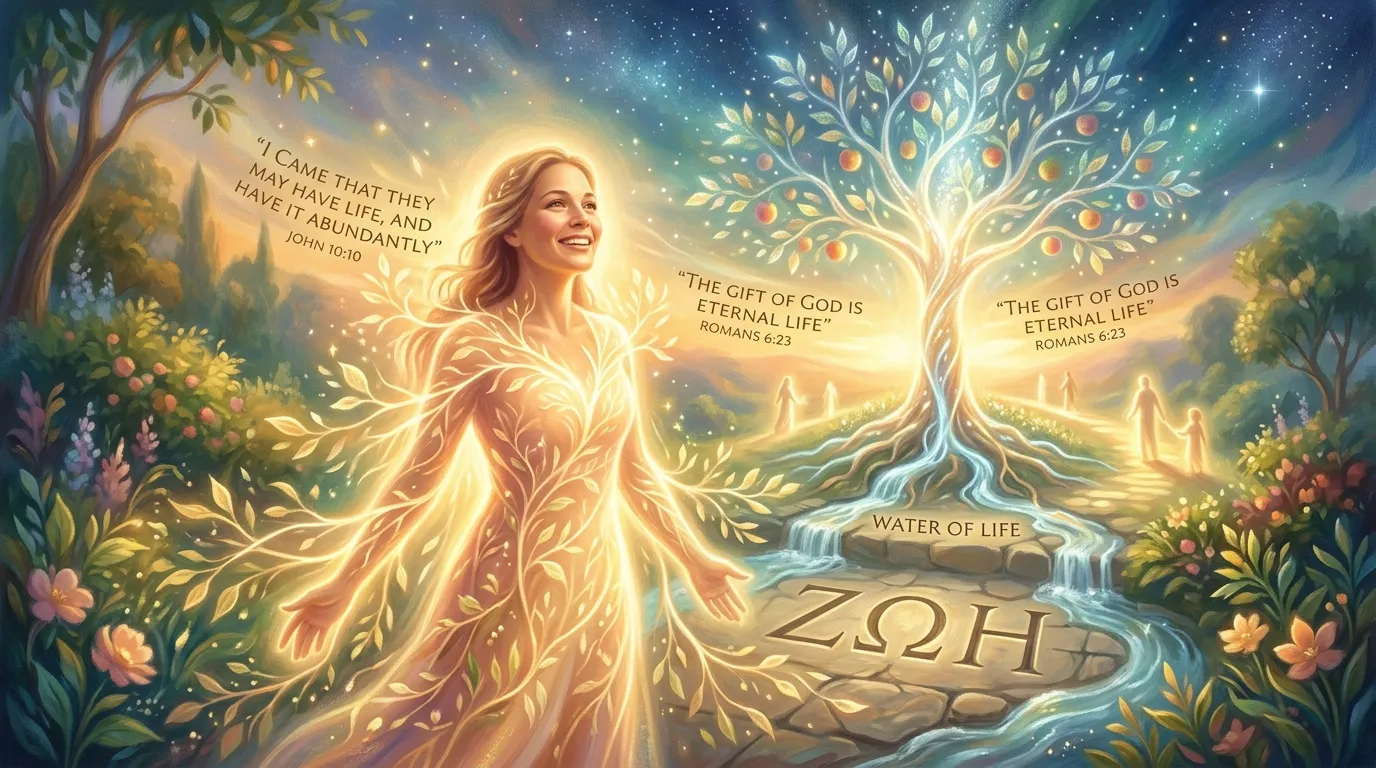
The ancient Greeks had two different words for “life,” and the difference between them is one of the most important ideas in the New Testament. One word, bios — the root of our word “biology” — meant the mechanics of living: the body, its needs, its lifespan. The other word, zoe (pronounced zoh-AY), meant something deeper: life in its fullness, vitality, the very principle of aliveness itself. When the New Testament writers wanted to talk about the life God gives, they reached, overwhelmingly, for the second word. Zoe appears more than 130 times in the New Testament, and almost every time, it is describing a kind of life that biology cannot produce and death cannot end.
To understand the Zoe meaning in the Bible is to understand what Jesus actually came to give. It was not merely a longer life, or a better life, or a life with fewer problems. It was a different kind of life — God’s own life, shared with human beings. The church fathers had a phrase for it: the life of God in the soul of man. Everything else in the Christian faith orbits this gift.
Bios and Zoe: Why the Distinction Matters
The New Testament uses bios sparingly — about ten times — and usually for the outward, material side of existence: “the pride of life” (bios, 1 John 2:16), the rich man’s “goods” or livelihood (Luke 8:14). Bios is what doctors measure and what wills distribute. It is real, God-given, and good — but it is not the main thing.
Zoe, by contrast, is the word of the great promises. “For God so loved the world that he gave his one and only Son, that whoever believes in him shall not perish but have eternal life” (John 3:16) — the word for “life” there is zoe. “I have come that they may have life, and have it to the full” (John 10:10) — zoe again. “In him was life, and that life was the light of all mankind” (John 1:4) — zoe.
The distinction protects us from two opposite errors. The first error is thinking Christianity is only about the afterlife — that zoe is a ticket to heaven and nothing more. The second is thinking it is only about this life — that Jesus came to improve our bios, to make our circumstances comfortable. Zoe refuses both reductions. It is eternal life that begins now, a present possession with a future consummation. “Whoever believes in the Son has eternal life” (John 3:36) — present tense. Not “will have.” Has.
Zoe in the Mouth of Jesus
Follow the word through Jesus’ teaching and a portrait emerges. In John 10:10, He contrasts Himself with the thief, who “comes only to steal and kill and destroy.” The thief deals in subtraction — from bios, from joy, from hope. Jesus deals in addition: “I have come that they may have life [zoe], and have it to the full” — literally, abundantly, overflowing, more than enough.
Notice what “abundant” does not mean here. Jesus spoke these words to people living under Roman occupation, most of them poor, many of them sick, all of them mortal. He was not promising abundance of bios — wealth, health, ease. He was promising abundance of zoe: a life so connected to God that occupation, poverty, and sickness cannot drain it. Paul would later prove the point from a prison cell, writing about joy and contentment with a joy that made no bios sense at all (Philippians 4:4, 11-13).
Then there is the most staggering zoe claim of all: “I am the resurrection and the life [zoe]. The one who believes in me will live, even though they die” (John 11:25). Jesus does not merely give zoe here; He is it. Zoe is not a commodity He distributes but a Person to be united with. To have zoe is to have Christ; to have Christ is to have zoe. “God has given us eternal life, and this life is in his Son. Whoever has the Son has life” (1 John 5:11-12).
The Tree of Life: Zoe from Genesis to Revelation
The Bible’s story of zoe begins before the word itself appears. In Eden stood the tree of life, and after the fall, humanity was barred from it “lest he… take also of the tree of life and eat, and live forever” (Genesis 3:22) — in a fallen state, which would have been a curse, not a blessing. The way back to the tree was closed.
Then watch the thread run through Scripture. Proverbs calls wisdom “a tree of life to those who take hold of her” (Proverbs 3:18). And at the very end of the Bible, the tree reappears: “On each side of the river stood the tree of life, bearing twelve crops of fruit, yielding its fruit every month. And the leaves of the tree are for the healing of the nations” (Revelation 22:2). The Bible opens with the tree of life guarded and closes with the tree of life given. Everything between is the story of how God reopened the way — through the cross, where the curse was borne, and the empty tomb, where death was undone.
Zoe, in other words, is Eden’s life restored and then surpassed. What Adam lost, Christ regained — and Paul insists the regain exceeds the loss: “For if, by the trespass of the one man, death reigned through that one man, how much more will those who receive God’s abundant provision of grace and of the gift of righteousness reign in life through the one man, Jesus Christ!” (Romans 5:17). How much more. Zoe is not a return to the garden; it is an arrival at the city.
What Zoe Looks Like on a Tuesday
Theology must land in the ordinary, so what does possessing zoe change about a regular day? John’s first letter gives the diagnostics — the observable symptoms of divine life in a human soul.
First, zoe loves. “We know that we have passed from death to life, because we love each other. Anyone who does not love remains in death” (1 John 3:14). Love — costly, concrete, enemy-including love — is presented not as the price of zoe but as its pulse. Where divine life flows, love shows up like a heartbeat on a monitor.
Second, zoe obeys with joy rather than duty. “This is love for God: to keep his commands. And his commands are not burdensome, for everyone born of God overcomes the world” (1 John 5:3-4). The person animated by zoe does not experience God’s commands as a cage but as a current — the way a fish does not find water restrictive.
Third, zoe is assured. John wrote his entire first letter “so that you may know that you have eternal life” (1 John 5:13). Assurance is not arrogance; it is the intended normal. The one who has zoe need not spend life anxiously auditing their spiritual bank balance. The life is a gift, the Giver is faithful, and the receipt is written in blood and signed by an empty tomb.
Zoe Cannot Be Earned, Only Received
This must be said plainly because everything in us resists it: zoe is not wages; it is gift. “For the wages of sin is death, but the gift of God is eternal life in Christ Jesus our Lord” (Romans 6:23). Wages are earned. Gifts are received. The entire biblical doctrine of grace stands on this hinge.
The rich young ruler came to Jesus asking what good thing he must do to get eternal life (Matthew 19:16) — and Jesus’ answer exposed the impossibility: with man it is impossible; with God all things are possible (Matthew 19:26). Nicodemus, the moral theologian, was told he must be “born again” (John 3:3) — birth is not an achievement; it is something that happens to you. Every biblical image of receiving zoe — birth, gift, drink of living water (John 4:14), bread from heaven (John 6:35) — puts the sinner in the posture of a receiver, not an earner.
And yet — held in proper tension — zoe grows. Peter urges believers to “grow in the grace and knowledge of our Lord and Savior Jesus Christ” (2 Peter 3:18). The life is complete as a gift and progressive as an experience. A newborn possesses full human life in an instant, then spends decades growing into it. So it is with zoe: received in a moment through faith, unfolded over a lifetime through obedience, prayer, suffering, and joy.
The Name and the Promise
It is no coincidence that Zoe became a beloved Christian name in the early church. In an age when infant mortality was high and life was fragile, naming a daughter Zoe — Life — was a confession of faith: a declaration that the life that matters most is the one death cannot touch. The name carried eschatology in it.
Whether Zoe is your name, your child’s name, or simply a word you encountered in Scripture, its message is the same and it is the center of everything: God has life in Himself, and He shares it. “For as the Father has life in himself, so he has granted the Son also to have life in himself” (John 5:26) — and the Son, in turn, grants it to all who come. Bios will end; every doctor’s chart eventually closes. Zoe will not. It is the life of the age to come, breaking into the present, offered freely to whoever will receive it.
Come thirsty. “Let the one who is thirsty come; and let the one who wishes take the free gift of the water of life” (Revelation 22:17). That is the whole meaning of Zoe in the Bible — and the whole offer of the gospel in a single Greek word. For readers who want to trace how the early church developed this doctrine of eternal life across the centuries, the Wikipedia overview of eternal life in Christianity provides useful historical context — but the life itself is not found in an article. It is found in a Person, and He is still giving it away.