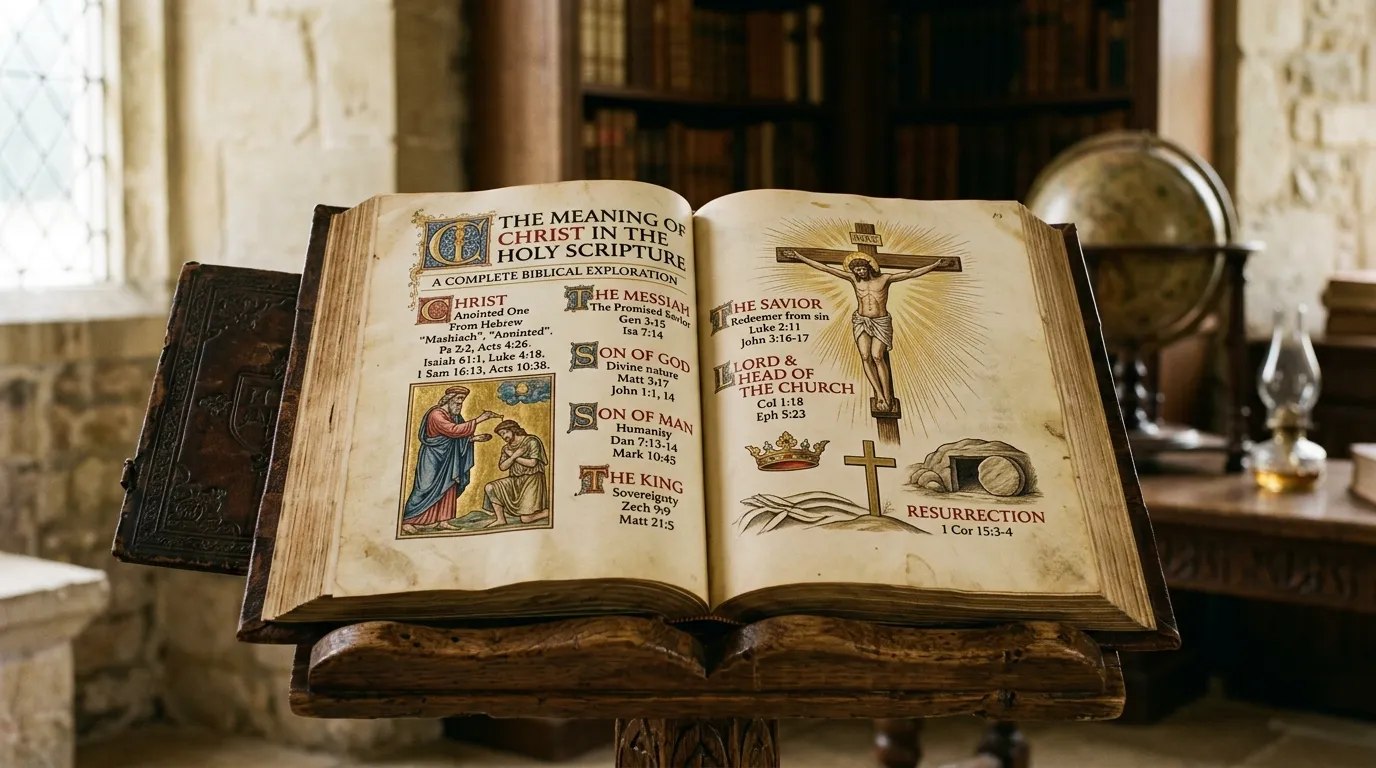
Picture the scene in Caesarea Philippi. Jesus turns to His disciples and asks a question that still hangs in the air two thousand years later: “But who do you say that I am?” (Mark 8:29). Peter answers with seven words that changed the world: “You are the Christ, the Son of the living God.” Jesus calls that answer a revelation from heaven itself. Notice what Peter does not say. He does not say, “You are a good teacher,” or, “You are a prophet.” He reaches for the most hope-loaded word in Israel’s vocabulary — Christ — and lays it at Jesus’s feet.
This guide explores that word the way Scripture does: as a title, not a surname. We will trace where it comes from, what it promised, how Jesus claimed it, and what it means for anyone who confesses it today. By the end, you will never again hear “Jesus Christ” as two names. You will hear it as a name and a verdict.
Not a Last Name: The Word Behind the Title
“Christ” is the English form of the Greek Christos, which means “anointed one.” The background is Israel’s ancient practice of setting people apart for sacred office by pouring oil on their heads. When Samuel anointed David, the oil was the visible sign of an invisible reality — the Spirit of the Lord coming upon him for the task ahead (1 Samuel 16:13). To be anointed was to be authorized by God for work no one could take up on their own authority.
The Hebrew word behind the same idea is Mashiach, from which we get “Messiah.” The Gospel writers treat the two as synonyms. When Andrew finds his brother Simon and exclaims, “We have found the Messiah,” John immediately translates for his readers: “which means Christ” (John 1:41). Two languages, one office, one person. Every occurrence of “Jesus Christ” in the New Testament is really saying “Jesus, the Anointed One” — the One the whole Old Testament had been pointing toward.
Three offices in Israel received anointing: prophets, priests, and kings. An anointed prophet carried a message that had to be heard. An anointed priest had access to God’s presence on behalf of the people. An anointed king ruled with God’s authority. In Israel’s history, every holder of these offices proved inadequate — prophets were rejected, priests were corrupted, kings failed and led the nation into exile. So hope crystallized around a coming figure who would finally fill all three perfectly. Jesus claims all three, and the title “Christ” bundles them into a single word.
The Portrait the Prophets Drew
The expectation of an Anointed One did not appear overnight. It grew across centuries, each prophecy adding a line to the portrait:
- The serpent-crusher: a seed of the woman who would crush the serpent’s head (Genesis 3:15) — the first promise that evil would be undone by a child.
- The eternal king: a descendant of David whose throne would be established forever (2 Samuel 7:12–16).
- The divine child: a son given, on whose shoulders the government would rest, called “Mighty God” and “Prince of Peace” (Isaiah 9:6–7).
- The suffering servant: one pierced for transgressions and crushed for iniquities, by whose wounds we are healed (Isaiah 53:5) — the shocking turn that the Anointed One would conquer by dying.
- The Bethlehem ruler: a ruler from the small town of Bethlehem whose origins are “from of old, from ancient days” (Micah 5:2).
No ordinary candidate could fit a profile this specific and this paradoxical — a reigning king and a slaughtered lamb in one person. The New Testament’s claim is that Jesus fits it precisely: born in Bethlehem (Matthew 2:1), descended from David (Romans 1:3), crucified for sins (1 Corinthians 15:3), and raised to reign (Acts 2:36). The prophecies were the lock. Jesus is presented as the key that turns in it.
Why So Many Missed Him
First-century Israel was full of people waiting for the Messiah, yet the religious leaders rejected Jesus. The failure was not a lack of evidence but a fixed picture of what the Anointed One should be. They wanted a military deliverer to break Rome’s yoke. Jesus offered a deeper conquest — victory over sin and death themselves. Peter’s confession was called a revelation from the Father (Matthew 16:17) because recognizing the true Christ requires God to open blind eyes. It still does, in every generation.
The Moment Jesus Claimed It
Jesus did not merely accept the title from others; He claimed it publicly. In the synagogue at Nazareth, He read Isaiah’s description of the Anointed One’s mission — good news to the poor, liberty to captives, sight to the blind — and then said, “Today this Scripture has been fulfilled in your hearing” (Luke 4:18, 21). The hometown crowd understood the claim perfectly, and they tried to throw Him off a cliff.
The anointing Jesus claims is not with oil but with the Spirit. At His baptism, the Spirit descended like a dove and the Father’s voice spoke from heaven — the true consecration of which every flask of oil had been a shadow. Peter later summarized the whole ministry in these terms: “God anointed Jesus of Nazareth with the Holy Spirit and with power” (Acts 10:38). The title is not decoration. It is the ministry’s job description.
Later, before the high priest, Jesus was asked directly: “Are you the Christ, the Son of the Blessed?” His answer — “I am” — was treated as blasphemy worthy of death (Mark 14:61–64). The title was that explosive. To claim it was to claim equality with God, and Jesus claimed it anyway.
What the Confession Requires of Us
The early church treated “Jesus is the Christ” as the load-bearing wall of the faith. “Whoever confesses that Jesus is the Son of God, God abides in him” (1 John 4:15). But what does a person actually affirm in those words? Four things at minimum:
- His identity: Jesus of Nazareth is the promised Messiah — not one option among many. On Pentecost Peter preached, “Let all the house of Israel therefore know for certain that God has made him both Lord and Christ, this Jesus whom you crucified” (Acts 2:36).
- His work: As the Christ, He is the only mediator between God and humanity: “there is one mediator between God and men, the man Christ Jesus” (1 Timothy 2:5). His death and resurrection are the accomplished atonement, not an inspiring story.
- His authority: The Christ is King, and His commands are not suggestions. To confess Him is to transfer allegiance — to say that every rival loyalty must bow. This is why the confession got Christians killed under Rome; it was a political claim as much as a spiritual one.
- Our dependence: Nobody anoints himself. The title confesses that salvation is received, not achieved. We do not climb to God; the Anointed One came down to us.
John draws the line without apology: “Who is the liar but he who denies that Jesus is the Christ?” (1 John 2:22). That is not cruelty toward honest doubters — it is clarity about the center. Remove the title and you have a wise teacher. Keep it and you have a Savior, a King, and a Judge before whom every knee will bow (Philippians 2:10–11).
Living Under the Anointed King
Theology that never reaches an ordinary Tuesday is just decoration. What does it change, day to day, that Jesus is the Christ?
It settles the question of access to God. An anointed priest enters the holy place on behalf of the people. Because Christ is our great high priest (Hebrews 4:14), believers need no human mediator, no perfect record, no religious pedigree to approach God. Prayer is not a performance; it is an audience granted by the Anointed One’s own blood.
It reorders fear. If the Christ reigns — seated at the right hand of the Father (Hebrews 1:3) — then the worst that history can do has an expiration date. Elections, diagnoses, and disasters are real, but none of them is ultimate. The King is on the throne, and His reign is not up for a vote.
It defines the mission. Those who belong to the Christ share His anointing in a derived sense: the same Spirit rests on His people for witness and mercy (Acts 1:8). The church is an anointed community doing anointed work — proclaiming good news, binding wounds, setting captives free.
And it anchors hope. The Christ who came in humility will come again in glory (Revelation 22:20). Every promise of God is “Yes” in Him (2 Corinthians 1:20). The title is a tether: whatever the present looks like, the Anointed One holds the future, and He is bringing His people with Him.
So the question Jesus asked at Caesarea Philippi stands before every reader still: “But who do you say that I am?” “Christ” is not a syllable to attach to His name out of habit. It is a verdict — that God anointed this man, vindicated Him by resurrection, and enthroned Him as Lord of all. To confess it is to change kingdoms (Colossians 1:13). Everything in the Christian life flows from getting this one title right. Those interested in how later generations wrestled with and preserved this confession will find the overview of the Christ title across church history a useful companion to the biblical portrait above.










