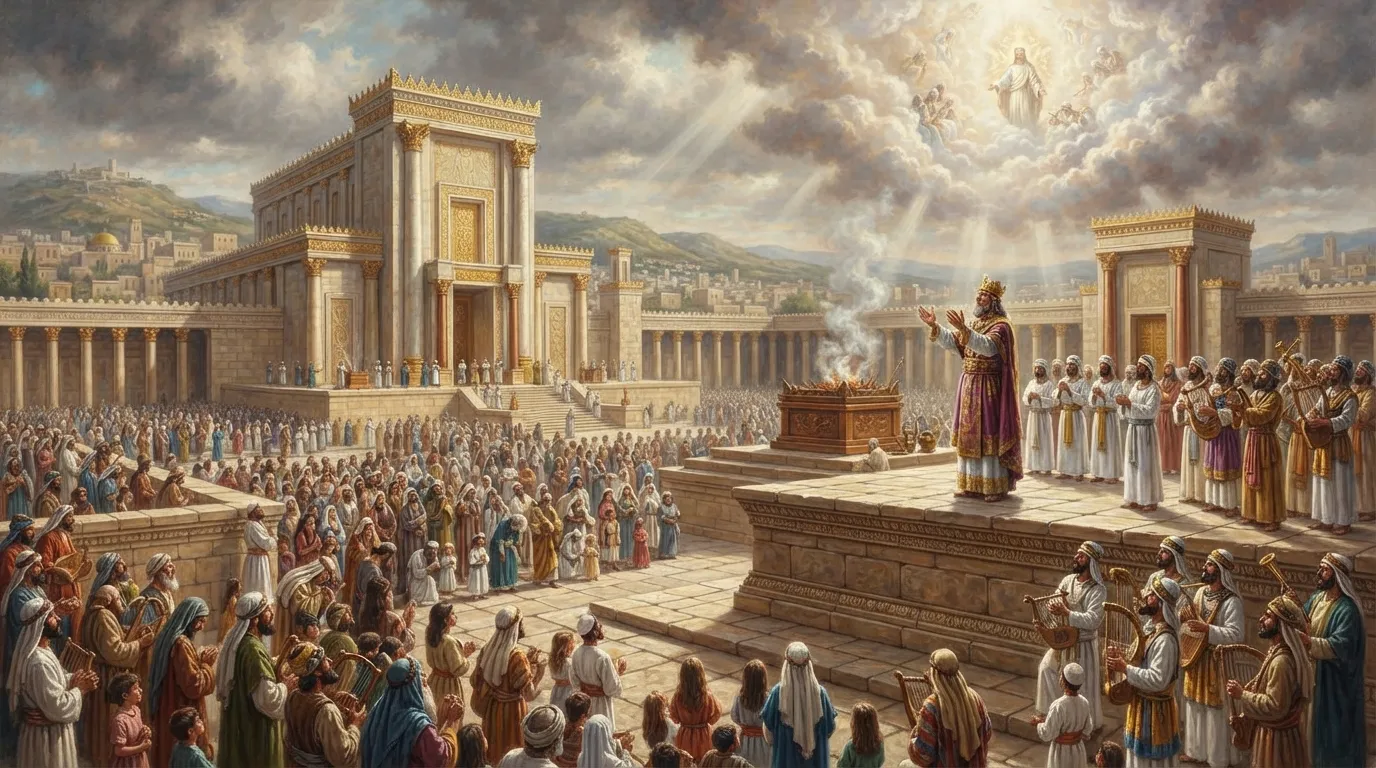
David wanted to build it. He had the desire, the resources, and the plans. But God said no — not because David was unworthy, but because David was a man of war, and the house of God would be built by a man of peace. “You shall not build a house for my name, for you are a man of war and have shed blood” (1 Chronicles 28:3). Instead, David spent his final years gathering materials: stone, timber, gold, silver, bronze, iron — a fortune stockpiled for a building he would never see. His son Solomon would build it. The temple that rose on Mount Moriah was the product of two generations: one man’s preparation, another man’s completion.
Solomon’s Temple, built in the tenth century BC, was the most important building in Israel’s history. It was the center of worship for four centuries, the destination of pilgrims, the home of the Ark, and the visible sign that God dwelt among His people. Its construction is described in 1 Kings 5–8 and 2 Chronicles 2–7 — some of the most detailed architectural passages in the Bible. And its meaning goes far beyond stone and gold.
Preparation: David’s Gift, Solomon’s Task
Solomon did not start from nothing. David had prepared everything: the site (the threshing floor of Ornan, where God had stopped the plague — 2 Samuel 24), the materials, the workers, and the plans, which David said were given “by the hand of the LORD” (1 Chronicles 28:19). Solomon’s first great act as king was not a battle or a decree. It was a construction project his father had designed.
There is a lesson in that. Most great works of God span generations. The person who plants is rarely the person who harvests. David gathered; Solomon built. Moses led out of Egypt; Joshua led into the land. John the Baptist prepared; Jesus fulfilled. Faithfulness often means preparing something you will never see finished — and trusting the next generation to complete it.
Solomon also made an alliance with Hiram, king of Tyre, who supplied cedar and cypress timber from Lebanon and skilled craftsmen. The temple was built with international help — a quiet hint that the God of Israel was never meant to be a tribal deity. The house in Jerusalem would one day welcome all nations (Isaiah 56:7).
Construction: Seven Years of Precision
Construction began in the fourth year of Solomon’s reign, in the month of Ziv, and took seven years (1 Kings 6:1, 37–38). The numbers are significant: the temple was begun 480 years after the exodus, linking the new house to the old deliverance. Seven is the number of completion in Scripture. The temple was finished completely, in God’s timing.
The building itself was about 90 feet long, 30 feet wide, and 45 feet high — modest by modern standards, but overlaid with staggering richness. The interior was paneled with cedar carved with gourds, open flowers, and cherubim, and overlaid with pure gold. The Most Holy Place was a perfect cube, 30 feet in each dimension, entirely covered in gold — 600 talents of it, according to Chronicles. Two great cherubim of olive wood, each 15 feet tall, stood with wings outstretched over the Ark.
One detail stands out: “When the house was built, it was with stone prepared at the quarry, so that neither hammer nor axe nor any tool of iron was heard in the temple while it was being built” (1 Kings 6:7). The stones were cut off-site and fitted silently into place. The house of God was built without the sound of violence — no clanging iron, no hammering. It was a house of peace, assembled in reverent quiet. The God who spoke the world into being without tools did not need tools’ noise in His house.
Dedication: Glory Fills the House
The dedication of the temple in 1 Kings 8 is one of the high points of the Old Testament. The Ark was carried in by the priests and placed in the Most Holy Place. The Levites sang. The musicians played. And then “a cloud filled the house of the LORD, so that the priests could not stand to minister because of the cloud, for the glory of the LORD filled the house of the LORD” (1 Kings 8:10–11). The same glory that had led Israel in the wilderness, the same glory that had settled on Sinai, now filled the temple. God had moved in.
Then Solomon prayed — the longest recorded prayer in the Bible. It is a masterpiece of theology. He began with praise, then asked God to hear prayers offered toward the temple, then prayed for a remarkable range of situations: defeat in battle, drought, famine, plague, foreign visitors, captivity in exile. For each, the answer was the same: if the people repent and pray, God will hear and forgive.
But the heart of Solomon’s prayer is a question: “But will God indeed dwell on the earth? Behold, heaven and the highest heaven cannot contain you; how much less this house that I have built!” (1 Kings 8:27). Solomon understood what many worshipers forget: no building can contain God. The temple was not a box for God. It was a sign of His presence, a place for prayer, a focus for worship — but the God who made heaven and earth cannot be housed. The temple pointed to a presence that transcends every building.
The Queen of Sheba’s Visit
The temple’s fame spread far beyond Israel. When the Queen of Sheba heard of Solomon’s wisdom and saw the temple, the palace, and the order of his court, “there was no more breath in her” (1 Kings 10:5). She told Solomon, “The half was not told me” (1 Kings 10:7). The temple was not only a place of worship; it was a witness to the nations. Foreigners came, saw the glory of Israel’s God reflected in the building and in the wisdom of its king, and were amazed. The temple fulfilled, in part, God’s promise that Israel would be a light to the nations. Yet the visit also carried a shadow: the gold and splendor that impressed the queen would later become a temptation. Solomon’s wealth grew, his wives multiplied, and his heart turned (1 Kings 11). The same glory that testified to God’s greatness became the stage for Solomon’s decline — a reminder that even the most God-honoring achievements can become idols if the heart drifts.
The Temple’s Decline and Destruction
The temple’s glory did not last. Within a generation of Solomon’s death, the kingdom split, and the temple became a political symbol as much as a spiritual one. Over the centuries, kings desecrated it, neglected it, and restored it in cycles. Manasseh put idols in it. Josiah purged it. And in 586 BC, Nebuchadnezzar’s army burned it to the ground.
The destruction was devastating, but the prophets had warned of it. The temple was never meant to be a talisman. When the people treated it as a charm — “the temple of the LORD, the temple of the LORD” (Jeremiah 7:4) — God removed it. The lesson is permanent: no building, no institution, no religious structure guarantees God’s presence. God is present where His people worship in spirit and truth (John 4:24).
The Temple That Jesus Became
The New Testament takes the temple’s meaning and centers it on Christ. Jesus called His own body the temple (John 2:19–21). Paul calls believers the temple of the Holy Spirit (1 Corinthians 6:19) and the church the temple of God (1 Corinthians 3:16; Ephesians 2:21–22). Peter calls Christians “living stones” being built into “a spiritual house” (1 Peter 2:5). The physical temple was a shadow. The reality is Christ and His people.
This is why the tearing of the temple curtain at the crucifixion matters so much (Matthew 27:51). The curtain separated the Holy of Holies from the rest of the temple. When it tore from top to bottom, God was announcing that the way into His presence was open — not through a building, not through an annual ritual, but through the torn flesh of Jesus (Hebrews 10:19–20). Solomon’s Temple took seven years to build. The true temple was built in three days — destroyed on Friday, raised on Sunday.
And Revelation ends the story where Solomon’s Temple began: with God dwelling among His people, but now without any temple at all. “And I saw no temple in the city, for its temple is the Lord God the Almighty and the Lamb” (Revelation 21:22). The temple was always a temporary signpost pointing to a permanent reality: God with us, forever, face to face.
Solomon built a house of gold and cedar, and the glory of God filled it. But the greater glory is this: the God who filled that house now fills His people. You are the temple. The presence Solomon prayed for is the presence that dwells in you. And the house that David prepared and Solomon built was only ever a preview of the house God is building now — a house of living stones, with Christ as the cornerstone, that will never be torn down. For the history of the First Temple, its construction, and its destruction, see the Wikipedia article on Solomon’s Temple.










