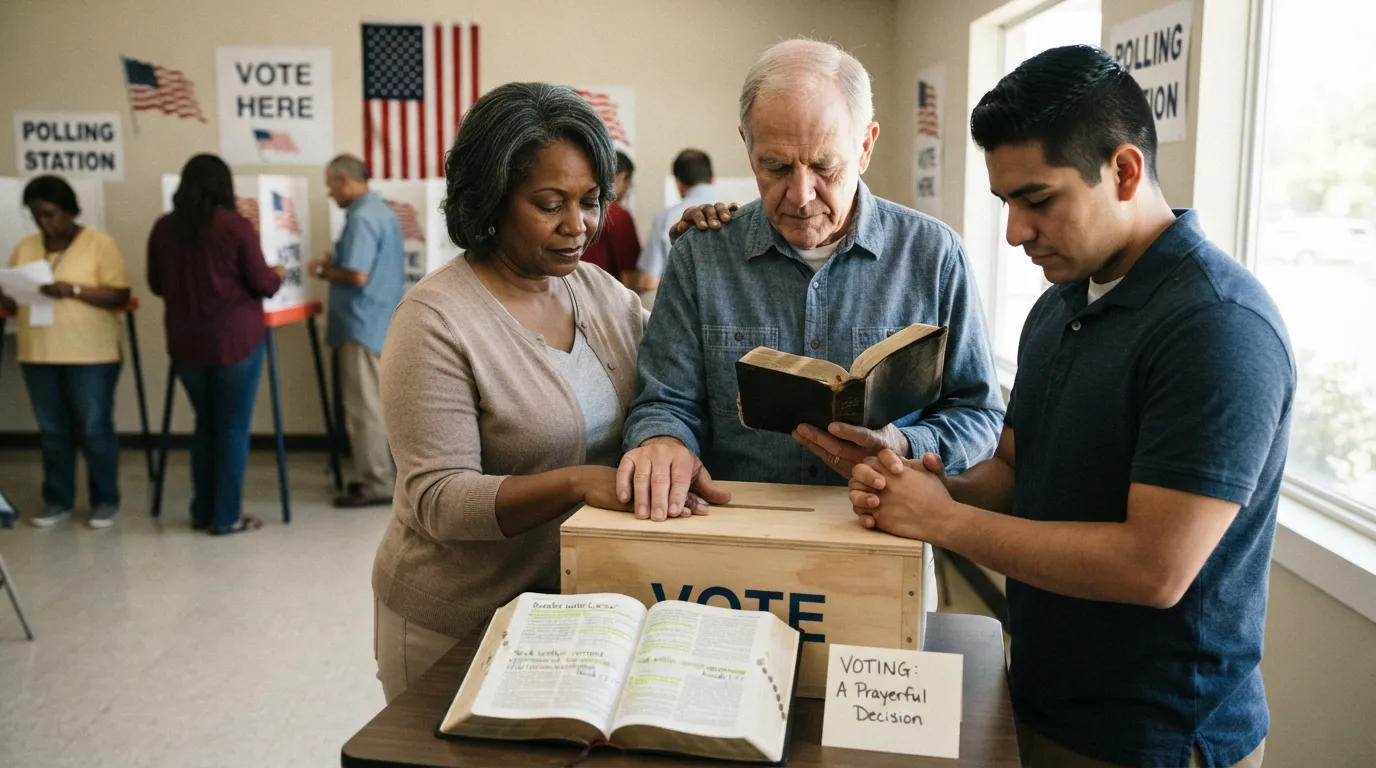
The Bible never says the words “go vote.” There were no ballot boxes in ancient Israel, no polling stations in Rome, no campaign ads in Corinth. The political systems of the Bible were monarchies, empires, and theocracies — not democracies. So anyone who claims the Bible commands Christians to vote for a particular candidate is claiming something Scripture never says.
But the Bible says a great deal about the things that voting involves: choosing leaders, seeking justice, loving neighbors, stewarding influence, speaking truth, and living as a citizen of two kingdoms at once. Christians in democracies have something the believers of the Bible never had: a say in who governs them. The question is not whether the Bible mentions voting. The question is what biblical wisdom does with the vote.
Two Kingdoms, One Citizen
Jesus drew the line that frames all Christian political thinking: “Render to Caesar the things that are Caesar’s, and to God the things that are God’s” (Matthew 22:21). The statement is both a limit and a liberation. Caesar gets his taxes, his roads, his due respect. But Caesar does not get your soul. Your ultimate allegiance belongs to a King whose kingdom is “not of this world” (John 18:36).
Paul adds the tension. On one hand, governing authorities are “instituted by God” and are “God’s servant for your good” (Romans 13:1, 4). Christians should respect them, pay taxes, and live as good citizens. On the other hand, Paul himself was executed by the government he told believers to respect. The same apostle who wrote Romans 13 also wrote, “Our citizenship is in heaven, and from it we await a Savior, the Lord Jesus Christ” (Philippians 3:20). Christians are dual citizens: residents of an earthly nation, citizens of a heavenly kingdom. The earthly citizenship is real and carries duties. The heavenly citizenship is ultimate and relativizes all the rest.
That dual citizenship is why voting matters — and why it must never become an idol. Your vote is a tool of earthly stewardship. It is not your salvation, not your identity, and not the measure of your faithfulness. No election will bring the kingdom of God. No candidate is the Messiah. Christians who forget that end up either devastated by every loss or triumphalist about every win — both of which betray a misplaced hope.
What the Bible Says About Choosing Leaders
Although Scripture never describes an election, it describes the selection of leaders repeatedly, and the criteria are consistent. When Jethro advised Moses to appoint leaders, he said to choose “able men, such as fear God, men who are trustworthy and hate a bribe” (Exodus 18:21). Four qualities: competence, godliness, trustworthiness, and incorruptibility. That is a strikingly useful rubric for evaluating any candidate.
When Israel wanted a king, God warned them about what kings do: they take sons for armies, daughters for service, fields, servants, and wealth (1 Samuel 8:11–18). Power concentrates. Leaders who are not constrained by character and law will expand their reach. The Bible is realistic about power: it corrupts, it tempts, and it must be checked.
When the apostles needed to replace Judas, they prayed and cast lots (Acts 1:24–26). When the church needed deacons, they chose “men of good repute, full of the Spirit and of wisdom” (Acts 6:3). The pattern is consistent: leadership selection should be prayerful, character-driven, and community-involved. Voting, at its best, is a modern form of that ancient practice — the community choosing those who will serve it.
The Bible also warns about the character of rulers. “When the righteous increase, the people rejoice, but when the wicked rule, the people groan” (Proverbs 29:2). “Woe to those who decree iniquitous decrees, and the writers who keep writing oppression” (Isaiah 10:1). Leaders matter. Their character shapes the lives of millions. Choosing them carelessly is not neutrality; it is negligence.
Principles for the Voting Booth
First, vote as a steward, not as a consumer. A consumer asks, “What will this candidate do for me?” A steward asks, “What will this candidate do for the common good, for the vulnerable, for justice, for truth?” Scripture’s vision of government is not self-service. It is service: “He is God’s servant for your good” (Romans 13:4). The biblical voter thinks about neighbors, not just self — including neighbors who cannot vote: the unborn, the poor, the immigrant, the persecuted, the unborn generations who will inherit today’s decisions.
Second, weigh character and policy together. Character without competence is well-meaning failure. Competence without character is efficient corruption. The Bible cares about both. A candidate’s private integrity predicts public behavior, and a candidate’s public policies reveal what their character produces. Christians should resist the false choice between “only character matters” and “only policy matters.” Both matter, because both affect real people.
Third, prioritize the weightiest matters. Jesus rebuked religious leaders who “tithe mint and dill and cumin, and have neglected the weightier matters of the law: justice and mercy and faithfulness” (Matthew 23:23). Every election involves many issues, and Christians of good conscience may weigh them differently. But Scripture gives special weight to certain things: the protection of life (Psalm 139:13–16; Proverbs 6:16–17), justice for the oppressed (Micah 6:8), care for the poor (Proverbs 31:8–9), religious freedom (Acts 5:29), truthfulness (Proverbs 11:3), and the rule of law (Romans 13:1–7). A biblical voter does not treat every issue as equal. Some issues carry more moral weight than others.
Fourth, inform yourself. Proverbs 18:13 warns, “If one gives an answer before he hears, it is his folly and shame.” Voting without knowledge is not faith; it is recklessness. Christians should read widely, check claims, listen to multiple perspectives, and resist the pull of echo chambers. Truth does not fear investigation.
Fifth, keep your conscience clear. Romans 14 teaches that on disputable matters, each person should be “fully convinced in his own mind” (Romans 14:5). Two Christians, both seeking God’s will, may vote differently — and both may be acting in good faith. The church is not a political party, and partisan uniformity is not a fruit of the Spirit. What matters is that each voter can stand before God and say, “I voted as I did because I believed it was right.”
What About Not Voting?
Some Christians conclude, from the brokenness of politics, that they should not vote at all — that participation compromises their witness. The Bible respects the impulse: Christians are not to put their trust in princes (Psalm 146:3), and no party platform will ever fully match the kingdom of God. But abstention is itself a choice, and it has consequences for neighbors. In a democracy, the vote is one of the few tools ordinary people have to protect the vulnerable, restrain evil, and promote justice. To decline it entirely because no candidate is perfect is to demand a purity that no earthly system can offer. The biblical pattern is not withdrawal from flawed systems — Daniel served in Babylon, Joseph served in Egypt, Esther served in Persia — but faithful engagement within them. A Christian may, in conscience, decline to vote in a particular race where no good option exists. But a blanket refusal to participate abandons the stewardship that God gave citizens of a free society. Vote with a clear conscience, hold the result loosely, and remember that your citizenship in heaven does not cancel your duties on earth — it gives them their proper weight.
After the Election: The Harder Duty
Voting is the easy part of Christian citizenship. What comes after is harder. Scripture commands believers to pray for their leaders — including leaders they did not vote for and do not like. “First of all, then, I urge that supplications, prayers, intercessions, and thanksgivings be made for all people, for kings and all who are in high positions” (1 Timothy 2:1–2). Paul wrote that when Nero was emperor. If Christians under Nero were commanded to pray for their ruler, Christians today have no excuse to curse theirs.
Christians must also respect the outcome. “Let every person be subject to the governing authorities” (Romans 13:1). That does not mean silence in the face of injustice — the prophets spoke boldly to kings, and the apostles disobeyed orders that contradicted God. But it does mean that disagreement is expressed lawfully, truthfully, and without hatred. The Christian’s political opponent is a neighbor, not an enemy. “You shall love your neighbor as yourself” (Matthew 22:39) does not come with a partisan exemption.
Finally, Christians must keep perspective. Elections matter, but they are not ultimate. The church survived Nero, Diocletian, Stalin, and Mao. It will survive your country’s next election, whatever the result. The kingdom of God does not rise and fall with any ballot count. As one theologian put it, the church’s mission is not to make America — or any nation — Christian, but to make Christians out of all nations.
So vote. Vote prayerfully, thoughtfully, and with your neighbor in mind. Vote for character and policy, for justice and mercy, for life and freedom. And then, whatever happens, pray for your leaders, love your neighbors — including the ones who voted the other way — and remember that your hope was never in a candidate. Your hope is in a King whose reign will never be decided by an election. For a survey of how Christian traditions have related faith to democratic participation, see the Wikipedia article on Christian democracy.










