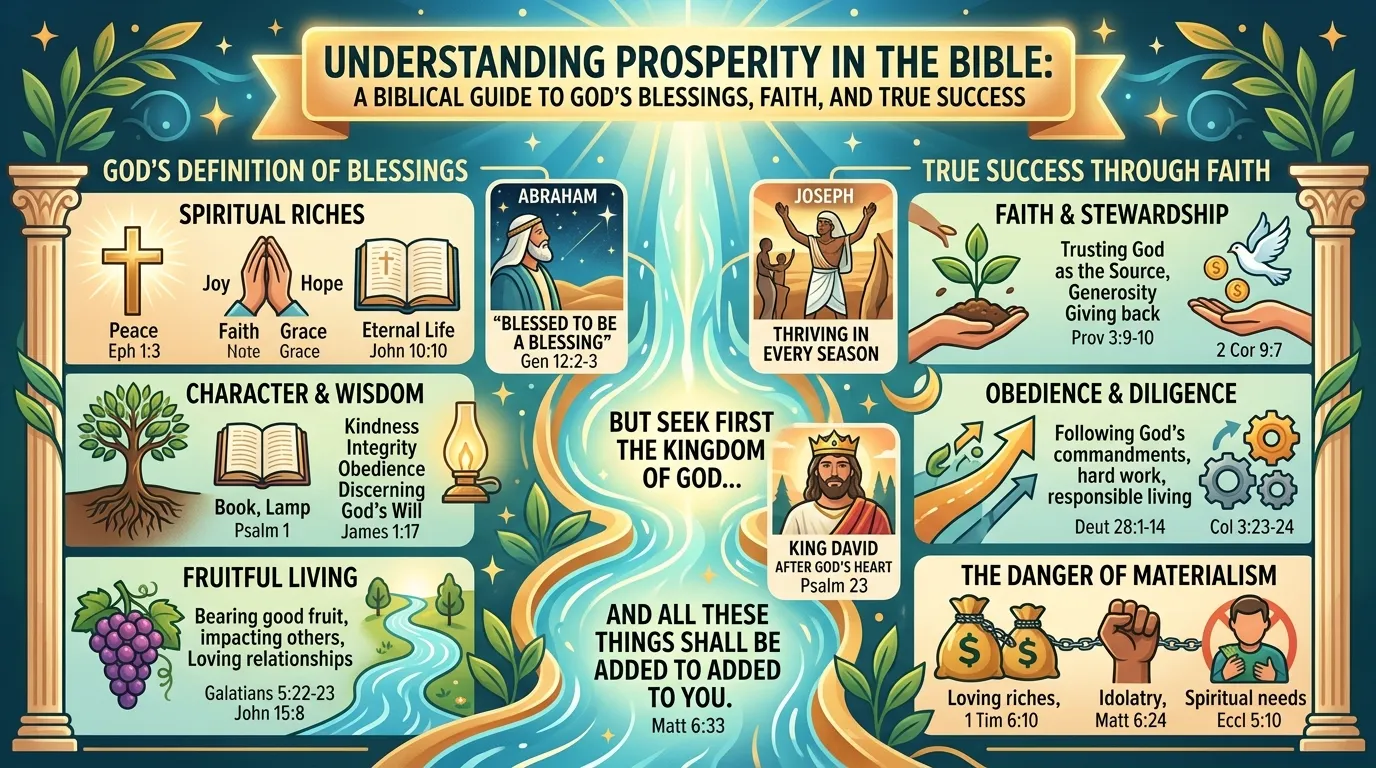
“Beloved, I pray that you may prosper in all things and be in health, just as your soul prospers” (3 John 1:2). “You cannot serve God and money” (Matthew 6:24). Both sentences are in the Bible. Both are true. And the tension between them is exactly where the honest conversation about prosperity has to begin. For some, prosperity is God’s promise to claim; for others, it is a gospel to denounce. Scripture refuses both shortcuts and offers something better: a full-orbed vision of what it means to flourish under God.
What “Prosper” Meant Before It Became a Slogan
The Hebrew word often translated “prosper” is tsalach — to advance, to succeed, to break through. When God tells Joshua, “meditate on the Book of the Law day and night… then you will make your way prosperous, and then you will have good success” (Joshua 1:8), the prosperity in view is covenant faithfulness bearing fruit: the mission succeeding because the man stays anchored to God’s Word.
Psalm 1 paints the Bible’s foundational picture of the prosperous person: like a tree planted by streams of water, yielding fruit in season, leaf un-withered — “in all that he does, he prospers” (Psalm 1:3). Notice what is absent: no promise of luxury, no exemption from winter. The tree prospers by being rooted, nourished, and fruitful — not by escaping the seasons. Biblical prosperity is vitality under God, not immunity from hardship.
The Greek New Testament word in 3 John 1:2 is euodoo — literally “to have a good journey.” John’s prayer for Gaius is a wish for his whole life to go well, body and soul together. It is a warm, pastoral blessing, not a financial formula. Reading it as a guarantee of wealth is like reading a birthday card’s “wishing you the best” as a legal contract.
Portraits of the Prosperous in Scripture
Before judging any teaching about prosperity, it helps to look at the people Scripture itself describes as prospering. Joseph is the clearest case: “The LORD was with Joseph, and he became a successful [prosperous] man” (Genesis 39:2) — written about a slave. Joseph prospered in Potiphar’s house, prospered in prison, and prospered in Pharaoh’s palace. His prosperity was not his circumstances; it was God’s presence producing wisdom, favor, and fruitfulness in every circumstance. That single verse dismantles the idea that prosperity equals comfort.
Daniel prospered under three pagan empires without compromising once — his prosperity looked like integrity that kings could not ignore (Daniel 6:3). Lydia, the first European convert, was a wealthy dealer in purple cloth whose prosperity funded the Philippian church’s hospitality (Acts 16:14-15). Boaz was a prosperous farmer whose wealth became the instrument of redemption for Ruth and Naomi. In each case, prosperity was stewardship: resources held in open hands for God’s purposes.
And then there are the counter-portraits Scripture refuses to let us forget. Lazarus the beggar, carried by angels to Abraham’s side while the rich man who ignored him woke in torment (Luke 16:19-31) — Jesus’ most unsettling statement that earthly prosperity can mask eternal poverty. The Laodicean church said “I am rich, I have prospered, and I need nothing,” and Christ called them “wretched, pitiable, poor, blind, and naked” (Revelation 3:17). Material prosperity, Scripture insists, is spiritually ambiguous: it can be a tool of grace or a veil over the soul, and only the heart’s allegiance tells which.
Where the Prosperity Gospel Goes Wrong — and Right
Honesty requires naming both sides. The so-called prosperity gospel — the teaching that faith obligates God to grant health and wealth — distorts Scripture in ways the Bible itself warns against. It turns 3 John 1:2 into a transaction, treats God as a means to our ends, and quietly implies that the sick or poor simply lack faith. That implication is cruel, and it collapses under the weight of counter-examples: Job, the prophets, the apostles, and Christ Himself, who “had nowhere to lay his head” (Matthew 8:20). Paul warned that those who see godliness as a means of gain have wandered from the faith (1 Timothy 6:5-10), and that “the love of money is a root of all kinds of evils.”
But honesty also requires admitting what the prosperity gospel gets right: God is generous, He does bless, and He is not glorified by our misery. The error is not in believing God blesses — Scripture is full of His material provision, from manna to the feeding of the five thousand. The error is in making blessing the point, in guaranteeing what God gives freely, and in measuring faith by net worth. As Jesus put it with devastating clarity: “A person’s life does not consist in the abundance of his possessions” (Luke 12:15).
The biblical correction is not poverty theology either — the equally unbiblical idea that holiness requires destitution. Scripture honors both the wealthy believer who holds riches loosely (Abraham, Job, Joseph of Arimathea) and the poor believer who is rich toward God (the widow with two mites). The issue is never the amount; it is always the allegiance. “You cannot serve God and money” (Matthew 6:24) — but you can serve God with money, which is precisely what generous saints have always done.
The Prosperity Scripture Actually Promises
So what does God promise? First, provision, not luxury: “My God will supply every need of yours according to his riches in glory in Christ Jesus” (Philippians 4:19). Needs, not greeds — but real needs, really supplied. Second, fruitfulness with purpose: prosperity in Scripture is almost always tied to mission — blessed to be a blessing, as God told Abraham (Genesis 12:2-3). Third, contentment as true wealth: “godliness with contentment is great gain” (1 Timothy 6:6). A contented heart is richer than an anxious millionaire; Paul learned the secret of being content “in any and every circumstance” (Philippians 4:12).
Fourth, and most overlooked: prosperity of soul as the foundation. John’s prayer moves from soul to body, not the reverse: prosper “just as your soul prospers.” A flourishing inner life — peace with God, a clear conscience, love for others — is the root; external flourishing is the possible fruit. Reverse the order and you get the prosperity gospel’s hollow core: full barns, empty soul.
Living the Balanced Vision
What does this look like on a Tuesday? It looks like working diligently as unto the Lord, because Scripture honors honest labor (Proverbs, Colossians 3:23). It looks like praying boldly for provision without demanding it as a right. It looks like generosity as a lifestyle — “whoever sows sparingly will also reap sparingly, and whoever sows bountifully will also reap bountifully,” with God loving “a cheerful giver” (2 Corinthians 9:6-7). It looks like holding every possession with an open hand, ready to give or release as God directs.
It also looks like refusing both envies: not envying the rich (their wealth is not proof of God’s favor) and not despising them either (their wealth is not proof of His displeasure). The balanced believer can celebrate a brother’s business success and sit with a sister’s financial struggle, honoring Christ in both, because neither bank balance defines anyone’s standing with God.
Finally, it looks like gratitude as a daily discipline. The prosperous heart of Scripture is the thankful heart — the one that traces every good gift to the Father’s hand (James 1:17) and refuses to call anything “mine” in the absolute sense. Gratitude is the antidote to both the prosperity gospel’s entitlement and poverty theology’s resentment. Before you ask God for more, thank Him for what is already in your hands; thanksgiving reframes every possession as a trust and every need as an invitation to watch Him provide. The truly prosperous person, in the Bible’s accounting, is the one who can say with Paul, “I have learned the secret of facing plenty and hunger, abundance and need” (Philippians 4:12) — and mean both halves.
Does God want me to be rich?
God wants you to be His — and within that relationship He gives generously, sometimes materially. But Scripture never promises wealth as the norm for believers, and it repeatedly warns that riches are spiritually dangerous (1 Timothy 6:9-10). Pray for provision; pursue faithfulness; leave the amounts to God.
Is it wrong for Christians to have money?
No. Money is a tool, morally neutral until loved or hoarded. What Scripture condemns is the love of money and trust in riches (1 Timothy 6:17). Wealthy believers are commanded not to be arrogant and to be “rich in good works” — generosity, not guilt, is the biblical response to abundance.
Biblical prosperity is neither the promise of a mansion nor the virtue of a hovel. It is the flourishing of a life rooted in God — soul prospering first, provision following as He wills, generosity flowing as a way of life. That vision will not fit on a bumper sticker, but it will carry you through every season. For background on the modern movement that takes its name from this debate, the overview of prosperity theology traces its history and its critics.










