Stand outside on a clear day and turn slowly in a circle. North, south, east, west. Four directions, and between them the whole world. It is no accident that human beings divide the compass this way, or that the Bible does too. The number 4 appears in Scripture the way the four winds appear in nature: everywhere, quietly, holding the world together. But before we explore where it shows up, a word of caution that every honest treatment of biblical numbers must begin with: the Bible never gives numbers fixed, dictionary-style meanings.
First, the Ground Rules
There is a thriving industry of number charts online, each confidently declaring that 4 means this and 7 means that. Most of it is numerology with Bible verses sprinkled on top. Scripture itself never says “the number 4 signifies X.” What Scripture does is use numbers in patterns, and thoughtful readers notice those patterns. The difference between noticing a pattern and decoding a secret is the difference between wisdom and superstition.
So treat everything that follows as observation, not revelation. The fours of the Bible are worth noticing because they cluster around certain themes: the created world, completeness on earth, universality. They are signposts, not secret codes. And like all signposts, they matter only because of where they point.
The Fourth Day: Lights to Govern
On the fourth day of creation, God made the sun, moon, and stars, “to separate the day from the night, and let them serve as signs to mark sacred times, and days and years” (Genesis 1:14). The fourth day is about order imposed on time and space: lights to govern the day and the night, seasons to structure human life.
There is a quiet fitness in this. The number most associated with the ordered physical world appears on the day God orders the heavens. The lights are not gods, as Israel’s neighbors believed, but servants, “governors” appointed by the true King. From its first appearance, four is tied to the world as God arranged it: structured, purposeful, and under His rule.
Four Corners, Four Winds: The Whole Earth
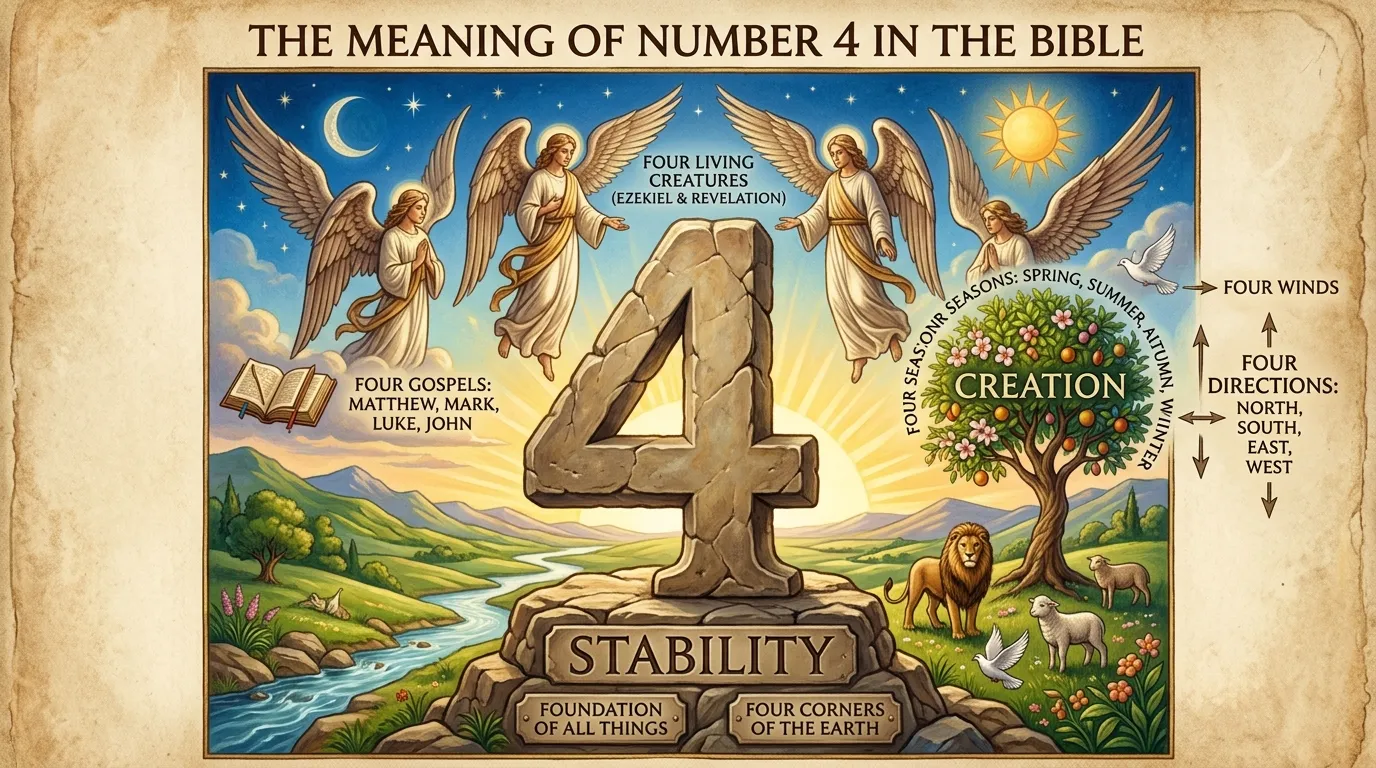
Again and again, Scripture uses “four” to mean everywhere. The prophets speak of the “four corners of the earth” (Isaiah 11:12) and the “four winds of heaven” (Daniel 7:2; Zechariah 6:5). Revelation picks up the image: angels “standing at the four corners of the earth, holding back the four winds” (Revelation 7:1).
Obviously the earth is not square. The phrase is phenomenological, describing the world as it appears: four directions, and therefore everywhere. When the Bible wants to say “from all over,” it says “from the four winds” (Ezekiel 37:9; Matthew 24:31). Four is the number of universality, of nothing left out, of God’s reach extending to every point of the compass.
This gives the devotional reader a lovely meditation. Your God is not a local deity, confined to one shrine or one nation. The four winds are His messengers, the four corners are His territory, and the whole wide earth is His parish. There is no direction you can turn where He is not already there, no corner of your life outside His reach, no exile so far that His winds cannot find you.
The Four Living Creatures: Creation Worshipping
Around God’s throne, John sees “four living creatures,” each with a different face: lion, ox, man, eagle (Revelation 4:6-8). Ezekiel saw the same beings by the river Kebar (Ezekiel 1:5-10). They never stop saying, “Holy, holy, holy is the Lord God Almighty.”
Interpreters have long seen in the four faces a picture of all creation: the lion for wild beasts, the ox for domesticated animals, the eagle for birds, the man for humanity. Four faces, four orders of created life, gathered around the throne in unceasing worship. If that reading is right, the four living creatures are creation itself, doing what it was made to do.
Whether or not every detail of that interpretation holds, the scene’s message is clear: the created order, in all its fourfold fullness, exists for worship. The number four here does not carry a secret. It carries a choir. And the song never stops, which means creation’s worship does not depend on our mood, our news, or our circumstances. It simply continues, inviting us to join.
The Fourfold Gospel: One Story, Four Witnesses
The New Testament’s most significant four is structural: four Gospels telling one story. Matthew, Mark, Luke, and John each present Jesus from a different angle, to a different audience, with different emphases, and together they give the church a complete portrait of Christ.
The early church noticed the parallel with the four living creatures and loved it. Irenaeus, writing in the second century, argued that just as there are four winds and four corners of the earth, so there are fittingly four Gospels carrying the good news to the whole world. It is a beautiful observation, and even if it is more poetic than exegetical, it captures something true: the gospel is for the four corners, and four witnesses carry it.
There is also a practical lesson in the fourfold witness. God did not give us one Gospel but four, because truth is rich enough to need multiple angles. The church has always resisted flattening the story into a single perspective. Four Gospels mean we get Jesus in stereo, or rather in rich quadraphonic sound, every angle adding depth to the portrait.
The Small Fours of the Gospels
Not every four in Scripture is cosmic. Some are quietly human, and they are worth noticing. When the paralyzed man was lowered through the roof to Jesus, it was four friends who carried him (Mark 2:3-4). They could not get through the crowd, so they tore up the roof. Four ordinary people, one extraordinary act of love, and a man walked home carrying his mat. The number is incidental; the friendship is the sermon. Some blessings arrive on the shoulders of four faithful friends.
Jesus fed four thousand in the wilderness (Mark 8:9), a miracle distinct from the feeding of the five thousand. Two feedings, two numbers, one compassionate Lord. The church has always read these together: Christ feeds Jews and Gentiles, the near and the far, the five thousand of Israel and the four thousand of the nations. Whether the numbers carry that symbolism or not, the compassion is undeniable. No one who comes to Jesus hungry goes away empty.
At the cross, four soldiers divided Jesus’ garments, “one for each soldier” (John 19:23). John notes the detail because it fulfilled Psalm 22:18, “They divide my clothes among them.” The smallest, grimmest four in the Gospels sits at the foot of the cross, gambling for a dead man’s tunic while the living God accomplished salvation above them. Four can be mundane, even sordid. The Bible does not romanticize its numbers; it reports them.
The Harder Fours: Judgment Too
Honesty requires mentioning that four is not always comforting. Zechariah sees four horns that scattered Judah (Zechariah 1:18), and four craftsmen sent to terrify them. Revelation’s four horsemen ride out as judgments upon the earth (Revelation 6:1-8). The four winds can scatter as well as gather.
This is worth sitting with, because it corrects the sentimental reading. If four is the number of the whole earth, then it is the number of the whole earth under judgment as well as under blessing. God’s universality cuts both ways: no corner is beyond His mercy, and no corner is beyond His justice. The four horsemen are terrifying precisely because they ride everywhere.
But even here, the gospel has the last word. The judgments of Revelation are not the end of the story. They are the birth pangs of the new creation, where the fourfold world will finally be what it was made to be: whole, healed, and worshipping.
Reading the Fours Without Superstition
So what do you do when you notice the number 4, on a clock, in a dream, in a date? The same thing you do with any pattern: let it prompt reflection, not divination. If fours remind you that God rules the whole earth, from every corner to every wind, that is a fine meditation. If they make you anxious about hidden messages, you have crossed the line.
Three tests keep you honest. First, does Scripture itself highlight the pattern, or am I importing it? Second, does the “meaning” lead me to Christ and His character, or to speculation? Third, would I be embarrassed to explain my reasoning to a mature believer? If the answers are yes, Christ, and no, you are probably on solid ground.
The fours of the Bible ultimately tell one story: the world is God’s, all of it, in every direction, and He has not abandoned a single corner of it. That is not numerology. That is theology, and it is worth far more than any code. For the number’s broader career in mathematics, culture, and symbolism beyond Scripture, the Wikipedia article on the number 4 makes for fascinating further reading.