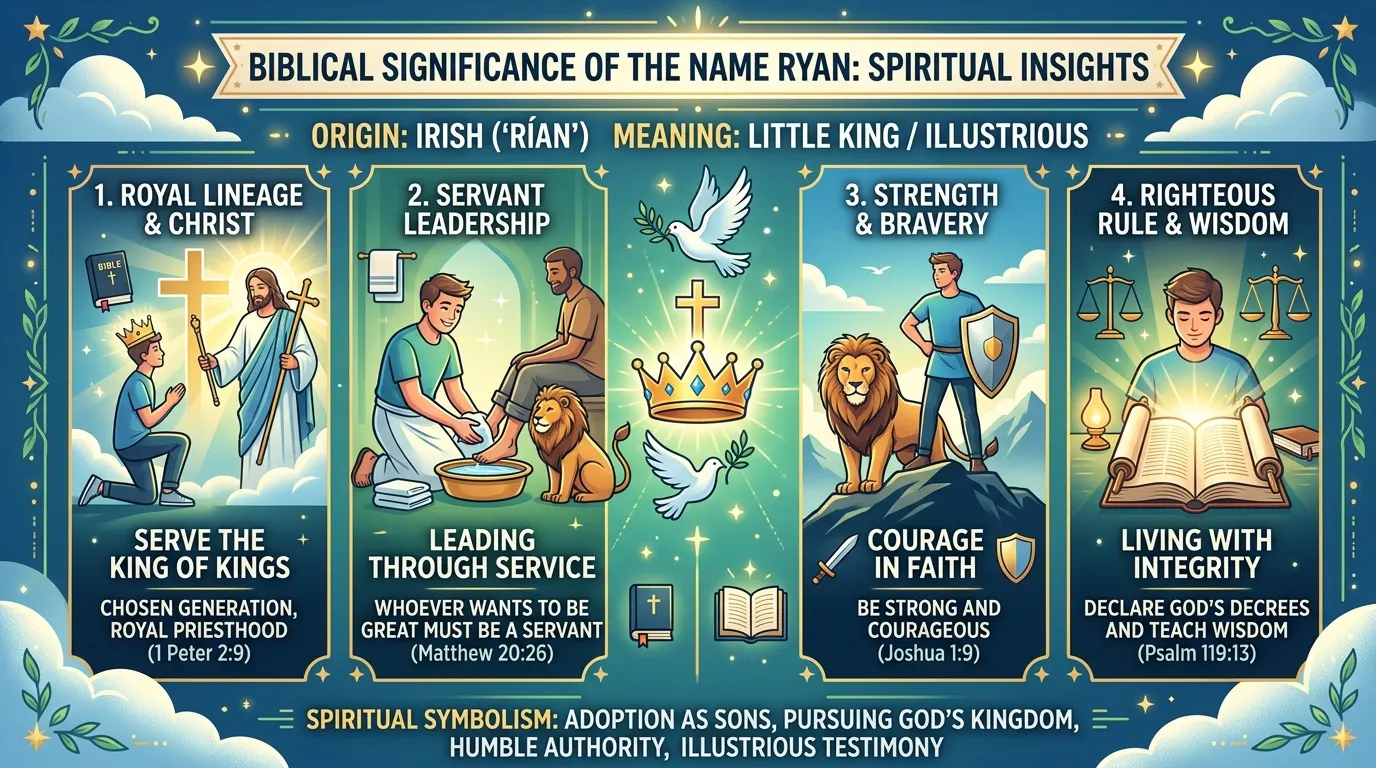
In delivery rooms and nurseries across the English-speaking world, it happens every day: parents settle on the name Ryan for a newborn son, often because they simply like the sound of it. Clean, strong, familiar, timeless. But names are never just sounds. They carry histories, and histories carry meanings. Ryan’s history is Irish, its meaning is royal, and its story, when set beside the Bible’s long meditation on kingship, becomes surprisingly rich and rewarding. Let us be honest from the start: Ryan does not appear in Scripture. But the idea inside it, kingship, is one of the Bible’s biggest ideas.
Where Ryan Comes From
Ryan began not as a first name but as an Irish surname: Ó Riain, meaning “descendant of Rian.” The personal name Rian is usually understood to mean “little king.” When Irish families carried the surname to America, Australia, and beyond, Ryan crossed over from last name to first name, and by the late twentieth century it had become one of the most popular boys’ names in the English-speaking world.
So the meaning embedded in Ryan is “little king” or “descendant of a king.” It is a royal name worn by millions of ordinary people, most of whom have never sat on a throne or commanded an army. That gap, between a royal name and an ordinary life, is exactly where the Bible’s teaching on kingship becomes interesting.
Scripture has a great deal to say about kings: the kings Israel demanded, the kings God gave, the King who was promised, and the King who came. A name meaning “little king” invites us into that whole story.
The Kings Israel Demanded
Israel’s experiment with kingship began badly. In 1 Samuel 8, the elders demanded a king “such as all the other nations have.” Samuel warned them what kings do: they take sons for armies, daughters for kitchens, fields for taxes, and freedom for power. The people insisted anyway, and God told Samuel, “It is not you they have rejected, but they have rejected me as their king” (1 Samuel 8:7).
The first king, Saul, proved Samuel right. Tall, impressive, chosen for his appearance, Saul began with promise and ended in disobedience, jealousy, and a lonely death on Mount Gilboa. He is the Bible’s great exhibit A for kingship gone wrong: power without obedience, position without character.
The lesson for anyone carrying a royal name is sobering. Titles do not make people great. Saul had the title, the anointing, the army, and the palace, and he lost everything that mattered. A “little king” who does not learn obedience is just a little tyrant. The crown is only as good as the character under it.
The King After God’s Own Heart
Then came David, and everything changed. He was the youngest son, a shepherd, overlooked by his own family, and God said of him: “I have found David son of Jesse, a man after my own heart” (Acts 13:22). David was far from perfect, his sins were grievous and public, but his heart kept returning to God, and that made all the difference.
David’s kingship shows what “little king” can mean at its best. He was little in his own eyes: “Who am I, Sovereign Lord, and what is my family, that you have brought me this far?” (2 Samuel 7:18). He was great in worship: the psalms he wrote still teach the church to pray. He was honest in repentance: Psalm 51 remains the model of a broken heart made whole.
And God made David an astonishing promise: his throne would endure forever (2 Samuel 7:16). That promise outgrew David completely and pointed to the one true King who would come from his line. Every “little king” in Israel’s history was a shadow; David was the brightest shadow, but a shadow still.
Solomon’s Request: What a King Should Ask For
David’s son Solomon, offered anything he wanted by God, asked for “a discerning heart to govern your people and to distinguish between right and wrong” (1 Kings 3:9). He did not ask for wealth, long life, or the death of his enemies. He asked for wisdom, and God was so pleased that He gave him the rest besides.
This is the Bible’s job description for kingship in a single request. The point of being a “king,” in any sphere, is not privilege but responsibility: governing well, judging rightly, serving those entrusted to you. Solomon understood that a king exists for his people, not the other way around.
For the Ryans of the world, the application is direct. You may never rule a nation, but you will rule something: a home, a team, a classroom, a business, your own life. The question Solomon’s story asks of every “little king” is: what will you ask for? Wisdom to serve, or power to indulge? The answer shapes everything.
The True King: Jesus
All of Israel’s kings were placeholders for the one the prophets promised. Isaiah foresaw a child upon whose shoulders the government would rest, “Wonderful Counselor, Mighty God, Everlasting Father, Prince of Peace” (Isaiah 9:6). The magi asked Herod, “Where is the one who has been born king of the Jews?” (Matthew 2:2), and Herod’s panic proved he understood the claim.
Jesus’ kingship turned every expectation upside down. He was born in a stable, not a palace. He rode a donkey, not a warhorse. His crown was thorns, His throne was a cross, and the sign above His head read “King of the Jews” in mockery that turned out to be prophecy (John 19:19). He defined His kingdom with words no earthly king could speak: “My kingdom is not of this world” (John 18:36).
And yet He is the King of kings and Lord of lords (Revelation 19:16), the one before whom every knee will bow. The “little kings” of the Bible all point to Him, the great King who rules not by taking but by giving, not by demanding lives but by laying down His own. Anyone named Ryan carries, hidden in his name, a pointer to Christ.
Melchizedek: The King-Priest
One biblical king deserves special mention: Melchizedek, the mysterious “king of Salem” and “priest of God Most High” who met Abraham with bread and wine (Genesis 14:18). He appears for three verses and vanishes, yet Hebrews builds a whole theology on him: he is the pattern for Christ’s eternal priesthood, “a priest forever, in the order of Melchizedek” (Hebrews 7:17).
Melchizedek matters for our theme because he unites the two roles the Bible usually keeps apart: king and priest, authority and intercession, ruling and blessing. In Christ, and by extension in His royal priesthood of believers, those roles come together. To be a “little king” in the biblical sense is also, always, to be a priest: one who blesses, intercedes, and brings God to people.
Every Believer’s Royal Identity
Here is the most surprising turn: the New Testament gives the royal title to ordinary Christians. “You are a chosen people, a royal priesthood, a holy nation” (1 Peter 2:9). Christ “has made us to be a kingdom and priests to serve his God and Father” (Revelation 1:6). In Christ, every believer is royalty, not by bloodline but by rebirth.
This is not metaphorical fluff. It means Christians are called to live with the dignity, responsibility, and self-control of royalty. A king does not grovel before every temptation. A king does not live for himself. A king represents his sovereign. The royal priesthood represents the King of kings to a watching world.
So the name Ryan, “little king,” turns out to describe every Christian’s calling. We are little kings under the great King, stewards of small kingdoms, homes, workplaces, friendships, called to rule them with the wisdom Solomon asked for and the servanthood Jesus modeled. The name fits the faith better than most bearers realize.
Wearing the Name Well
What should a Ryan do with his name? First, wear it humbly. The Bible’s kings who remembered their littleness, David, Solomon at the start, Josiah, flourished. The ones who forgot it, Saul, Uzziah, Herod, fell. “Little” is the operative word in “little king,” and humility is the virtue that makes the title safe.
Second, wear it responsibly. Wherever God has given you influence, however small, rule it as Solomon prayed to rule: with a discerning heart, for the good of the people entrusted to you. The father who leads his home with patience, the manager who treats employees justly, the friend who speaks truth kindly, these are the true “little kings.”
Finally, wear it pointing upward. Every earthly kingship is a shadow of Christ’s. Let your life, in its small sphere, reflect His large one: justice tempered with mercy, strength expressed in service, authority exercised in love. A name meaning “little king” is a daily reminder of the great King you serve. For the name’s journey from Irish surname to global first name, the Wikipedia entry on Ryan as a given name traces its history and popularity in helpful detail.










