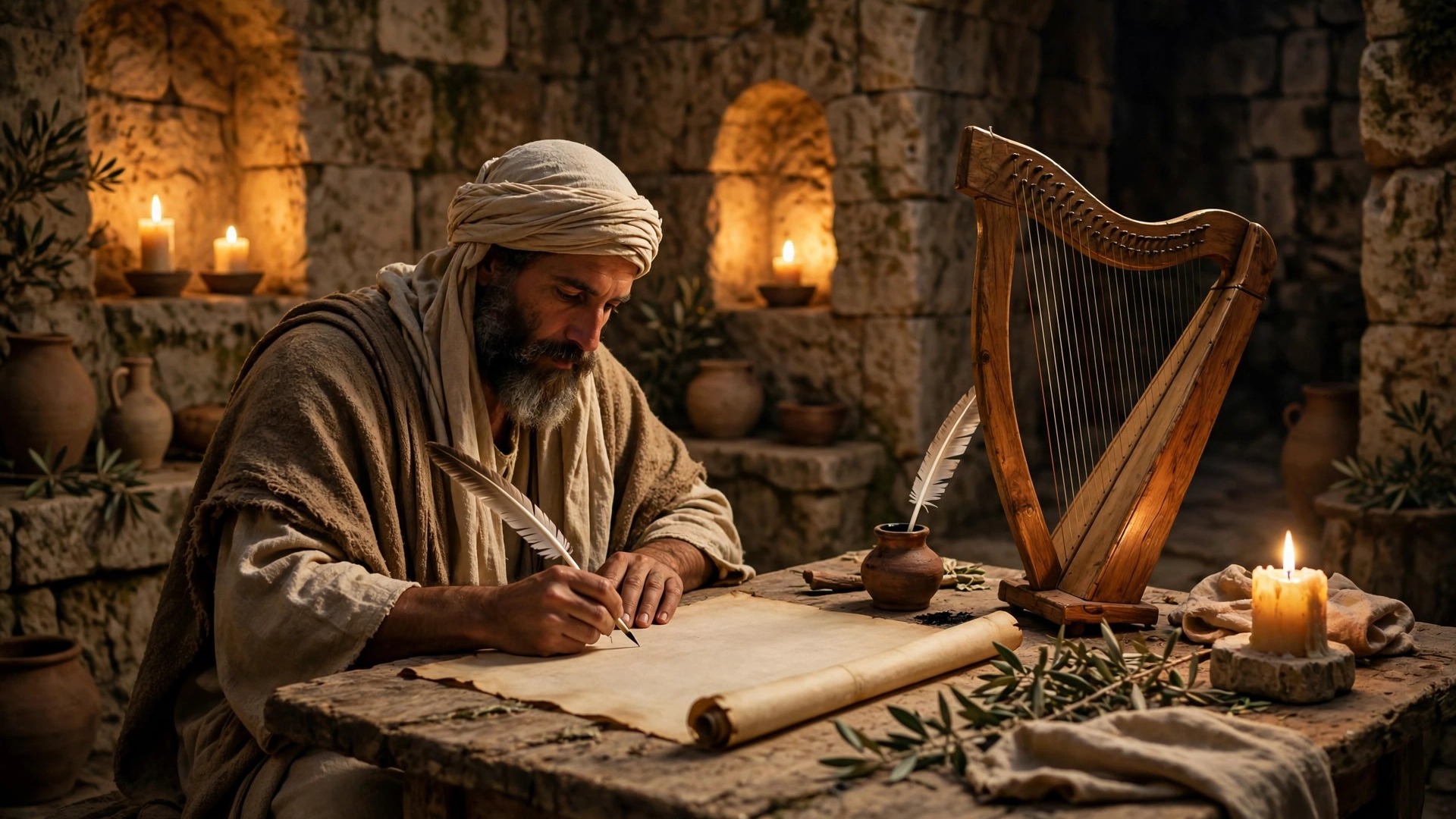
The book of Psalms has comforted grieving hearts, guided confused minds, and given voice to joyful praise for three thousand years. But have you ever wondered who actually wrote these songs? The meaning of the Psalms’ authors in the Bible opens a window into the hearts of the people God used — shepherds, kings, musicians, and even a rebel’s sons — to give His people a prayer book for every season of life. Knowing who wrote the Psalms does not just satisfy curiosity. It transforms how you read them. A psalm of David fleeing for his life reads differently when you know the cave he hid in. A song from the sons of Korah carries deeper weight when you know their family’s story. Let us meet the authors.
David: The Sweet Psalmist of Israel (73 Psalms)
Nearly half the Psalter — 73 psalms — bears David’s name in its title. David is called “Israel’s singer of songs” (2 Samuel 23:1), and his authorship is the best attested in Scripture. But David was not a professional poet writing from an ivory tower. He was a shepherd boy turned fugitive turned king, and his psalms bleed with real life.
David wrote psalms of desperate prayer while running from Saul: “How long, Lord? Will you forget me forever?” (Psalm 13:1). He wrote psalms of repentance after his sin with Bathsheba — Psalm 51 remains the Bible’s greatest prayer of confession: “Create in me a pure heart, O God” (Psalm 51:10). He wrote psalms of triumphant praise, like Psalm 18 after God delivered him from his enemies, and psalms of quiet trust, like the beloved Psalm 23: “The Lord is my shepherd, I lack nothing.”
What David’s authorship teaches us is profound: God welcomes every emotion in prayer. David brought God his fear, his anger, his guilt, his joy, and his doubt. Nearly a third of the Psalms are laments — complaints poured out to God — and most of them are David’s. The Bible’s greatest king shows us that faith is not the absence of struggle; it is bringing the struggle to God.
David also wrote more Messianic psalms than anyone. Jesus and the apostles quoted David’s psalms to explain Christ: Psalm 22 (“My God, my God, why have you forsaken me?”) at the crucifixion (Matthew 27:46); Psalm 110 (“The Lord says to my lord”) for Christ’s exaltation (Matthew 22:44); Psalm 16 for the resurrection (Acts 2:25–28). David, the king, kept pointing beyond himself to the greater King.
Asaph: The Worship Leader (12 Psalms)
Twelve psalms (50, 73–83) are attributed to Asaph, the chief musician David appointed over worship (1 Chronicles 16:5). Asaph was not a king but a Levite — a professional worship leader, the man in charge of the music when the ark came to Jerusalem. His psalms are honest and searching. Psalm 73 is one of the most relatable psalms in the book: Asaph confesses that he nearly lost his faith envying the prosperity of the wicked — “my feet had almost slipped” — until he entered God’s sanctuary and saw the end of the story (Psalm 73:17). Asaph teaches us that worship leaders struggle too — and that the sanctuary is where perspective is restored. His psalms also carry a strong note of judgment and national confession (Psalms 74–79), showing that worship includes lament for the nation, not just praise for blessings.
The Sons of Korah: Grace for a Rebel’s Family (11 Psalms)
Eleven psalms (42–49, 84–85, 87–88) come from the sons of Korah. Their story is stunning. Korah led a rebellion against Moses and was swallowed by the earth. But his sons survived — “the line of Korah, however, did not die out” (Numbers 26:11) — and became temple musicians. The descendants of a rebel became the worship leaders of Israel. Grace, written across a family tree.
Their psalms are among the most beloved, including the song of longing for God’s dwelling place: “How lovely is your dwelling place, Lord Almighty! My soul yearns, even faints, for the courts of the Lord” (Psalm 84:1–2). The sons of Korah teach us that your family’s past does not determine your future. The children of a rebel became the authors of the church’s deepest longings for God. If God could use Korah’s sons, He can use you.
Solomon: The Wise King (2 Psalms)
Two psalms bear Solomon’s name: Psalm 72 and Psalm 127. Psalm 72 is a royal prayer — a plea that the king would rule with justice, defend the afflicted, and bring prosperity to the people. It ends with a vision that outgrows any earthly king: “May all kings bow down to him and all nations serve him.” The prayer for Solomon’s reign becomes a prophecy of the Messiah’s. Psalm 127 is the builder’s psalm: “Unless the Lord builds the house, the builders labor in vain.” The wisest man who ever lived wrote the shortest lesson: God builds, or nothing stands. Solomon’s psalms remind us that wisdom without God is vanity, and that every human project — a house, a family, a nation — depends on the Lord.
Moses: The Oldest Psalm (1 Psalm)
Psalm 90 is attributed to Moses — the oldest psalm in the book, written centuries before David. It is a prayer about time: “Teach us to number our days, that we may gain a heart of wisdom” (Psalm 90:12). Moses, who watched a generation die in the wilderness, knew how short life is. His psalm is sober and steady: human life is like grass that withers, but God is “from everlasting to everlasting.” The contrast is the point: our days are brief; God is eternal. Numbering our days — living with the end in view — is the beginning of wisdom. Moses’ single psalm carries the weight of a lifetime of wandering and the peace of a man who found his home in God, not in a land.
Ethan, Heman, and the Anonymous: The Rest of the Choir
Psalm 89 is attributed to Ethan the Ezrahite, and Psalm 88 to Heman the Ezrahite. Both were wise men of Solomon’s court (1 Kings 4:31). Heman’s psalm is the darkest in the Psalter — it ends without resolution: “darkness is my closest friend” (Psalm 88:18). Its inclusion is a mercy: the Bible’s prayer book has room for prayers that end in darkness. God does not edit out the laments that have no happy ending. Ethan’s psalm, by contrast, wrestles with God’s covenant promises in the face of apparent failure — and clings to them anyway.
And then there are the anonymous psalms — nearly fifty of them, including Psalm 1, Psalm 23’s neighbors, and many of the Songs of Ascents. We do not know their authors. God does. Their anonymity is itself a lesson: the Psalms are not a celebrity songbook. They are the prayers of ordinary people whose names history forgot but whose words God preserved. Your prayers, too, matter to God even if no one ever knows you prayed them.
Why Multiple Authors Matter: The Bible’s Honest Prayer Book
The Psalms’ many authors are not an accident; they are a feature. A single author could give you one perspective. Many authors give you the whole human experience: kings and commoners, priests and rebels’ sons, the joyful and the despairing, the young and the old. The Psalter is not a book of abstract theology; it is a book of lived faith — faith with fear, doubt, anger, joy, and hope all mixed in. That is why it has survived three thousand years: it tells the truth about what it feels like to walk with God.
The many authors also point to the one Author behind them all. David, Asaph, Korah’s sons, Solomon, Moses — each wrote from his own life, yet together they wrote one book with one hero: the Messiah. Jesus said, “Everything must be fulfilled that is written about me in the Law of Moses, the Prophets and the Psalms” (Luke 24:44). The Psalms’ choir, with all its different voices, sings one song: the coming King.
How to Pray the Psalms
Read them slowly, not quickly. The Psalms are not meant to be skimmed; they are meant to be prayed. When a psalm expresses an emotion you feel, pray it back to God in your own words. When it expresses an emotion you do not feel — like Psalm 88’s darkness — pray it for someone who does. Use the psalms as a language school for prayer: they teach you how to bring God your anger without sinning, your grief without despairing, and your joy without forgetting Him. And when you do not know what to pray, start with Psalm 1 (“Blessed is the one who does not walk in step with the wicked”) or Psalm 23 (“The Lord is my shepherd”) or Psalm 51 (“Create in me a pure heart”). Three thousand years of believers have started there. You are in good company.
Conclusion: Join the Choir
The Psalms’ authors were not perfect people. David was an adulterer and a murderer. Korah’s sons were a rebel’s children. Heman prayed a prayer that ended in darkness. Asaph nearly lost his faith. And yet God used every one of them to write the Bible’s songbook. That is the message of the Psalms’ authors: God does not wait for perfect people to write His songs. He takes broken people, honest people, struggling people — and gives them a voice. Your voice belongs in the choir too. Bring God your fear, your anger, your joy, your doubt, your praise. He has been collecting the prayers of His people for three thousand years, and He is still listening. The choir is not finished. Join it. For a general overview of the book of Psalms, see the Wikipedia article on Psalms.










