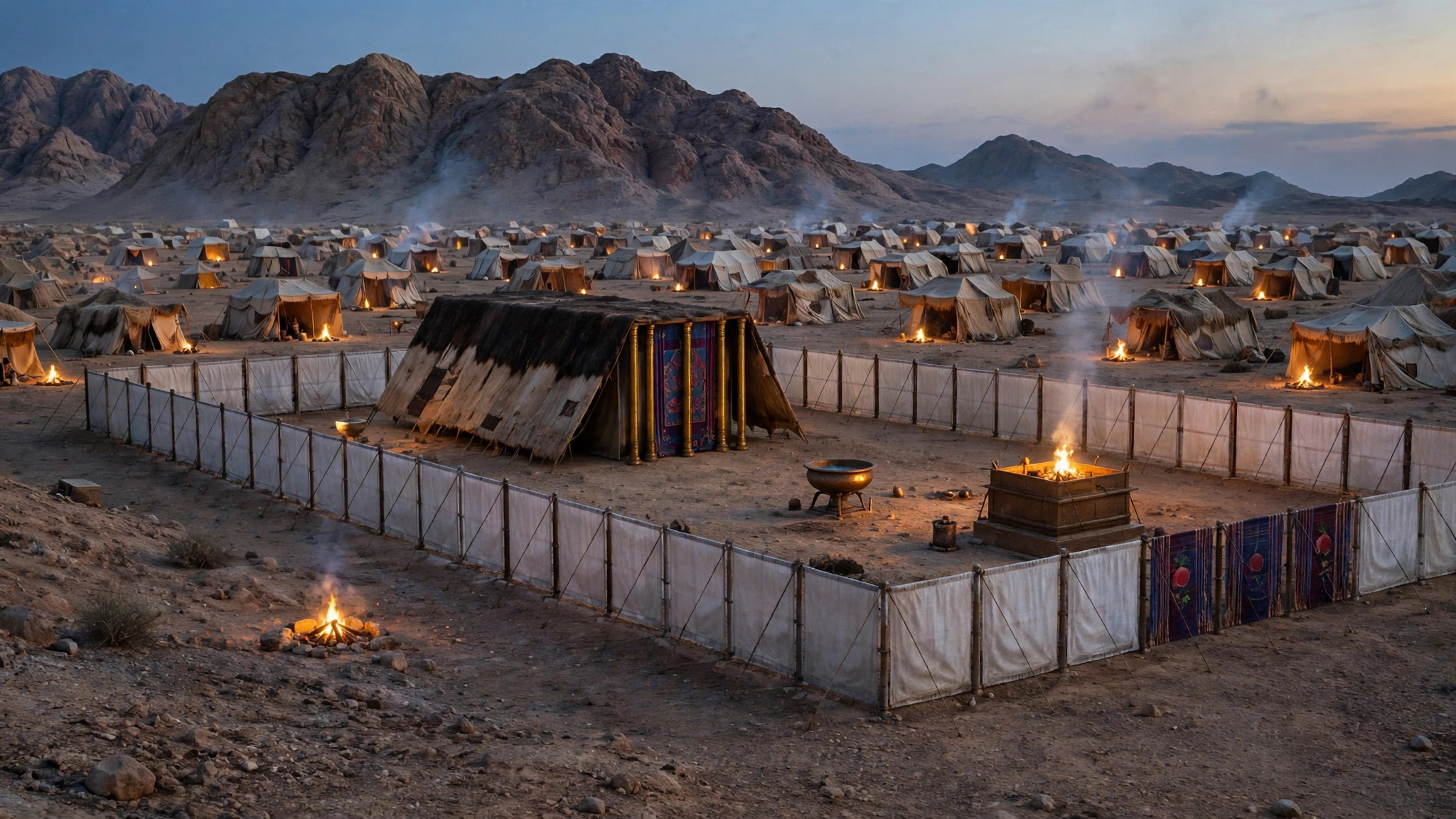
Picture this: nearly two million people camped in the desert, arranged in a perfect formation around a single tent — the tabernacle — where the glory of God Himself dwelled. This is not imagination; it is the Israel wilderness camp described in the book of Numbers. If you have ever wondered about the Israel wilderness camp meaning in the Bible, you are about to discover one of Scripture’s most beautiful pictures of God’s order, God’s presence, and God’s heart for His people. The wilderness camp was far more than an ancient campground. Every tribe had its assigned place. Every banner had its meaning. And at the very center stood the presence of God. For Christians today, this ancient arrangement still preaches: God wants to be at the center of everything — your family, your plans, your life.
The Layout: A Nation Arranged Around God
After God rescued Israel from slavery in Egypt, He organized them at Mount Sinai into a holy nation on the move. Numbers 2 gives the detailed layout: the twelve tribes camped in four groups of three, one on each side of the tabernacle — east, south, west, and north.
On the east, facing the sunrise, camped Judah, Issachar, and Zebulun — with Judah leading the march (Numbers 2:3–9). On the south were Reuben, Simeon, and Gad (Numbers 2:10–16). On the west, Ephraim, Manasseh, and Benjamin (Numbers 2:18–24). On the north, Dan, Asher, and Naphtali (Numbers 2:25–31). Each tribe camped “under their standard and holding the banners of their family” (Numbers 2:2).
At the center stood the tabernacle, surrounded by the tribe of Levi — the priests and Levites who served God directly (Numbers 1:50–53). God’s command was explicit: “the Levites… are to camp around the tabernacle… so that my wrath will not fall on the Israelite community” (Numbers 1:53). The arrangement was not decorative; it was theological. God at the center, His people around Him, everything in divine order.
The numbers are staggering: the census counted 603,550 fighting men (Numbers 1:46), which means the total camp — including women, children, and the elderly — likely approached two million people. Yet this massive crowd moved with precision. When the cloud of God’s presence lifted from the tabernacle, the trumpets sounded and the camp marched in order (Numbers 9:17–23). When the cloud settled, they stopped. Israel moved when God moved and rested when God rested.
Three Truths the Camp Teaches: Order, Holiness, Presence
First, God is a God of order, not chaos. Paul would later write, “God is not a God of disorder but of peace” (1 Corinthians 14:33). The camp’s precise arrangement — every tribe in its place, every march in its sequence — shows that God’s work is not random. He has a place for everyone and a plan for everything. If your life feels chaotic, the wilderness camp is a reminder: God brings order to chaos. He is not the author of your confusion.
Second, God is holy, and holiness has a shape. The camp was arranged so that the unclean were kept outside (Numbers 5:1–4), the Levites guarded the center, and access to God’s presence was carefully ordered. “Be holy, because I am holy” (Leviticus 11:44). The camp’s structure taught Israel that God cannot be approached casually or carelessly. The good news of the gospel is that Christ has opened the way: the veil tore, and now we can approach God’s throne of grace with confidence. But the holiness the camp pictured has not changed. God is still holy, and His people are still called to be holy.
Third, God dwells at the center of His people. The tabernacle’s name means “dwelling place.” God promised, “I will dwell among the Israelites and be their God” (Exodus 29:45). The camp was built around that promise. The tabernacle was not at the edge of the camp, off to one side — it was at the center. God’s presence was not an accessory to Israel’s life; it was the organizing principle of it. The same is true for you: God’s presence is not meant to be a compartment of your life; it is meant to be the center of it.
The Cloud: Moving When God Moves
The most remarkable feature of the camp was not its geometry but its guidance. A cloud covered the tabernacle by day and fire by night. When the cloud lifted, Israel marched. When it settled, Israel camped. At the Lord’s command they encamped, and at the Lord’s command they set out (Numbers 9:17–23). Sometimes the cloud stayed for a day; sometimes for a month; sometimes for a year. Israel did not vote on when to move. They watched the cloud.
This is the Bible’s picture of guidance: not a map, but a presence. God did not give Israel a detailed itinerary for forty years. He gave them a cloud to follow. He does the same for you. You may not know the whole route — but you do not need to. You need to watch for God’s leading today. “In all your ways submit to him, and he will make your paths straight” (Proverbs 3:6). Wait when the cloud waits. Move when the cloud moves. That is the whole strategy of the wilderness.
What the Camp Means for Your Life Today
Put God at the center, not the edge. The Israelites arranged their entire camp around God’s presence. Most of us arrange our lives around work, family, or entertainment — and try to fit God into the gaps. The camp challenges that arrangement. What would change if God were the center of your schedule, your budget, your decisions, your relationships? Everything. That is the point.
Know your place — and stay in it. Every tribe had an assigned place and an assigned banner. There was no jockeying for position, no competition for the best spot. God assigns each believer a place in the body: “God has placed the parts in the body, every one of them, just as he wanted them to be” (1 Corinthians 12:18). Your assignment is not everyone’s assignment. Stop comparing. Serve where God put you, under the banner He gave you.
Live as a pilgrim, not a settler. The camp was designed to move. Tents, not houses. The Israelites were pilgrims in the wilderness, heading for a promised land. So are you: “Dear friends, I urge you, as foreigners and exiles, to abstain from sinful desires” (1 Peter 2:11). Do not sink your roots too deeply into a world you are only passing through. Travel light. Follow the cloud.
Let God’s presence be your identity. What made Israel different from every other nation was not their army, their size, or their wealth. It was the presence of God in the middle of their camp. The same is true of the church. “Don’t you know that you yourselves are God’s temple and that God’s Spirit dwells in your midst?” (1 Corinthians 3:16). God’s presence is still the church’s distinguishing mark — and your life’s.
The Camp’s Fulfillment: From Tabernacle to Christ to New Jerusalem
The wilderness camp was a shadow; Christ is the substance. “The Word became flesh and made his dwelling among us” (John 1:14) — the Greek word for “dwelling” is literally “tabernacled.” Jesus is the true tabernacle: God dwelling with humanity, not in a tent, but in a Person. And the story ends where it began — with God at the center. Revelation pictures the final camp: “Look! God’s dwelling place is now among the people, and he will dwell with them. They will be his people, and God himself will be with them and be their God” (Revelation 21:3). The wilderness camp was a rehearsal for eternity. One day, the cloud will not lift and settle; it will stay. God at the center, His people around Him, forever.
Questions People Ask
Why were the Levites in the center with the tabernacle? Because they were set apart to serve God directly and to guard the holiness of His presence (Numbers 1:50–53). Their position taught Israel that access to God is precious and ordered — and that someone must stand between a holy God and a sinful people. In Christ, that role is fulfilled forever: He is our High Priest and our Mediator.
How did two million people stay organized? By God’s design: tribal standards, trumpet signals, and the cloud’s guidance (Numbers 2; 9–10). The camp’s order is itself part of the lesson — God’s people, even in massive numbers, can move as one when they follow one Presence.
Conclusion: God at the Center
The Israel wilderness camp meaning in the Bible can be summed up in a single image: a nation arranged around a tent, and a tent filled with glory. God at the center, His people around Him, everything in divine order, moving when He moves and resting when He rests. That is not just ancient history; it is a picture of the life God still wants for you. Put Him at the center. Follow His cloud. Travel light. And know this: the God who dwelled in the middle of the camp now dwells in the middle of your life. “For I know the plans I have for you,” declares the Lord, “plans to prosper you and not to harm you, plans to give you hope and a future” (Jeremiah 29:11). The camp was God’s way of saying, “I am with you, and I am at the center.” He still is. For background on the tent at the camp’s heart, see the Wikipedia article on the Tabernacle.










