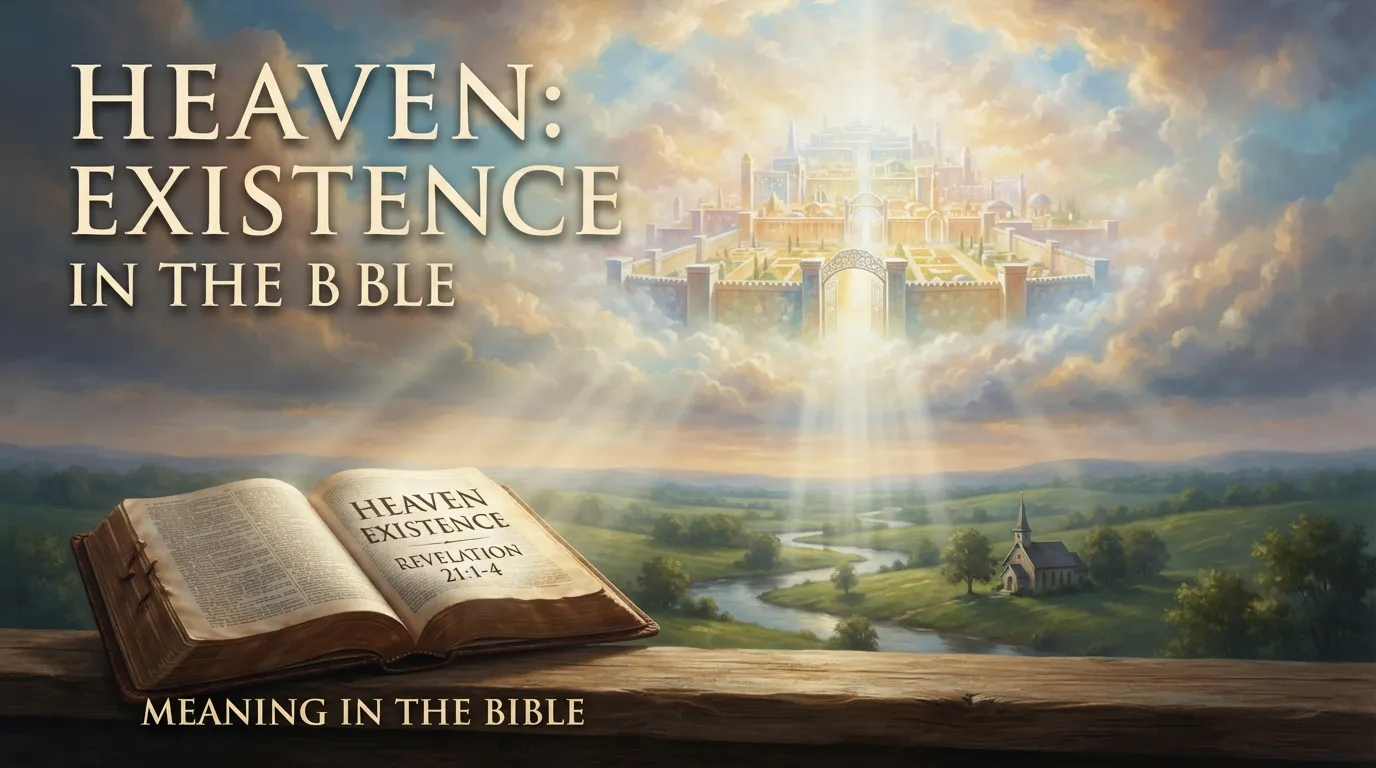
Ask ten people what heaven is, and you will get ten answers: clouds and harps, a mansion, a reunion, a feeling, a metaphor. The Bible’s answer is more concrete than most of those and more surprising than all of them. Heaven in Scripture is not primarily a place where good people go when they die. It is the realm where God’s will is done perfectly, the throne room from which He rules the universe, and the future home He is preparing for His people — a home that will ultimately come down to a renewed earth.
Scripture speaks of heaven with confidence and restraint at the same time. It insists heaven is real. It refuses to answer every question about it. That combination — certainty about existence, humility about details — is the right posture for reading what the Bible says.
Three Ways the Bible Uses the Word “Heaven”
Confusion about heaven often starts with the word itself. In both Hebrew (shamayim) and Greek (ouranos), “heaven” has more than one meaning, and context decides which one is in view.
First, heaven means the sky — the visible atmosphere, the realm of clouds, birds, and weather. “The heavens declare the glory of God, and the sky above proclaims his handiwork” (Psalm 19:1). When Genesis 1:1 says God created “the heavens and the earth,” this visible heaven is at least part of the picture.
Second, heaven means outer space — the realm of sun, moon, and stars. Genesis 1:14–17 describes the lights placed “in the expanse of the heavens.” When Abraham was told his descendants would be as numerous as the stars of heaven (Genesis 15:5), this is the sense in view.
Third, heaven means God’s dwelling place — the spiritual realm where His presence is most fully manifest, where His throne is, and where His will is done without resistance. This is the heaven Jesus meant when He taught His disciples to pray, “Your will be done, on earth as it is in heaven” (Matthew 6:10). It is the heaven Paul referred to when he spoke of being “caught up to the third heaven” (2 Corinthians 12:2) — a Jewish way of distinguishing God’s dwelling from the sky and the stars.
Keeping these three senses apart clears up many arguments. When Scripture says God is in heaven, it does not mean He is confined to a location in the sky. It means His rule, His glory, and His presence are centered in a realm beyond our sight — and yet He is also present everywhere (Psalm 139:7–8).
Does the Bible Say Heaven Really Exists?
Yes — consistently, and from the first page to the last. Genesis 1:1 assumes it. The Psalms celebrate it. The prophets glimpse it. Jesus describes it. Revelation portrays its future.
Isaiah saw it: “I saw the Lord sitting upon a throne, high and lifted up; and the train of his robe filled the temple. Above him stood the seraphim” (Isaiah 6:1–2). Ezekiel saw wheels within wheels and a throne of sapphire. Daniel saw “the Ancient of Days” seated on a throne of fire, with “a thousand thousands” serving Him (Daniel 7:9–10). These visions are symbolic in their details — no one claims God literally sits on a physical chair — but they are not symbolic about the reality. Something real is being seen, from a human vantage point, in human language.
Jesus spoke of heaven as a fact, not a fable. “In my Father’s house are many rooms. If it were not so, would I have told you that I go to prepare a place for you?” (John 14:2). He told the dying thief, “Today you will be with me in paradise” (Luke 23:43). He described heaven as a kingdom, a treasure, a wedding feast, a father’s house. Parables are stories; but the reality they point to is not fiction.
Paul adds his own testimony. He knew a man — almost certainly himself — who was caught up to paradise and “heard things that cannot be told, which man may not utter” (2 Corinthians 12:4). The detail is striking: Paul had a glimpse of heaven and was not permitted to describe it. Scripture’s restraint about heaven is deliberate. God gave us enough to hope on, not enough to satisfy curiosity.
What Heaven Is Like, According to Scripture
The Bible describes heaven less by geography and more by negatives and relationships. Revelation 21:4 gives the most beloved description: “He will wipe away every tear from their eyes, and death shall be no more, neither shall there be mourning, nor crying, nor pain anymore, for the former things have passed away.” Heaven is defined by what is absent: no death, no grief, no pain, no curse (Revelation 22:3).
Positively, heaven is defined by presence. “The dwelling place of God is with man. He will dwell with them, and they will be his people, and God himself will be with them as their God” (Revelation 21:3). The core joy of heaven is not golden streets or pearly gates. It is God Himself — seeing Him face to face (1 Corinthians 13:12), knowing Him fully, worshiping Him with the angels and the redeemed.
Heaven is also defined by holiness. “Nothing unclean will ever enter it, nor anyone who does what is detestable or false, but only those who are written in the Lamb’s book of life” (Revelation 21:27). This is why heaven requires redemption. Fallen people cannot simply walk into a holy place; they must be made holy. That is what the cross accomplished, and it is why the only entrance to heaven is through Christ: “I am the way, and the truth, and the life. No one comes to the Father except through me” (John 14:6).
The Bible also hints at recognition and reunion. David expected to go to his child (2 Samuel 12:23). Jesus said Abraham, Isaac, and Jacob would be at the feast in the kingdom (Matthew 8:11). The Transfiguration showed Moses and Elijah alive, recognizable, and conversing with Christ (Matthew 17:3). Heaven is not amnesia; it is restoration — including the restoration of relationships.
The Surprise: Heaven Comes Down
Here is the part most people miss. The Bible’s final picture of heaven is not believers floating up to escape the earth. It is heaven coming down to a renewed earth. Revelation 21:2: “I saw the holy city, new Jerusalem, coming down out of heaven from God, prepared as a bride adorned for her husband.” God’s plan is not to abandon creation but to restore it.
This matches the promise woven through the whole Bible. Isaiah foresaw “new heavens and a new earth” (Isaiah 65:17). Peter said the heavens and earth are reserved for a day when God will make “new heavens and a new earth in which righteousness dwells” (2 Peter 3:13). Paul said creation itself “will be set free from its bondage to corruption” (Romans 8:21). The resurrection of Jesus — a bodily resurrection in a renewed body — is the first sample of what is coming for the whole world.
That changes how Christians think about heaven now. If the future is a renewed earth, then the work we do in this world — creating, building, healing, cultivating, making beauty — is not wasted. It is a rehearsal for the kingdom. And when a believer dies today, Scripture teaches they go to be “with Christ” (Philippians 1:23) — a conscious, blessed intermediate state — awaiting the resurrection and the new creation when heaven and earth become one.
Living in Light of Heaven
Heaven is not only a future destination; it is a present orientation. Colossians 3:1–2 says, “If then you have been raised with Christ, seek the things that are above, where Christ is, seated at the right hand of God. Set your minds on things that are above, not on things that are on earth.” That does not mean ignoring earthly life. It means evaluating everything — money, success, suffering, time — by eternity’s scale.
Heaven also reframes grief. Paul writes that believers grieve, but not “as others do who have no hope” (1 Thessalonians 4:13). Christian grief is real grief — Jesus wept at Lazarus’s tomb — but it is grief with a horizon. The separation is temporary. The reunion is certain. The tears will be wiped away by the hand that made them.
And heaven reframes suffering. “For this light momentary affliction is preparing for us an eternal weight of glory beyond all comparison, as we look not to the things that are seen but to the things that are unseen” (2 Corinthians 4:17–18). The affliction is real, but it is light next to the weight of glory. The seen things are temporary; the unseen things are eternal.
Heaven exists. God is there, Christ is there, and a prepared place awaits everyone who belongs to Him. The Bible does not tell us everything about it — and that is part of its mercy. It tells us enough to live with hope, die with confidence, and long for the day when heaven comes down and God dwells with His people forever. For a survey of how Christian traditions have understood heaven’s nature and history, see the Wikipedia article on heaven in Christianity.










