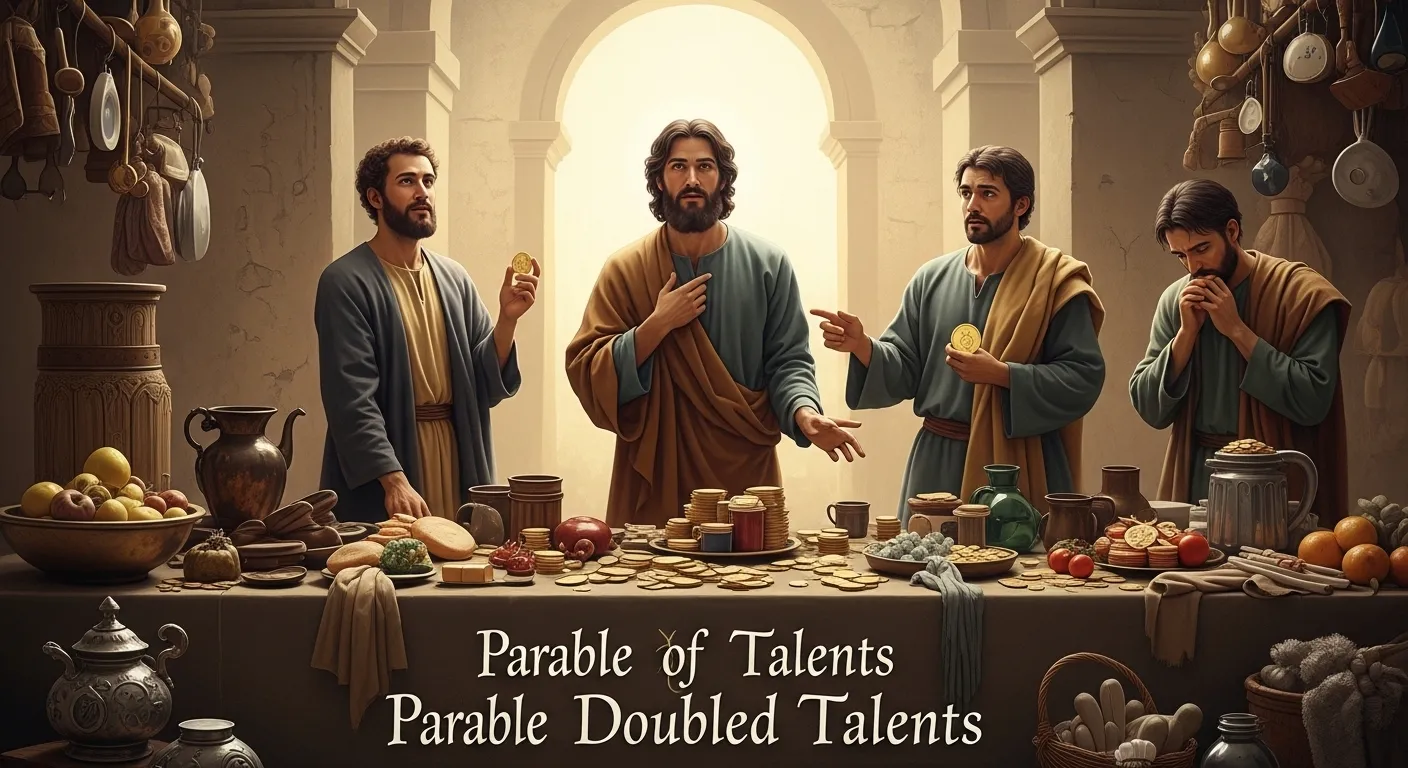
A “talent” was not a compliment in Jesus’ day. It was a unit of weight — roughly twenty years’ wages for a laborer, a fortune in silver. When Jesus tells of a master entrusting five talents to one servant, two to another, and one to a third (Matthew 25:14-15), the modern reader should feel the weight of it: this is not pocket money. It is life-changing capital, handed over with shocking trust. The Parable of the Talents is Jesus’ most searching teaching on what God expects us to do with what He has given — and its verdict is more gracious, and more severe, than most readers expect.
Unequal Gifts, Equal Joy
The story’s first surprise is the inequality. The master distributes “to every man according to his several ability” (Matthew 25:15) — not equally, but appropriately. Five, two, one. God does not pretend everyone starts with the same resources, intelligence, opportunities, or health. The parable assumes difference as the created order, not as an injustice to be resented.
The second surprise is what happens at the reckoning. The five-talent servant doubles his money; the two-talent servant does the same. And the master greets them with identical words: “Well done, thou good and faithful servant: thou hast been faithful over a few things, I will make thee ruler over many things: enter thou into the joy of thy lord” (Matthew 25:21, 23). Word for word, the same praise. The same joy. The servant who started with less receives no lesser welcome.
This demolishes the economy of comparison. God does not grade on a curve against other servants; He measures faithfulness against what was given. The two-talent servant is not a consolation-prize Christian. His smaller capital, faithfully traded, earns the identical “well done.” In God’s accounting, faithfulness is the only currency, and it spends the same whatever the starting amount.
The Third Servant’s Real Problem
The third servant buries his single talent — and his explanation is revealing: “Lord, I knew thee that thou art an hard man, reaping where thou hast not sown, and gathering where thou hast not strawed: and I was afraid, and went and hid thy talent in the earth” (Matthew 25:24-25). Fear, built on a false picture of the master.
Notice the logic. He calls the master “hard” — harsh, unfair, exploitative. If that were true, burying the money would be prudent self-protection. But the parable has already shown the master’s true character: generous in entrusting, joyful in rewarding, identical in praise. The servant’s theology was wrong, and his wrong theology produced wrong action. He hid the talent because he believed in a master worth hiding from.
This is the parable’s psychological masterstroke. What we believe about God determines what we do with God’s gifts. The first two servants acted boldly because they trusted a generous master. The third acted fearfully because he imagined a harsh one. Many buried talents today — unshared faith, unused gifts, unattempted callings — are buried for exactly this reason: a picture of God as a hard master who punishes risk rather than a joyful Father who rewards faithfulness.
The master’s reply exposes the excuse: even on the servant’s own terms, fear was no defense. “Thou oughtest therefore to have put my money to the exchangers, and then at my coming I should have received mine own with usury” (Matthew 25:27). If the master were truly that hard, the servant would have done something — even the minimal, risk-free option. Fear that produces total inaction is not caution. It is disobedience wearing caution’s clothes.
Faithfulness, Not Comparison
The parable quietly redefines success. The world measures by results — how much, how visible, how impressive. The master measures by faithfulness — what did you do with what you had? The five-talent servant’s ten talents and the two-talent servant’s four are, to the master, the same achievement: 100% faithfulness.
This liberates every believer from the tyranny of comparison. The question is never “Why didn’t God give me five?” but “What am I doing with my one — or my two?” Your gifts, as Peter writes, are given “that ye may minister the same one to another, as good stewards of the manifold grace of God” (1 Peter 4:10). The talent is not for admiration or accumulation. It is for trading — put to work in service, risked in love, invested in people. Note, too, that the master distributes “to every man according to his several ability” — the gift is fitted to the servant. God never entrusts what He has not equipped for. The one-talent servant was not set up to fail; he was given exactly what he could handle, and his failure was not incapacity but unwillingness. Whatever is in your hands today is, by definition, within your ability to trade faithfully.
And “trading” implies risk. The first two servants could have lost everything; markets fail, ventures collapse. Faithfulness in this parable is not safe — it is active. God prefers the servant who risks and occasionally fails over the servant who preserves everything by doing nothing. The buried talent is safe, intact, and utterly condemned.
The Twin Parable: The Minas in Luke
Luke records a sibling story — the parable of the minas (Luke 19:11-27) — and the differences are instructive. There, a nobleman going “into a far country to receive for himself a kingdom” gives ten servants one mina each — equal amounts, about three months’ wages. The results vary wildly: one earns ten more, another five, another hides his in a cloth. The nobleman is explicitly going to receive a kingdom — the parable was told, Luke says, “because he was nigh to Jerusalem, and because they thought that the kingdom of God should immediately appear” (Luke 19:11).
Set the two parables side by side and a fuller picture emerges. In Matthew, the gifts are unequal (five, two, one) — emphasizing that God distributes according to ability and judges by faithfulness. In Luke, the gifts are equal (one mina each) — emphasizing that every servant has something, and no one can plead emptiness. Together they close every excuse: the five-talent servant cannot boast (his capital was a gift), and the one-mina servant cannot plead poverty (he had his mina). Much or little, all have received, and all must trade.
Luke’s version also sharpens the political edge: the nobleman’s citizens hate him and send a delegation saying “We will not have this man to reign over us” (Luke 19:14) — a transparent portrait of Jesus’ rejection by His own. The unfaithful servant’s excuse is nearly identical to Matthew’s (“I feared thee, because thou art an austere man”), and the verdict is the same. Two parables, two settings, one verdict: the King is coming back, the capital is His, and faithfulness is not optional. The repetition across two Gospels suggests Jesus returned to this theme more than once — because the temptation to bury what God entrusts is perennial.
The Reckoning Is Coming
The parable sits in Matthew 25 among teachings about Christ’s return — the ten virgins before it, the sheep and goats after. Its context is eschatological: the master will return, the books will be opened, and every servant will give account. “After a long time the lord of those servants cometh, and reckoneth with them” (Matthew 25:19). The delay is not cancellation.
The third servant’s fate is stark: the talent is taken and given to the one with ten, and the “unprofitable servant” is cast out (Matthew 25:28-30). The severity shocks modern sensibilities, but the logic is consistent: a gift refused is a gift forfeited, and it will be entrusted to someone who will use it. God’s work will go on — with us or, sadly, through others.
Yet the parable’s dominant note is not terror but invitation. Twice the master says, “Enter thou into the joy of thy lord.” The reckoning, for the faithful, is not an audit to dread but a celebration to anticipate. The master’s joy is the reward — shared delight with the One who trusted us. Every act of faithfulness now is a deposit on that coming joy.
So the question the parable leaves is simple and unavoidable: what has the Master put in your hands — time, ability, resources, influence, a single talent or five — and is it in the ground or in the market? For the history of this parable’s interpretation and its influence on the very word “talent,” the Wikipedia article on the Parable of the Talents offers helpful background; the parable itself offers the challenge — trade boldly, trust the Master’s goodness, and aim for the day when faithfulness, however small its capital, hears the same great words: well done.










