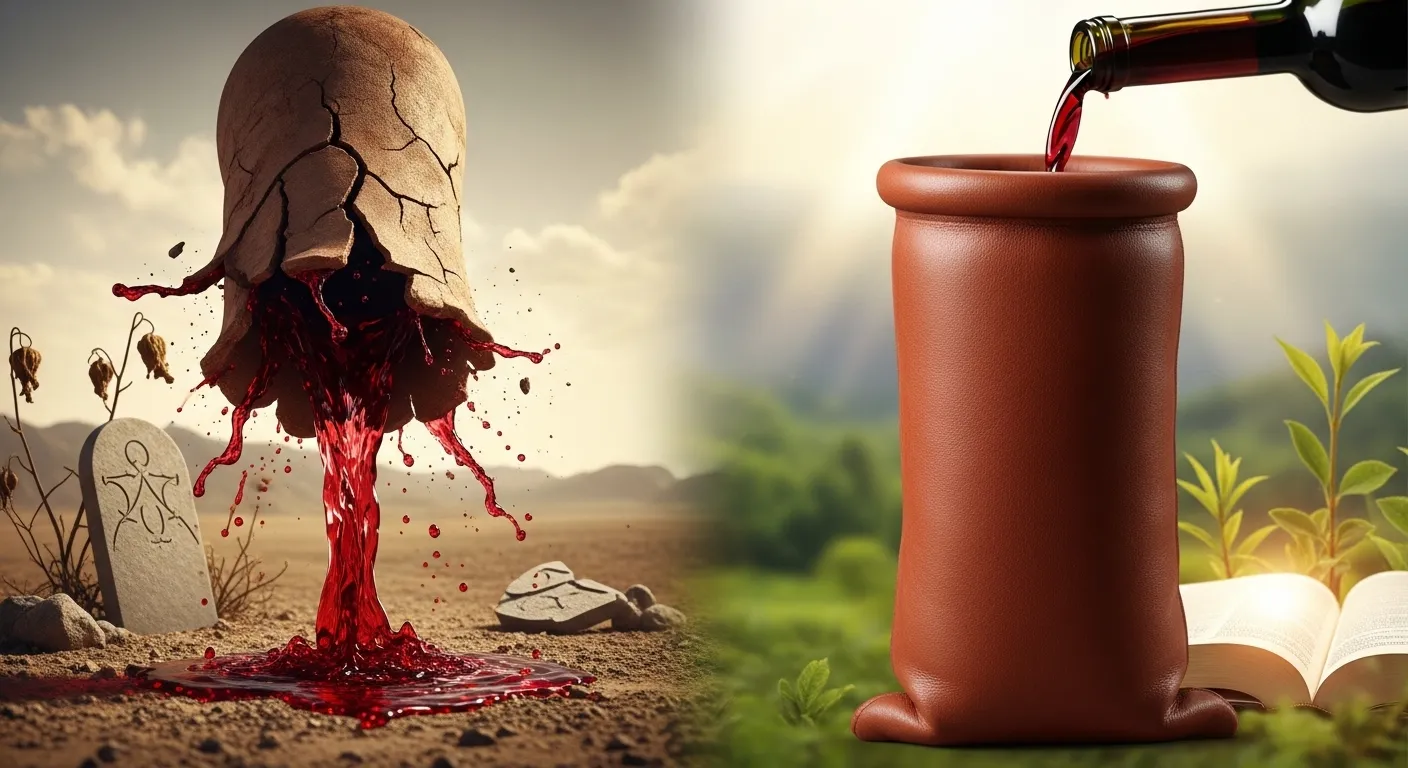
The question came from the religious professionals, and it sounded reasonable: “Why do the disciples of John fast often, and make prayers, and likewise the disciples of the Pharisees; but thine eat and drink?” (Luke 5:33). They were watching Jesus’ followers enjoy a feast at Matthew’s house — tax collectors and sinners at the table, wine flowing — and the contrast with their own disciplined piety bothered them. Jesus answered with a wedding, a garment, and a wineskin. The wineskin image has echoed for two thousand years: “No man putteth new wine into old bottles; else the new wine will burst the bottles, and be spilled, and the bottles shall perish” (Luke 5:37). But the saying was never really about wine. It was about what happens when the new thing God is doing meets people determined to keep everything exactly as it was.
Three Pictures, One Point
Luke records that Jesus gave not one illustration but three, rapid-fire. First, the bridegroom: “Can ye make the children of the bridechamber fast, while the bridegroom is with them?” (Luke 5:34). Fasting is for absence; feasting is for presence. The Messiah is here — this is a wedding, not a funeral. Demanding gloom during the celebration misunderstands the occasion entirely.
Second, the garment: “No man putteth a piece of a new garment upon an old; if otherwise, then both the new maketh a rent, and the piece that was taken out of the new agreeth not with the old” (Luke 5:36). Patching the old system with pieces of the new ruins both. Jesus did not come to refurbish the existing religious machinery with a few fresh patches. He came with an entirely new garment.
Third, the wineskin — the image that stuck. In the ancient world, wine was stored in goatskins. New wine was still fermenting; it expanded, releasing gases, and needed a supple container that could stretch. Fresh skins could. Old skins, dried and brittle with age, could not — the pressure would split them, losing both wine and wineskin. Everyone in the audience knew the physics. Jesus gave them the theology.
All three pictures make one point: the new cannot be contained by the old. The gospel is not an addition to the existing order; it is a new order. Trying to pour it into the old structures — old rituals, old expectations, old categories — destroys both.
What the New Wine Is
The “new wine” is the inbreaking kingdom Jesus proclaimed: forgiveness without the temple’s machinery, access to God without priestly mediation, a righteousness of the heart rather than of ritual. It is the wine of the wedding feast — joy, grace, the Spirit’s fermenting, expanding life.
Wine in Scripture is consistently associated with joy and celebration: “wine that maketh glad the heart of man” (Psalm 104:15). The new wine is the gladness of the gospel — the shocking good news that God has come near, that sinners are welcomed at the table, that the bridegroom is here. It ferments: it bubbles, expands, refuses to sit still. Genuine encounters with Christ have a way of outgrowing the containers people build for them.
This is why the image still unsettles. Every generation of believers is tempted to decide, consciously or not, exactly how God is allowed to work — which styles, which structures, which people. And every genuine movement of the Spirit has a fermenting quality that strains those decisions. The new wine will not be managed. It can only be received.
What the Old Wineskin Is
It is crucial to get this right: the old wineskin is not old people or old traditions as such. A wineskin becomes “old” not by age but by rigidity — by losing its suppleness. The Pharisees questioning Jesus were not wrong to value fasting, prayer, and holiness. They were wrong to have hardened around their forms until the forms could no longer stretch to contain God’s actual presence when He arrived.
An old wineskin, spiritually speaking, is any heart, habit, or system that has decided in advance what God may and may not do. It is the believer who says, “I will follow Christ as long as He doesn’t disturb my routines.” It is the church that says, “We will welcome the Spirit as long as He behaves like He did in 1950.” It is the theologian who has the categories so neatly arranged that the living God no longer fits in them.
Jesus adds a haunting postscript that Luke alone preserves: “No man also having drunk old wine straightway desireth new: for he saith, The old is better” (Luke 5:39). The deepest obstacle is not ignorance but preference. People cling to the old not because it is better but because it is familiar. Comfort becomes the enemy of renewal. The palate trained on the old genuinely cannot taste the new — which is why the transformation must happen in the drinker, not just the drink.
The First Miracle: New Wine at Cana
It is no accident that Jesus’ first recorded miracle involves wine — and new wine, in overwhelming abundance. At the wedding in Cana, when the wine ran out, Jesus turned some 120 to 180 gallons of water into wine — and the master of the feast tasted it and marveled: “thou hast kept the good wine until now” (John 2:10). The customary order was reversed: the best wine first, the inferior later. With Jesus, the best comes last — the new surpasses the old.
John calls this “the beginning of miracles” and says Jesus thereby “manifested forth his glory” (John 2:11). The glory revealed is precisely the glory of the new wine: joy in superabundance, grace that overflows the containers, celebration that embarrasses scarcity. The old wine — the old order — had run out, as it always does. The new wine arrived in jars meant for ritual washing: the vessels of the old purification system, repurposed to hold the joy of the new. The symbolism is almost too perfect: the old containers, filled with the new wine, serving a wedding feast.
And note what the new wine does at Cana: it saves a wedding from shame. The old wine’s failure would have meant humiliation for the hosts; the new wine’s arrival means celebration continues. This is the gospel in miniature — the old order runs dry, shame looms, and Christ arrives with abundance no one expected. The wineskins parable warns against containing the new in the old; the Cana miracle shows what happens when the new is received: joy, glory, and a feast that goes on.
Staying Supple
The parable’s practical question is personal before it is institutional: am I still stretchable? Suppleness is a spiritual discipline. It is maintained by the practices that keep the heart soft: honest confession (hardened hearts rarely admit fault), continued learning (the teachable stay flexible), obedience in small things (each act of surrender keeps the leather oiled), and regular exposure to Scripture’s surprises (God keeps saying things we didn’t expect).
Paul gives the New Testament’s version of the same principle: “be not conformed to this world: but be ye transformed by the renewing of your mind” (Romans 12:2). Renewal is continuous — present tense, ongoing. The Christian life is not a wineskin filled once but a skin kept supple for a lifetime of fresh pourings.
There is mercy in the image, too. God does not discard old skins contemptuously; He simply knows their limits. And He provides new ones: “ye must be born again” (John 3:7) is, among other things, a promise of fresh wineskins — new hearts capable of holding new wine. Ezekiel’s prophecy stands behind it all: “A new heart also will I give you, and a new spirit will I put within you: and I will take away the stony heart out of your flesh, and I will give you an heart of flesh” (Ezekiel 36:26). Stone cannot stretch. Flesh can.
The feast at Matthew’s house went on, the Pharisees went home unsatisfied, and the saying about the wineskins entered the permanent record — a standing invitation and a standing warning. God is always pouring new wine. The only question is whether we will offer Him something that can still stretch to hold it. For the historical background of this saying and its interpretation across the centuries, the Wikipedia article on new wine into old wineskins surveys the discussion; the saying itself remains as searching as the day it was spoken — not a lecture on viticulture, but a question about the condition of the heart.










