Imagine someone who once fought against the followers of Jesus later becoming one of the greatest messengers of the gospel. That is the story of Paul. Before his conversion, Paul was deeply involved in opposing the early Christians. This raises an important question: What is the meaning of Paul as a Sanhedrin member in the Bible? Did Paul actually belong to the Sanhedrin, or is this an assumption based on what Scripture tells us about his life?
The Bible gives us strong clues about Paul’s education, religious position, and authority. However, Scripture never directly says that Paul was an official member of the Sanhedrin. Some Christians and Bible teachers believe he may have been connected to the council or had authority within its circles, but this should not be stated as a certain biblical fact.
Understanding this distinction matters. Paul’s story is not mainly about his position in Jewish leadership. It is about God’s grace, transformation, redemption, and the power of Jesus Christ to change a life.
Let us look at what Scripture says and what Christians can learn from Paul’s story.
What Was the Sanhedrin in the Bible?
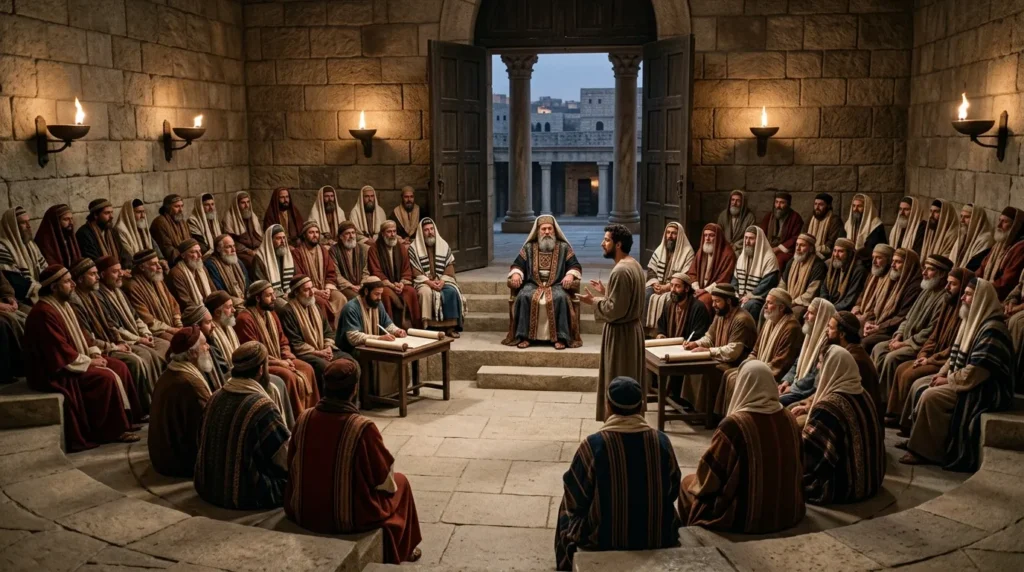
The Sanhedrin was a Jewish council that dealt with religious and legal matters. The New Testament often refers to it as the council.
For example, Jesus was questioned before Jewish leaders during His trial. Matthew 26:57–68 describes Jesus being brought before Caiaphas and the religious leaders. Mark 14:55 also describes the chief priests and the whole council seeking testimony against Jesus.
The council included important Jewish religious leaders. It was closely connected with the chief priests, elders, and scribes.
In Acts 4:5–6, rulers, elders, scribes, Annas, Caiaphas, and other leaders gathered in Jerusalem. Acts 4:15 says that the apostles were ordered to leave while the leaders discussed the matter.
So, when we read about the Sanhedrin in the New Testament, we are reading about a powerful religious leadership body in Jerusalem.
Was Paul Actually a Member of the Sanhedrin?
This is where careful Bible study is important.
The Bible does not explicitly say, Paul was a member of the Sanhedrin.
Paul was certainly a highly educated and zealous Jewish religious leader. He describes his background in several places.
In Acts 22:3, Paul tells the crowd that he was educated in Jerusalem at the feet of Gamaliel and was taught according to the strict manner of the law of his ancestors.
Gamaliel was a respected Pharisee and teacher of the law. Acts 5:34 identifies him as a member of the council.
Paul also says in Philippians 3:5 that he was:
- A Hebrew of Hebrews
- A Pharisee
- A member of the tribe of Benjamin
- Circumcised according to Jewish law
He describes himself as extremely zealous for the traditions of his ancestors in Galatians 1:14.
These facts show that Paul had a strong position within the religious world of his time. Yet none of these passages directly identifies Paul as a voting member of the Sanhedrin.
Why Do Some People Believe Paul Was a Sanhedrin Member?
Some Bible teachers connect Paul with the Sanhedrin because of his authority against Christians.
Acts 26:10 says Paul received authority from the chief priests. He explains that when believers were put to death, he cast his vote against them.
This verse is important because it may suggest that Paul had some kind of official role in the proceedings.
However, the exact nature of his authority is not fully explained.
Therefore, the safest biblical conclusion is:
Paul had significant authority among the Jewish religious leaders, but Scripture does not clearly establish that he was an official member of the Sanhedrin.
That distinction protects us from turning an inference into a biblical fact.
Paul’s Authority Before Following Jesus
Before Paul became a Christian missionary, he strongly opposed the followers of Jesus.
In Acts 8:3, Saul was described as entering houses and dragging out men and women who followed Christ.
Acts 9:1–2 says Saul was still breathing threats and murder against the disciples. He went to the high priest and asked for letters giving him authority to arrest followers of Jesus in Damascus.
This shows that Paul was not simply an ordinary observer.
He actively used his influence to oppose the early church.
Paul later admitted how serious his actions had been.
In 1 Timothy 1:13, he described himself as formerly a blasphemer, persecutor, and violent man. Yet he immediately pointed to God’s mercy.
This is one of the most beautiful parts of Paul’s testimony:
God’s grace was greater than Paul’s past.
Paul as Sanhedrin Member Meaning in the Bible: A Picture of Transformation
Even though Scripture does not confirm Paul as a Sanhedrin member, the idea often raises a deeper spiritual question: What can Paul’s former religious authority teach us?
The answer is powerful.
Paul knew Scripture. He had strong religious training. He was passionate about his beliefs. Yet he was wrong about Jesus.
His encounter with Christ changed everything.
Acts 9:3–6 describes Paul seeing a light from heaven and hearing Jesus speak to him. Paul was confronted with the truth that the Jesus he was persecuting was Lord.
Afterward, Paul became a devoted follower of Christ.
The man who once tried to destroy the church became one of its greatest servants.
That is a strong picture of redemption.
Paul as Sanhedrin Member Hebrew Meaning
The phrase Paul as Sanhedrin member does not have a special Hebrew phrase or hidden biblical code.
The New Testament word translated council or associated with the Sanhedrin is the Greek word synedrion (συνέδριον), referring to a council or assembly.
The word Sanhedrin itself comes into English through Greek and is commonly represented in Hebrew as סַנְהֶדְרִין (Sanhedrin).
In the Bible, the idea of a council or assembly can also be expressed through other Hebrew concepts, depending on the passage. For example, qahal can refer to an assembly or congregation.
So, if you are searching for the Paul as Sanhedrin member Hebrew meaning, there is no biblical Hebrew definition that says Paul was a Sanhedrin member or gives the phrase a secret spiritual meaning.
The important biblical meaning comes from Paul’s life, actions, conversion, and calling, not from a hidden word meaning.
What Does Paul Represent Spiritually?
When Christians reflect on Paul’s story, several spiritual themes stand out.
God’s Grace Can Reach Anyone
Paul was persecuting Christians when Jesus called him.
This reminds us that no person’s past is too great for God’s mercy.
Someone may look far from God today and still have a future that God can redeem.
Paul’s life gives hope to parents praying for children, spouses praying for loved ones, and believers praying for friends who have walked away from faith.
Religious Knowledge Needs Truth and Humility
Paul had impressive religious training.
But knowledge alone did not cause him to recognize Jesus as Messiah.
This does not mean biblical knowledge is unimportant. Scripture encourages believers to grow in wisdom and truth.
However, Paul demonstrates that knowledge without humility can lead us in the wrong direction.
James 1:22 reminds believers to be doers of the word, not hearers only.
God Can Redirect a Life
Paul believed he was doing the right thing.
Then Jesus stopped him.
His entire direction changed.
Acts 9 becomes a powerful reminder that God can redirect a person’s plans without wasting the person’s life experience.
Paul’s education, knowledge of Scripture, Roman citizenship, and communication skills later became useful in spreading the gospel.
What Did Paul Mean When He Said He Was a Pharisee?
Paul’s identity as a Pharisee is explicitly stated in Scripture.
In Acts 23:6, while standing before the council, Paul said:
I am a Pharisee, the son of a Pharisee.
His statement was connected to the resurrection of the dead, which was a major point of disagreement between Pharisees and Sadducees.
Acts 23:6–9 shows that this statement caused a dispute among the council members.
This passage is especially interesting because Paul himself stood before the council. But being before the Sanhedrin is not the same thing as Scripture saying he was a member of it.
That is why we should avoid overstating the evidence.
Why Paul Was So Zealous Before His Conversion
Paul explains his former life in Philippians 3:4–6.
He had strong religious credentials and considered himself blameless according to the righteousness found in the law.
Galatians 1:13–14 gives more detail. Paul says he had intensely persecuted the church and advanced in Judaism beyond many of his peers.
His zeal was real.
His sincerity was real.
But his understanding of Jesus was wrong.
This teaches an important lesson:
Being sincere does not automatically make a belief correct.
Christians are called to test what they believe against God’s Word.
Paul Before and After His Encounter With Christ
Paul’s transformation can be seen clearly by comparing his life before and after Acts 9.
Before Christ:
- He persecuted believers.
- He sought authority to arrest Christians.
- He was deeply zealous for Jewish traditions.
- He believed he was defending his faith.
After meeting Christ:
- He preached that Jesus is the Son of God.
- He suffered for the gospel.
- He encouraged churches.
- He taught salvation through faith in Christ.
- He became a servant of the very people he once persecuted.
Acts 9:20 says Paul immediately began preaching Jesus in the synagogues.
That is a remarkable change.
What Does Paul Teach Christians About God’s Redemption?
Paul’s life gives one of the clearest examples of redemption in the New Testament.
In 1 Corinthians 15:9–10, Paul says he was the least of the apostles because he had persecuted the church. Yet he adds that by the grace of God he was what he was.
Notice where Paul places the focus.
He does not boast about his education.
He does not celebrate his former authority.
He points to God’s grace.
That is the heart of Paul’s testimony.
Your past may explain where you have been, but it does not have to determine where God is leading you.
Can Paul as a Sanhedrin Member Appear in a Dream?
Some people may dream about Paul, the Sanhedrin, Jerusalem, religious leaders, or being part of an important council.
A dream like this can feel meaningful, especially for someone studying the Bible.
However, the Bible does not teach that every dream contains a direct message from God.
Scripture contains examples of God using dreams, such as Joseph in Matthew 1:20 and the dreams described in Daniel. Yet the Bible also warns believers to seek truth and wisdom rather than blindly accepting spiritual impressions.
If you dream about Paul as a Sanhedrin member, consider the dream carefully rather than assuming it predicts something.
It may bring up themes such as:
- Religious authority
- Fear of judgment
- Personal responsibility
- A need for humility
- A major life change
- Conviction about past choices
- A desire for spiritual direction
Most importantly, test every spiritual interpretation against Scripture.
A dream should never be used to create a doctrine that the Bible does not teach.
Spiritual Meaning of Seeing Paul or the Sanhedrin
If Paul or the Sanhedrin comes to mind during prayer, Bible study, or a dream, you can use the subject as an opportunity for reflection.
Ask yourself:
Am I relying on position instead of God?
Paul had status and religious knowledge, but he needed Christ.
Is God calling me to change direction?
Paul’s life shows that God can completely redirect someone.
Am I judging someone because of their past?
Paul’s past was terrible, yet God used him.
Do I need more humility?
Paul learned that religious zeal must be joined with truth and love.
These questions are useful whether or not the experience has a special spiritual meaning.
Biblical Lessons From Paul’s Life
Paul’s story gives practical lessons for everyday Christian life.
Do Not Let Your Past Define You
Perhaps you have made choices you regret.
Paul’s testimony reminds us that God’s grace can bring redemption from a painful past.
Repentance does not erase history, but God can give a person a new direction.
Be Careful With Spiritual Pride
A person can know many Bible verses and still need to grow in humility.
Paul’s transformation reminds Christians that the goal of Bible study is not simply to know more facts.
The goal is to know God and live faithfully before Him.
Allow God to Correct You
Paul had to admit that he was wrong.
That takes humility.
When Scripture corrects our attitudes or actions, we should not fight against God’s truth. We can pray for wisdom and allow Him to shape our hearts.
Do Not Assume That Authority Means Approval From God
Paul had authority before his conversion.
Yet his actions against Christians were wrong.
This teaches us that human position does not automatically equal God’s approval.
God looks at the heart and calls His people to walk in truth.
What Can Christians Learn From Paul’s Appearance Before the Council?
Paul later stood before the very type of religious leadership connected with his former world.
Acts 23:1–5 records Paul’s interaction with the council. He declared that he had lived before God with a good conscience.
When confronted, Paul responded strongly, but the passage also shows the tension and difficulty of his situation.
His experience teaches us that following Christ does not always remove conflict.
Sometimes faithfulness means standing calmly for truth when others disagree.
God can give His people courage in difficult places.
Frequently Asked Questions
Was Paul a member of the Sanhedrin?
The Bible does not explicitly state that Paul was a formal member of the Sanhedrin. He had authority from Jewish religious leaders and describes himself as a Pharisee, but claiming that he definitely held a seat on the Sanhedrin goes beyond what Scripture clearly says.
Did Paul vote to kill Christians?
Acts 26:10 says Paul cast his vote against believers who were being put to death. This indicates that he had some authority in these proceedings, although Scripture does not explain exactly what formal position he held.
Was Paul a Pharisee?
Yes. Paul explicitly identifies himself as a Pharisee in Acts 23:6 and Philippians 3:5. He was also trained under Gamaliel, a respected teacher of the law.
What is the spiritual meaning of Paul’s conversion?
Paul’s conversion strongly illustrates grace, repentance, transformation, and God’s ability to redeem a person’s life. His story shows that God can turn a former persecutor into a faithful servant.
What does the Sanhedrin symbolize spiritually?
The Sanhedrin itself does not have one fixed symbolic meaning in Scripture. In Christian reflection, it may bring thoughts of religious authority, judgment, leadership, or opposition to Jesus. These applications should not be treated as biblical definitions.
What if I dream about Paul or the Sanhedrin?
Treat the dream thoughtfully but carefully. Do not assume that the dream is a divine message. Compare any spiritual impression with Scripture, pray for wisdom, and avoid interpretations that contradict God’s Word.
Final Thoughts
The question Paul as Sanhedrin member meaning in the Bible takes us into an interesting part of Paul’s early life. Scripture clearly shows that Paul was a highly trained Pharisee who had authority connected with the persecution of Christians. Yet the Bible does not explicitly identify him as a formal Sanhedrin member.
That distinction matters because faithful Bible study should separate what Scripture says from what we infer.
More importantly, Paul’s story points us beyond his position.
It points to Jesus Christ.
Paul was once moving in the wrong direction with great confidence. Then Christ confronted him, changed his heart, and gave his life a new purpose.
That same God is still gracious.
If you are struggling with your past, remember Paul’s testimony. If you feel you have gone too far, remember God’s mercy. If you are unsure about your future, remember that God can redirect a life in ways you cannot yet see.
Your past is not bigger than God’s grace.
Pray for wisdom. Search the Scriptures. Stay humble. And trust God to lead you one step at a time.
Paul’s story ultimately reminds us that God does not only call perfect people. He transforms people and then uses them for His purposes.